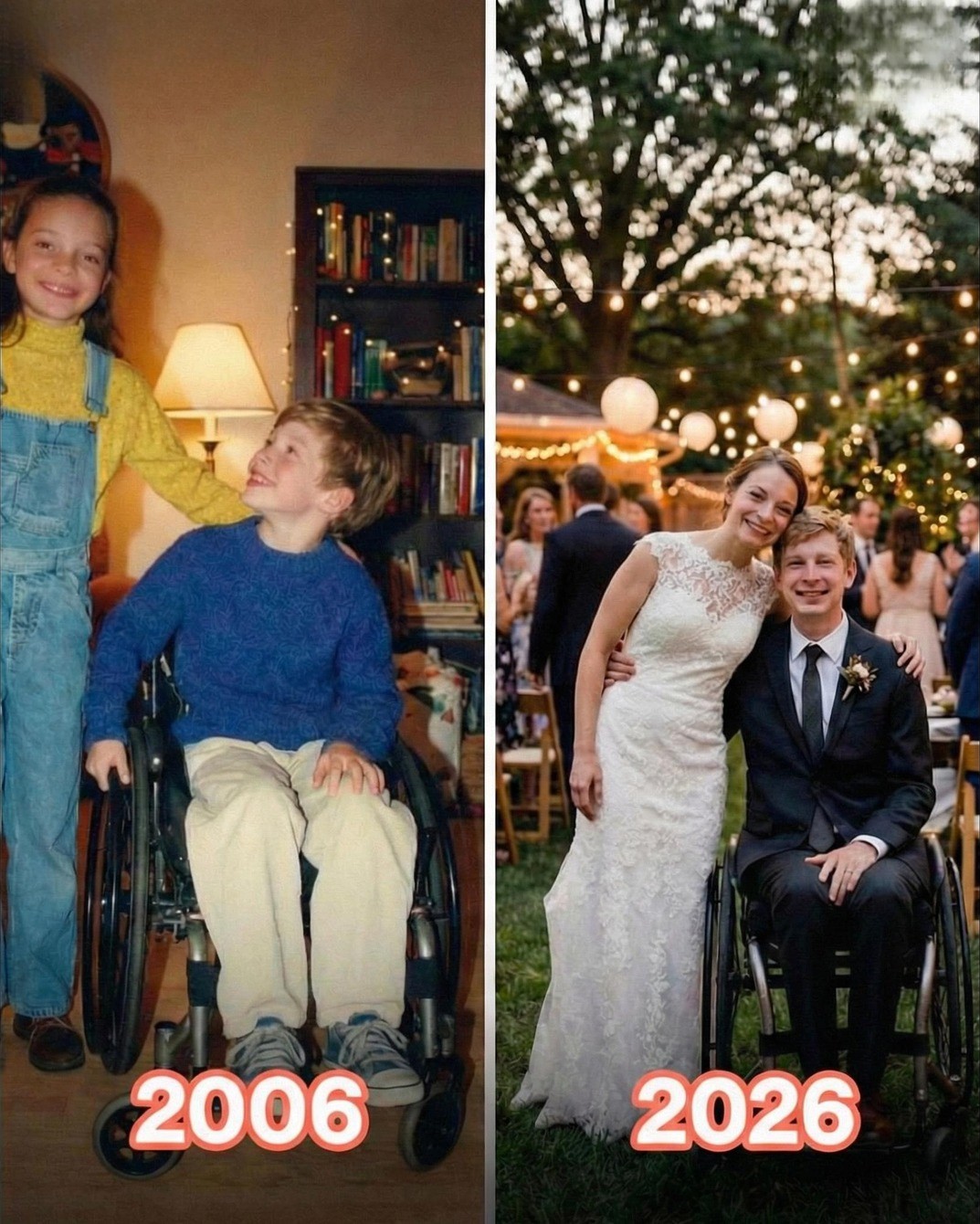
My name is Claire, and I grew up in foster care, moving from home to home with such frequency that I learned not to unpack or get too attached. I knew early on that the concept of stability was not for someone like me. I became accustomed to the constant upheaval, never forming roots, always prepared to leave. By the time I arrived at my last group home, I had made peace with the idea that no one would ever stay in my life long enough to make me feel truly anchored. I had accepted that I would have to navigate the world on my own.
But then came Noah. He was a quiet boy in a wheelchair, often sitting by the window, observing the world outside but never engaging in it. I remember the first time I met him—I sat beside him, trying to break the silence with a joke about sharing the view. His response wasn’t what I expected. He smiled shyly, introduced himself, and for the first time in a long while, I felt seen. From that moment, a connection began to form, slowly but surely. Noah and I became constants in each other’s lives. We spent countless hours talking late into the night, sharing inside jokes that only we could understand, and, without saying it out loud, we became each other’s chosen family. It wasn’t a promise, but a quiet, mutual understanding that no matter where we went, we would be there for each other.
As we grew older, the foster system became a distant memory. When we aged out and were pushed into the real world, we faced it together, carrying our belongings in nothing more than plastic bags. The future felt uncertain, but as long as we were a team, I knew we could face it. We found a small, humble apartment and learned to make it our own, furnishing it with secondhand furniture and pieces of our lives that, while not fancy, were filled with meaning. We worked multiple jobs to make ends meet, each one trying to support the other, both of us working toward the future we knew we could have if we just held on long enough.
Over time, our friendship deepened. What started out as companionship slowly shifted into something more, something we never really defined but understood completely. Love bloomed not through grand gestures, but in small, everyday acts—like making breakfast together, like holding each other in silence when words weren’t enough. There were no dramatic confessions, no fireworks, just the steady and reliable presence we offered each other. When Noah proposed in our tiny kitchen, with nothing more than a simple question about building a life together, I said yes without a second thought. Our wedding was modest—decorated with secondhand pieces and held in the same small apartment—but it felt rich, overflowing with everything that truly mattered: love, joy, and the feeling that we had finally created something permanent. That night, as we fell asleep as newlyweds, we believed the hardest chapters of our lives were behind us.
Then, the next morning, a knock at the door shattered that peace. A well-dressed man, introduced as Thomas, asked to speak with Noah. He explained that he had been searching for him for years and handed over an envelope from someone named Harold Peters. Noah didn’t recognize the name, but his hands trembled as he opened the letter. The story it contained was one of simple yet profound kindness. It told of an elderly man who had fallen outside a grocery store, only to be ignored by passersby—until a young boy in a wheelchair stopped, helped him up, and stayed with him until he was safe. Harold had never forgotten that act of kindness, and, with no family of his own, he made a decision that would change Noah’s life forever. Harold had left his home, his savings, and a trust in Noah’s name, as a gesture of gratitude for that one simple act of compassion.
Thomas confirmed the contents of the letter. It wasn’t a fortune, but it was enough—a modest house, some savings, and a trust fund set up in Noah’s name. It wasn’t extravagant wealth, but for us, it was something far more precious: security. A security we had never known. A place we could call our own, something that couldn’t be taken away. The weight of it was too much to comprehend in the moment. As Thomas left, Noah and I sat together, holding hands on our worn-out couch, lost in a stunned silence, trying to process what had just happened. It was the first time in our lives that we had something truly permanent, something that couldn’t be swept away in the tide of uncertainty that had defined our existence for so long.
A few weeks later, we visited the house Harold had left behind. It was a modest, lived-in home, welcoming in its simplicity. The sun streamed through the windows, and there was a ramp at the front door, perfectly accommodating Noah. As Noah rolled into the center of the living room, a soft whisper escaped him: “I never thought I’d live in a home that couldn’t be taken away.” It was a statement that carried the weight of everything we had fought for, everything we had built from the ground up. I reminded him that we had learned to survive far worse things than this. For the first time, we weren’t just surviving—we were finally being given the opportunity to truly live. We were being chosen by a future that felt like it belonged to us.
We had a home. We had a future. And most importantly, we had each other.