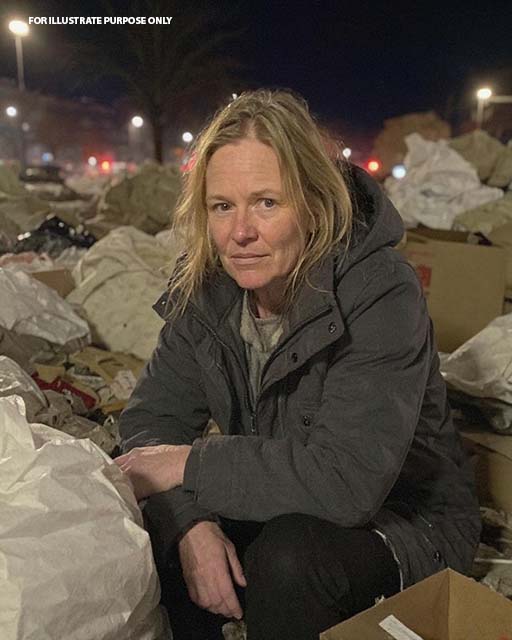
When a wealthy but emotionally distant man offers shelter to Nina, a homeless woman, he finds himself drawn to her fierce independence. Their unlikely connection begins to deepen—until one day, he enters his garage unexpectedly and discovers something unsettling. Who is Nina really, and what is she hiding?
I had wealth that made people stare: a mansion perched on a cliff, a collection of classic cars, and more money than I could ever spend. But there’s a silence that comes with having everything—and it’s deafening if you’re alone.
At sixty-one, I, Elliott Granger, had spent my life wrapped in caution and contracts. My parents passed away in my twenties, leaving me their empire. I dated, occasionally—but every relationship ended under the shadow of doubt. Were they interested in me, or in my money?
So I stopped trying. Retired early. Built a fortress of solitude.
That evening, I was driving back from a meeting with my estate manager. The streets were quiet. At a stop sign, I noticed movement in a narrow alley—a woman searching through a trash can behind a bakery.
Her hair was matted into a bun, long past caring. Her jacket was torn, hanging awkwardly. Yet her stance radiated determination.
I don’t know what compelled me to stop.
I rolled down my window. “Hey,” I said.
She froze, ready to bolt, like a startled deer.
“I’m not a cop,” I added quickly. “I just… are you okay?”
She turned slowly, wary but sharp-eyed. “Define ‘okay.’”
Fair enough.
“Do you need anything? Food, a ride?”
Her brow furrowed, like she was deciphering a puzzle called: Why would a rich man ask that?
“Depends,” she said. “Are you offering because you feel guilty or because you actually care?”
I paused. “Maybe a bit of both,” I admitted.
She studied me. “Most people act out of guilt. It never lasts.”
“Well,” I said, stepping out of the car, “I’m not most people.”
She tilted her head. “Weird.”
“I get that a lot,” I said, smiling softly. “I’m Elliott.”
“Nina,” she replied cautiously.
“Look, Nina… I have a garage converted into a guest space. Heat, water, fridge. You could stay there—temporarily. Until you figure things out.”
“You want me to sleep in your garage?”
“It’s not a jail cell. It has a sofa bed and Wi-Fi.”
Nina crossed her arms. “No strings attached?”
“No strings,” I assured her.
She studied me long, then nodded slowly. “Just for tonight.”
I drove us back in silence. Nina stared out the window the whole way, smelling of rain and motor oil. I showed her the converted garage: modest but clean—sofa bed, small kitchenette, bathroom.
“There’s leftover lasagna in the fridge,” I said.
She nodded curtly. “Thanks.”
Over the next few days, I saw Nina mostly in passing. Occasionally, she’d join me for coffee on the back patio. At first, she spoke little—short answers, sarcastic comments.
One afternoon, sitting under the pergola while the wind stirred the lemon trees, she said suddenly, “I used to run a gallery.”
I looked up from my book. “Really?”
“Yes,” she nodded. “Small, local artists, rotating exhibits. I was one of them.”
“What happened?”
“Divorced a man who wanted a younger muse. He emptied our joint account, left me with debt collectors and nowhere to go.”
I swallowed. “That’s… cruel.”
She shrugged. “Life doesn’t care about cruelty.”
“Do you still paint?”
She glanced at me briefly. “I try… but it’s hard when you’re hungry.”
Gradually, Nina became part of my quiet routine. Dinner together sometimes, news discussions, or silent companionship. Her sharp wit both challenged and comforted me. It was… soothing.
I didn’t realize how much space she had filled until one morning, she wasn’t there for coffee. Assuming she was sleeping in, I went to the garage to fetch the air pump. I didn’t knock—never had before.
I opened the door—and froze.
The floor was covered in canvases.
Dozens of them.
My face stared back from each one—twisted, distorted. One showed me trapped in a birdcage. Another, screaming silently in a suit of dollar bills. One depicted me hollow-eyed, like a ghost in my own home.
And one… one showed me in a coffin surrounded by gold coins.
I felt punched in the chest.
Was this how she saw me?
Was this what she thought of the man who gave her shelter?
That evening, I cooked steak and mashed potatoes. She approached the table hesitantly, smiling faintly. I couldn’t respond.
We ate in silence.
“Something wrong?” she asked.
“The paintings, Nina. I saw them,” I said, trying to stay calm. “The ones of me… with chains, blood, the coffin. What is this?”
Her face went pale. “You went in without knocking?”
“That’s your response?”
“They weren’t meant for you,” she said.
“They’re of me,” I snapped.
“Is that how you see me? As a monster?”
“No, it’s not that,” she said, voice shaking. “I was angry. I lost everything while you had so much. I needed to let it out.”
I recoiled.
“So you painted me as a villain?”
“No,” she said quickly. “You’ve been kind. That’s real. The paintings… they’re not about you. They’re about what you represent—the world I lost.”
I was silent, heart storming with betrayal and confusion.
Finally, I said, “You need to leave.”
Her mouth fell open. “Please—Elliott—”
“I said no strings. That includes trust. I can’t trust someone who paints me in a coffin.”
She didn’t argue. She left, shoulders heavy.
The next morning, I drove her to a women’s shelter. Quiet ride. Before she stepped out, I handed her an envelope.
“Some cash,” I said. “Use it wisely.”
She looked at me, a mix of gratitude and sorrow, then closed the door.
Weeks passed. My routines felt dimmer without her sarcasm, insight, presence.
Then, one afternoon, I found a package at my gate.
Inside was a painting.
It wasn’t grotesque. It was calm.
Me, sitting on the back patio, coffee in hand, sunlight on my face. Peaceful.
A note read:
“Elliott,
I wanted to show the version of you I finally saw.
Thank you—for shelter, for kindness, for making me feel human again.
—Nina”
A phone number followed.
I stared, finger hovering. Then I pressed call.
It rang once, twice, then: “Hello?”
“Nina… it’s Elliott.”
Silence.
“I got your painting. It’s beautiful.”
“Thank you. I hoped you’d like it. I wanted you to see… what I really meant.”
“You didn’t owe me anything. But I think I owed you understanding I didn’t give.”
“No, you were right to be hurt. I projected my pain onto you.”
I took a breath. “Would you… like to meet for dinner?”
Surprised, she said quietly, “I’d like that.”
That weekend, she arrived in new clothes, spark in her eyes, working part-time at an art supply store, saving for her own apartment.
At the quiet restaurant, overlooking the bay, glasses clinked.
The paintings weren’t the end. They were the raw beginning.
And I no longer wanted to live with doors—my heart—so tightly closed.