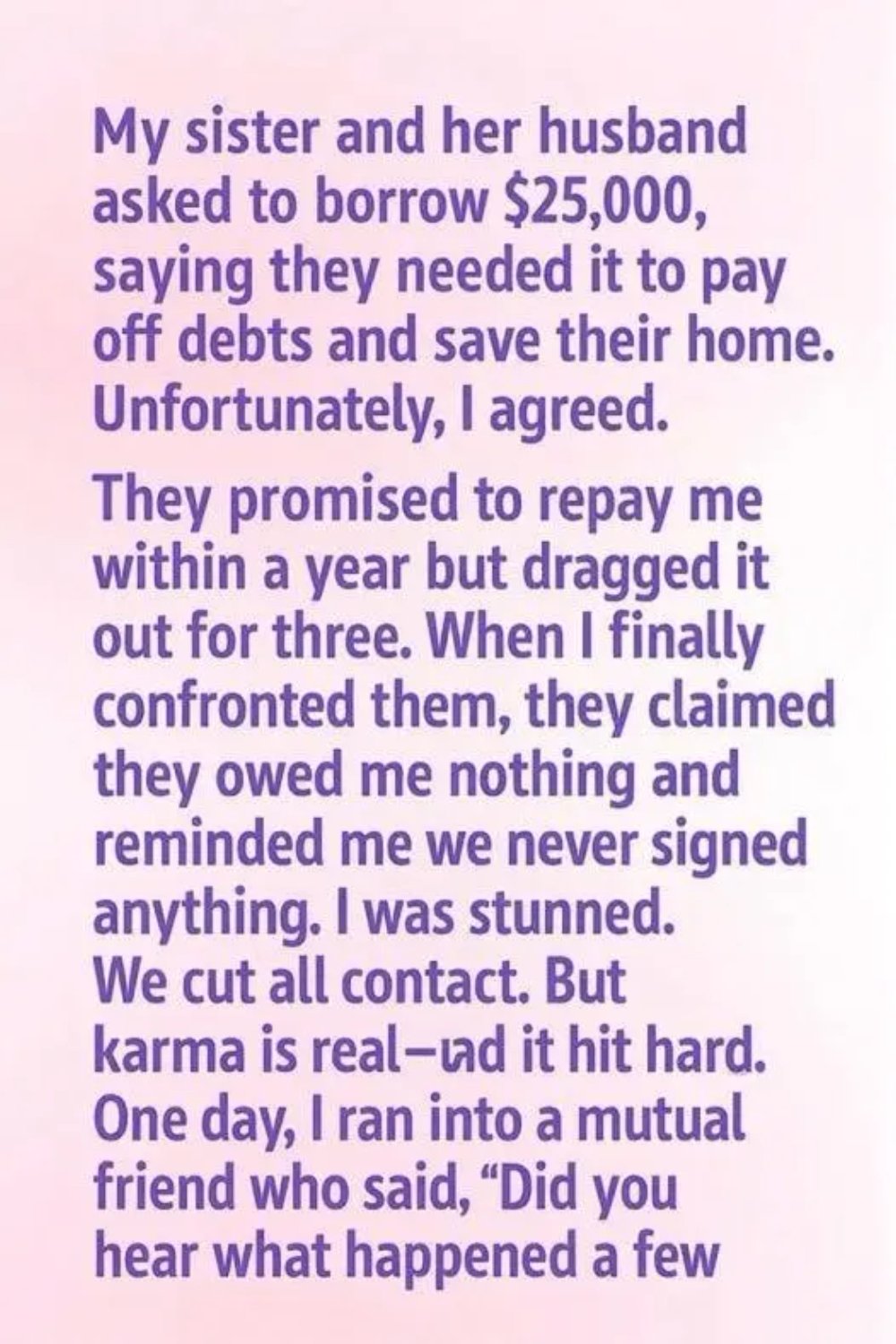
When my sister and her husband first came to me for help, I didn’t hesitate. There was no calculation, no weighing of risks, no moment of internal debate. They sat at my kitchen table exhausted and defeated — dark circles under their eyes, hands twisting with anxiety, voices trembling as they explained how close they were to losing everything. Bills stacking up, unexpected expenses hitting at once, late fees multiplying, job hours shrinking. They weren’t exaggerating. They were scared. And because I loved them, I wanted to shoulder that fear for them.
So I said yes. I transferred the $25,000 that same day. I didn’t ask for a contract or a signature. They were family. I trusted them. They promised they’d return the money once they were stable again, and I told them there was no rush. Helping them felt like the only decent thing to do.
But time has a way of revealing people with a clarity emotion often clouds.
At the beginning, they were grateful. They checked in regularly. They updated me on their progress. They reassured me they hadn’t forgotten. Slowly, though, the tone shifted. The calls grew shorter. The updates became vague. Gratitude softened into something else — something that resembled entitlement more than appreciation. As months passed into a year, and then into two, I realized that I was always the one bringing the loan up—never to pressure them, simply to understand when repayment might happen.
Each conversation sidestepped the point. They downplayed it. They delayed. They hid behind cheerful excuses. I was stunned by how quickly a promise could become an inconvenience people treated like a burden.
Eventually, after thinking carefully about my words, I asked them to come over. I stayed calm. I didn’t accuse. I didn’t push. I simply asked what their plan was.
What I received in return was denial.
They insisted the money had never been a “loan.” They claimed they remembered the moment differently — that it had been a “gift,” freely given, without expectation. They pointed out that there was no written agreement, no signature, no proof.
Their expressions were controlled, almost rehearsed, as if they’d prepared the story long before I asked.
That moment didn’t just hurt — it split something inside me. It wasn’t about the $25,000 anymore. It was about trust, and the realization that mine meant so little to them. Watching them rewrite the truth in front of me, as if I were some stranger with no right to expect honesty, hollowed me out in ways I didn’t expect.
So I made a choice.
I didn’t argue. I didn’t raise my voice. I didn’t beg for what was owed. I simply stepped back. I chose peace — not because they earned it, but because I needed it. There was nothing left to protect except my own dignity.
Pulling away wasn’t simple. It meant letting go of the hope that they would eventually do the right thing. It meant accepting that even the people closest to you can take advantage of your generosity. And it meant releasing the expectation of ever receiving emotional or financial repayment.
But as time passed, the weight began to lift. I started rebuilding the pieces of my life that had nothing to do with them. I stopped replaying that conversation. I stopped hoping for closure they were incapable of giving. And I stopped letting that loss shape how I moved through the world.
Then one afternoon at the grocery store, I ran into a mutual friend — someone who knew my sister and her husband well. After a warm greeting, her expression shifted. She lowered her voice the way people do when delivering news they’re not sure you’re ready to hear.
She told me my sister and her husband were facing another financial collapse — worse than before.
And this time, there was no one left to rescue them. No one to charm. No one to guilt. They were drowning again—unpaid bills, plummeting income, a repossessed car, and the looming threat of losing their home once more.
They were terrified. But unlike the first time, there was no soft landing waiting for them.
As she spoke, I stood silently in the aisle, hands resting on my cart. And to my own surprise, I felt no satisfaction. No vindication. No triumphant sense of justice. Instead, I felt a slow, steady clarity.
Life balances itself.
Not out of revenge. Not out of cruelty. But because choices — honest or dishonest — eventually return to the people who make them. The debt they denied wasn’t just financial. It was moral. It was about integrity. And integrity, avoided long enough, creates its own consequences.
Walking out of the store into the warm sunlight, I realized something important. I felt lighter — not because anything had been paid back, but because I finally understood that repayment was never really about money. It was about closure. And I had already given that to myself the day I stepped away.
Letting go doesn’t erase betrayal, but it frees you from carrying it. And seeing their situation unfold — not by my hand, not out of malice, but through the natural course of life — reminded me that justice doesn’t need chasing. It arrives on its own timeline.
Maybe they’ll remember what I did for them someday. Maybe they won’t. Maybe they’ll finally learn the difference between kindness and weakness. But none of that affects my life anymore.
I helped out of love. They responded out of denial and pride. And life eventually answered in ways neither of us controlled.
What I lost wasn’t money. It was the illusion that love alone guarantees loyalty.
What I gained was peace — and that has proven far more valuable than anything I handed across that kitchen table.