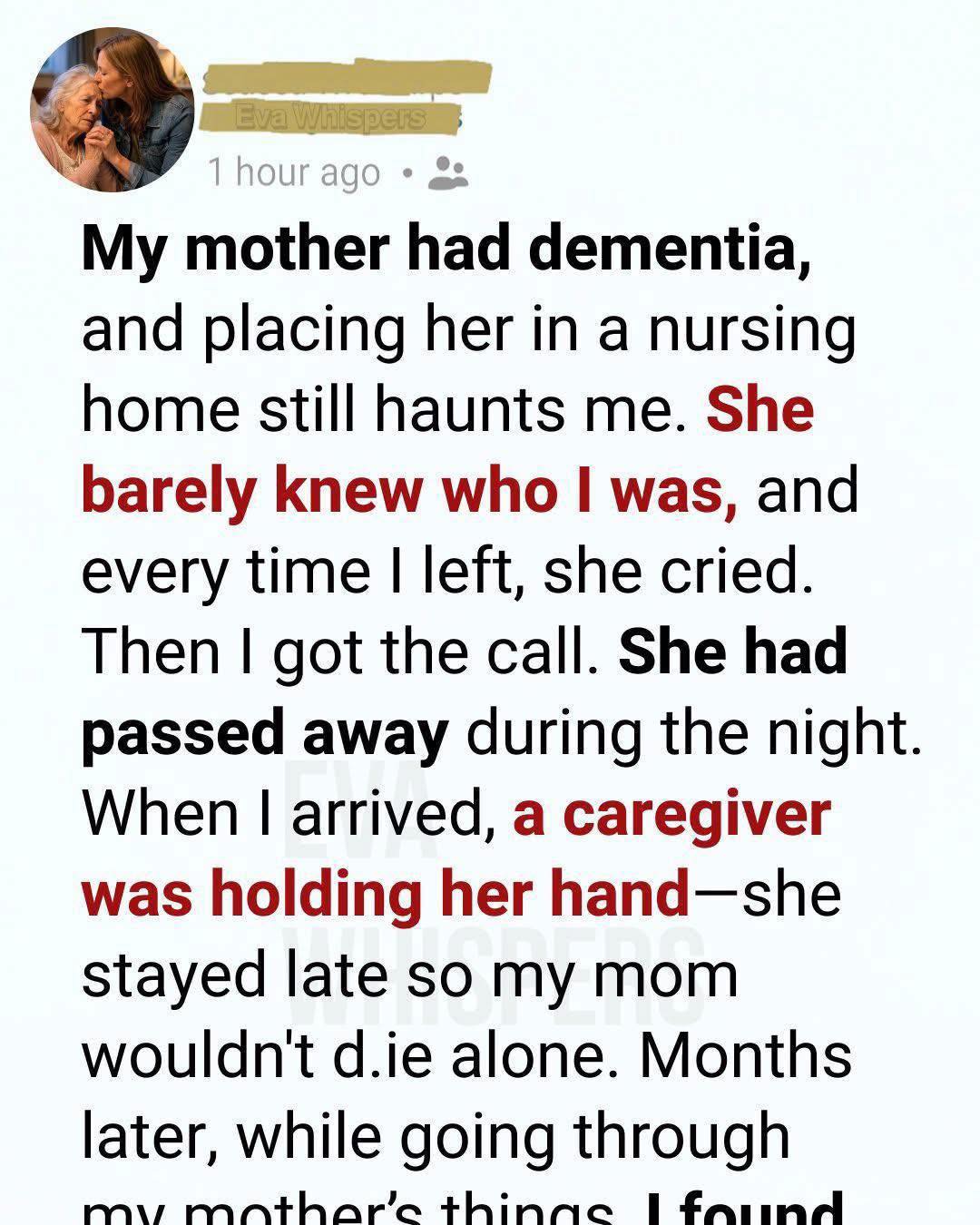
The guilt was unbearable. It settled over me like a thick fog that refused to lift, pressing on my chest with every thought of her. I had left my mother in a nursing home, convinced that in doing so, I had failed her when she needed me most. The very act of admitting her decline had felt like betrayal. I had told myself it was for the best—that she would receive better care than I could ever provide alone—but logic offered no comfort to a heart weighed down by shame. Every visit tore me open in ways I hadn’t anticipated. I’d sit beside her in the sterile, humming hallways, my hands gripping hers, and feel the slow, relentless ache of helplessness. Each smile I forced seemed to mock me, each fleeting laugh reminded me that life was moving forward without my full presence. And every goodbye—each one longer than the last—felt like desertion, like I was closing a door on a life that needed me fully and could not reach me.
I braced myself for a lonely, unfinished ending, expecting to walk into her room one last time and find nothing but silence, the cold indifference of mortality. I imagined the hospital bed empty of warmth, the sheets undisturbed, the room echoing with the quiet hum of machines and the distant footsteps of overworked staff. I pictured the final goodbye as an unbearable void where love should have been, a stark reminder of my absence, my failings, my inability to be enough. And yet, when I pushed the door open on that day, my expectations were shattered.
I walked into the room expecting silence and found tenderness instead. There was a presence that I hadn’t anticipated—someone who had quietly filled the space my absence left behind. A young caregiver sat beside my mother’s body, her hands gently intertwined with my mother’s, holding her as if she were aware that even in death, the touch of another human being mattered. Her posture spoke of reverence, her eyes glinting with quiet devotion, and her voice, when it broke the hush, was soft and deliberate. She had stayed behind after her shift, not because it was required of her, but because she could not bear the thought of my mother leaving this world alone. She told me later how she had read aloud from my mother’s favorite books, how she had brushed her hair with deliberate care, how she had filled the fading hours with gentle conversation, laughter, and reminders of the life she had lived.
I watched them both for what felt like hours, unable to move, unable to speak, unable to reconcile the mixture of relief and shame that coursed through me. The caregiver had been the bridge over the chasm of my guilt, providing the comfort and attention that I had feared I could never give. And yet, as I observed, I realized that what she offered wasn’t just duty—it was love in its purest, most selfless form. The realization hit me with a profound ache: my mother had not died in loneliness. Even when I was absent, there had been care circling her, care that had carried the weight of my absence and softened the edges of my failings.
Months later, the notebook appeared—almost timidly, as if it were aware of the delicate emotions it contained. It had been tucked away somewhere safe, a repository of the quiet intimacy of my mother’s final days. As I turned its pages, I discovered fragments of her life I had never known, memories preserved in ink, each line a gentle whisper from the past. There were notes about the songs that calmed her, the meals she had savored even in weakness, and the particular way her eyes had lit up at certain names and phrases. I read descriptions of small joys: the sunlight falling across her favorite chair in the morning, the way a visit from a familiar friend could bring her laughter that seemed to echo beyond the walls of the nursing home. Every detail painted a portrait of a life that had been rich, nuanced, and deeply loved—even if I hadn’t always been able to witness it.
On the final page, one line waited for me, sparse but profound: “She talked about her daughter today. She loved her very much.” My chest tightened at the words. My guilt didn’t vanish—it never fully could—but it softened, transformed into something more manageable, more forgiving. I realized that love had been present in that room, in the hands that held her, in the gentle voice that read to her, in the small attentions that had cushioned the final passage of her life. Love had been there even when I wasn’t. It had circled her, held her, carried the weight of what I could not.
That notebook became a talisman for me, a reminder that even in moments of profound absence or perceived failure, love persists. It reshaped my understanding of duty, of presence, and of the quiet ways in which care manifests itself. And in the silence that followed her passing, I found a measure of peace: my mother had been cradled in the embrace of kindness, and in that embrace, I finally understood that the love between a mother and her daughter endures beyond proximity, beyond the limitations of time, and beyond the guilt that so often binds us to regret.