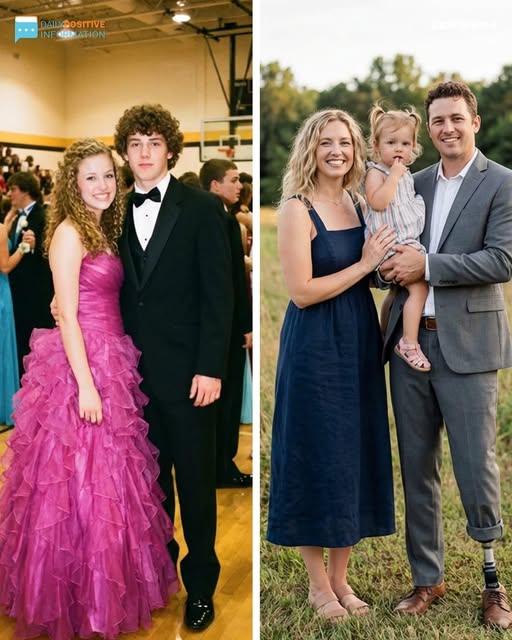
When I opened the front door that Saturday afternoon, the silence inside the house hit me like a physical force.
No music from the kitchen. No faint humming from my wife as she usually sang along to whatever was on the radio. Just the steady ticking of the hallway clock and the distant hum of the refrigerator—those kinds of sounds you only notice when everything else has disappeared.
On the kitchen counter sat a birthday cake, unfinished. Half the frosting was spread unevenly across the surface, and a bowl of chocolate icing stood beside it with a smear on the rim, as if she had stopped in the middle of decorating and simply left. A spatula rested inside it at an odd angle. Near the ceiling, a helium balloon drifted slowly, its ribbon caught on a cabinet handle, shifting slightly with the air from the vent.
“Jess?” I called out, louder than I meant to. My voice echoed through the empty rooms.
Only silence answered.
A tightness formed in my chest as I moved through our small house in suburban Ohio. Every step of my prosthetic leg against the hardwood floor sounded heavier than usual, each one amplifying the feeling that something was wrong.
The bedroom door was open—unusual, because Jess always closed it when she was tidying.
I stepped inside and froze.
Her side of the closet was empty. The floral hangers she loved swayed gently, but her clothes were gone. The duffel bag from the top shelf was missing. So were her shoes—her flats, her sneakers, even the heels she almost never wore.
All of them gone.
My balance faltered as I moved down the hallway toward our daughter’s room, my thoughts racing into places I didn’t want them to go.
Evie was still asleep in her toddler bed, one hand curled around her stuffed duck, her breathing slow and steady. For a brief second, nothing felt broken in that room.
I knelt beside her and gently touched her shoulder.
“What is going on, Jess?” I whispered. My voice shook. “What did you do?”
That’s when I noticed the note.
It was placed neatly on Evie’s dresser, beside the framed photo of our family at Cedar Point. Folded carefully, like she had taken time to make sure it wouldn’t be missed.
My hands were unsteady as I opened it.
“Callum,
I’m sorry. I can’t stay anymore.
Take care of Evie. I made a promise to your mom. Ask her what I mean.”
“-J.”
I read it over and over again, as if repetition might somehow soften the meaning or reveal something I had missed.
I can’t stay anymore.
The words didn’t just sit on the page—they sank into me.
My mind immediately snapped backward to earlier that afternoon, replaying everything in fragments, searching for a moment I should have recognized as a warning.
The words stopped there.
That’s when I went inside—and everything that had been holding together my ordinary Saturday finally gave way.
The house felt wrong before I even fully stepped through the door. Not loud wrong. Not chaotic wrong. The kind of wrong that only silence can create when it doesn’t belong.
The cake was still there on the counter, half-finished, like someone had intended to come back to it and simply never did. The frosting bowl sat open beside it, a slow, drying spiral of chocolate clinging to the edges. The balloon near the ceiling drifted slightly whenever the vent clicked on, its movement too gentle for how violently my thoughts were starting to move.
“Jess?” I called again, though I already knew there wouldn’t be an answer.
Nothing.
I walked through the house slower this time, like moving carefully might keep the truth from becoming real. The bedroom confirmed what my instincts had already started whispering on the walk up the driveway.
Her closet was empty.
Not “mostly packed.” Not “half gone.”
Empty.
The kind of empty that takes time. The kind that requires decisions. The kind that doesn’t happen in a panic—it happens in preparation.
My chest tightened as I stood there, staring at the hollow space where her life had been only hours earlier.
Then I turned toward Evie’s room.
She was still asleep, completely unaware that the world had shifted under her feet. One small hand curled around her stuffed duck, her face calm in the way only children can be when nothing has broken into their reality yet.
For a moment, I just stood there watching her breathe, trying to convince myself that if she was still here, maybe nothing was as bad as it looked.
But then I saw the note again.
On the dresser. Folded. Deliberate.
My hands felt unsteady as I picked it up and opened it for what felt like the first time, even though I had already read it.
Callum,
I’m sorry. I can’t stay anymore.
Take care of Evie.
I made a promise to your mom. Ask her what I mean.
“-J.”
I read it again.
And again.
As if the letters might rearrange themselves into something less impossible.
But they didn’t.
I can’t stay anymore.
My mind snapped backward to the morning, searching for anything—any fracture, any warning, any crack in the normal that I had been too blind to see.
The second letter explained everything—and somehow made it all worse.
That night, after I brought Evie home and laid her in my bed because I couldn’t stand the thought of sleeping alone, I sat in the dark listening to her breathe. The house felt too large without Jess, too hollow without the soft sounds of her moving through it.
I don’t know why I opened the nightstand drawer. Maybe I was looking for something familiar, something solid to hold onto. It was mostly clutter—old receipts, a broken watch, paperback novels with bent spines from deployment days.
That’s when I saw it.
Tucked inside my worn copy of The Things They Carried was another folded letter.
“Callum,
If you’re reading this, it means I couldn’t say this to your face. Maybe I should have tried harder. Maybe I owed you more than a letter. But I was too much of a coward.
I don’t even remember his name. It was one night while you were deployed. I was lost, and everything felt like it was slipping out of my control. And then you came home, and I wanted so badly to believe it didn’t matter—that we could still be us.
Then Evie came. And she looked like me. And you held her like she had fixed everything that was broken in your world. I buried the truth because your mother convinced me you wouldn’t survive it if I didn’t tell you. And your mother is usually right about things.
But the lie grew. It filled every corner of our home. It sat with us at dinner. It followed me into bed at night.
I watched you become the most incredible father—patient, gentle, steady. I couldn’t match that version of you. You never once looked at Evie like she might not be yours. And I couldn’t stop myself from wondering.
Please protect her. Let her stay little as long as possible. I left because staying would have destroyed what’s still intact between you and her.
I love her, and I love you. Just not the way I used to. Not the way you both deserved.
—J.”
I read it twice before the tears finally came.
The next morning brought hard questions from a three-year-old—and even harder truths.
Evie woke in my arms just after dawn, curls tangled, her stuffed duck still tucked under her chin. I had barely slept at all. My emotions were a mess—anger at Jess, rage at my mother, confusion over everything I thought I knew about my life.
And underneath it all, a quiet fear that maybe, somehow, it was my fault.
“Where’s Mommy?” Evie asked, her voice heavy with sleep.
“She had to go away for a while,” I said gently. “But Daddy’s here. I’m not going anywhere.”
She didn’t ask anything else. She just rested her head against my chest and went still.
Later that morning, I sat on the edge of the bed taking off my prosthetic. My residual limb was red and irritated from the socket. I reached for the ointment on the nightstand.
Evie climbed up beside me, watching closely.
“Does it hurt?” she asked, pointing.
“A little, sweetheart. Just needs medicine.”
She thought for a moment. “Do you want me to blow on it? That’s what Mommy does when I get hurt.”
Something in me cracked open at that.
“Yeah,” I said softly. “That would help.”
She carefully placed her duck beside my leg, then leaned forward and blew gently, serious as a doctor. Afterward, she curled into my side like she had always belonged there.
We stayed like that for a long time, quiet.
That afternoon, she played on the living room rug, brushing her doll’s hair while I tried—awkwardly—to braid hers with hands that wouldn’t quite steady themselves.
“Mommy might not come back for a while, Evie. Maybe not ever. But we’re going to be okay. I promise.”
“I know,” she said simply. “You’re here.”
Sunlight spilled across the floor, warm and golden over her small face, and something inside me shifted.
She was still here. And so was I.
We were smaller now—a family of two instead of three—but we were still a family.
And I would learn how to hold us together, even if it felt like I was doing it with one hand missing.