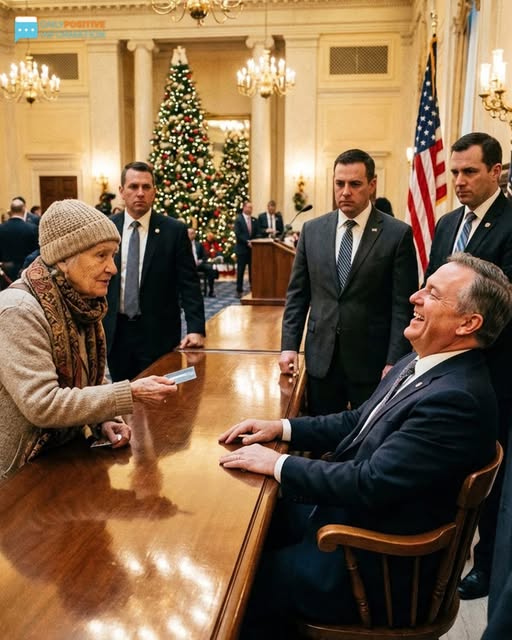
“I’d like to check my balance,” the ninety-year-old Black woman said softly, her voice carrying just enough tremor to ripple across the glossy marble lobby of First National Bank’s downtown Seattle headquarters on a Tuesday afternoon in October.
Conversations paused. Some people glanced over with that polite curiosity reserved for moments slightly out of the ordinary. Others sighed, returning to their phones and routines, as though a ninety-year-old woman using the bank was a minor inconvenience they hadn’t anticipated. Muted laughter bubbled somewhere in the middle of the lobby—the kind of laughter that happens when people think no one is listening, though, in reality, everyone is.
First National Bank occupied the top floors of a sleek downtown tower, a building designed to make some feel powerful and others small. The lobby was cathedral-like—marble floors reflecting artificial light in ways that suggested infinite depth, walls stretching upward to a ceiling so high you had to crane your neck to see it, expensive artwork chosen to signal wealth and permanence, a statement that this institution would endure long after most people were gone.
At the center of it all stood Charles Hayes, the bank president. Fifty-two, dressed in a custom suit worth more than many earned in a month, he moved with a confidence cultivated over decades in positions of authority. Born into privilege, educated at the right schools, and connected to the right people, he had spent his life serving clients who never faced denial or exclusion, who always belonged in spaces like this.
When Charles heard her request, he let out a loud, cutting laugh—the kind meant not to amuse but to belittle, sharp as a blade slicing silk. This laugh, honed over years, was a tool: an assertion of power, a reminder of who he believed belonged here and who did not.
Charles had inherited both the bank and the arrogance that came with it. The Hayes family had been a fixture in this institution since his great-grandfather founded it in 1932. Charles knew his place—and assumed everyone else did too.
To him, the elderly woman in her modest coat and scuffed shoes seemed out of place, a disruption, someone daring to approach his desk as if she had a right to access what had always been reserved for others.
“Ma’am,” he said, projecting his voice across the marble expanse, “you seem confused. This is a private banking floor. Perhaps the neighborhood branch would be more suitable for you.”
The message was clear: you do not belong here.
The woman—Margaret Williams, though he didn’t know her name—rested both hands on her cane, polished smooth from decades of use. She didn’t flinch. She didn’t apologize. Her coat was simple wool, faded with age but well cared for. Her leather shoes were scuffed, heels worn from years of walking. And yet, her gaze was unwavering, tempered by ninety years of endurance, indignity, and perseverance.
Margaret recognized disrespect instantly. She had heard that tone before—voices commanding her to disappear, to feel small—but she did not yield.
“Young man,” she said evenly, her hands moving deliberately as she drew a black card from her pocket, “I want to check my balance. I did not ask for advice on where I should bank.”
She did not beg or justify herself. She simply spoke her truth and waited, steady in a way that made others uncomfortable, confident in a knowledge that had taken a lifetime to cultivate.
Charles scrutinized the card as if it were a threat. Its corners were bent, its numbers faded. To him, it looked counterfeit, meaningless, laughable. He scoffed loudly enough for the nearby patrons to hear.
“Janet,” he called to his assistant, voice echoing across the marble chamber, “another person attempting deception. This is exactly what security exists to prevent. We cannot allow every confused individual to wander in here thinking they have accounts.”
Well-dressed customers chuckled awkwardly, aligning themselves with the apparent authority, some covering their mouths, pretending to restrain themselves. This was public humiliation disguised as social conformity.
Margaret remained calm. Patient. Hands gripping her cane, posture unyielding. Her eyes held a certainty earned through decades of survival, a quiet power that could not be threatened by scorn or ridicule.
Janet, the assistant, approached cautiously. Young, new to the bank, she still navigated a culture where cruelty was rewarded.
“Sir,” she said quietly, low enough for only Charles to hear, “we could just verify it in the system. Any account can be checked in seconds.”
“No,” Charles snapped, voice sharp and cutting. “I won’t waste time on nonsense. I won’t squander the bank’s resources on someone walking in here with a fake card and a story. This is exactly why people don’t respect institutions anymore—we’ve grown too accommodating, too willing to entertain anyone who walks through the door.”
He waved her off, a gesture meant to dismiss, to end the conversation, to signal that his decision was final.
Then something shifted.
Margaret smiled.
Not nervously. Not apologetically. Not the type of smile meant to placate. It was a smile layered with decades of memory, experience, and understanding. It was the smile of someone who had been waiting for this exact moment, who had prepared for it, who knew its weight in ways Charles could never grasp.
For a brief second, Charles felt a tightening in his chest, a warning. Something inside him whispered caution, urging him to reconsider. He ignored it, as he always did, relying on confidence, privilege, and the certainty that he was right.
Two security guards approached—large men in dark suits tasked with maintaining order. Their eyes, however, betrayed unease. They sensed, even if they couldn’t articulate, that this situation was different, that it did not sit right.
“Ma’am,” one said gently, voice apologetic, “Mr. Hayes has asked us to escort you outside.”
Margaret’s eyes sharpened. She had grown up in the 1940s American South. She understood the weight behind “escort outside,” the implications for someone who looked like her, and the history contained in those words. She knew what being removed from a space by hired enforcers had meant for people like her for generations.
“I never said I was leaving,” she replied softly, voice steady. “I said I want to check my balance.”
Charles laughed again, louder this time, performative, theatrical. Designed for the audience, to show power, to make them align with him.
“See?” he announced, projecting across the lobby. “This is why we have security—confused elderly people trying to use services they don’t understand, trying to access accounts they don’t have, waving cards they picked up who knows where.”
A wealthy woman nearby—Catherine Vance, in designer clothes worth more than Margaret’s entire wardrobe—lifted her purse to cover a grin, a gesture of private amusement that was ironically very public.
“Poor thing,” she said, voice carrying. “She probably has memory issues. My household employee had something similar—they lose track of reality, of what they actually own, of where they belong.”
Her words hung in the air, a wall built between Margaret and the room.
Then Margaret laughed. Deeply, clearly, fully. Not cruelly, not gently, but in a way that claimed the space around her, echoing against the marble. It was a laugh that spoke of understanding, of survival, of truths long ignored.
“Memory issues?” she said, voice steady, projecting across the lobby. “Interesting. Because I remember clearly—working fourteen-hour days cleaning your grandfather’s office in 1955. I remember him exactly. The details that never made it into family stories.”
The lobby fell silent. The kind of silence that shifts the air itself, making everyone aware they were witnessing something important.
Charles stiffened. Hands that had relaxed now tensed. His family had owned this bank since 1932. Few knew the personal details of his grandfather—facts intentionally omitted from public history, known only to those who had been there.
“Excuse me?” he said, voice unsure, stripped of its earlier authority.
“You were fifteen,” Margaret continued, voice heavy with seventy years of memory. “I worked after school so my mother and I could eat. We lived across the tracks, in the part of the city your family never visited. Your grandfather left lit cigarettes on the marble floor just to see if I’d react. He enjoyed it—to watch me clean up after him, to assert his power.”
She paused, letting it sink in.
“I never complained. We needed the money. That’s what I remember most—needing it. At fifteen, I needed that job so my mother could take her medicine. I cleaned up his cigarettes. I pretended not to notice his laughter. I made myself smaller so he could feel bigger.”
Janet, the assistant, swallowed. She began to realize this was bigger than a banking dispute—it was a reckoning, a confrontation with history.
“I remember him telling me people like me should be grateful to serve people like him,” Margaret continued. “He said it casually, like it was fact, like it was natural, like I should be grateful for my place. Grateful to be near people of quality, in service of those who mattered more.”
She smiled, a sad, knowing smile, heavy with decades of endurance.
“Funny how habits pass through generations, isn’t it, Mr. Hayes? Arrogance, dismissal, certainty that some matter more than others. Belief you can judge worth by appearance, by dress, by demeanor. Such a family trait. It’s in the water here.”
Charles’s face flushed, red creeping up his neck. Sweat formed along his hairline. He looked like a man confronted by a truth he had spent his life avoiding.
“These are just stories,” he muttered defensively. “Anyone could make this up. There’s no proof. This is just an elderly woman spinning tales about events seventy years ago.”
“Your grandfather had a scar on his left hand,” Margaret said deliberately, each word precise, a strike at the hidden truth. “He got it the day he tried to smash a glass over my head. I asked for my paycheck early—my mother was very sick. I asked him if it could be arranged. He got angry. Immediately. Like I’d committed a crime by asking for money I’d earned.”
She paused, gripping her cane slightly tighter.
“He grabbed a glass. I ducked. It shattered behind me, and he cut his hand. He stared at it, shocked. The blood—he couldn’t believe it happened to him.”
“He told everyone it was a gardening accident. The family story, wasn’t it? A gardening accident. I watched him fabricate that lie. I watched him deceive his wife at dinner. I watched them let everyone believe it, because the truth—that he tried to harm a fifteen-year-old girl asking for what she had earned—was too much for his pride.”