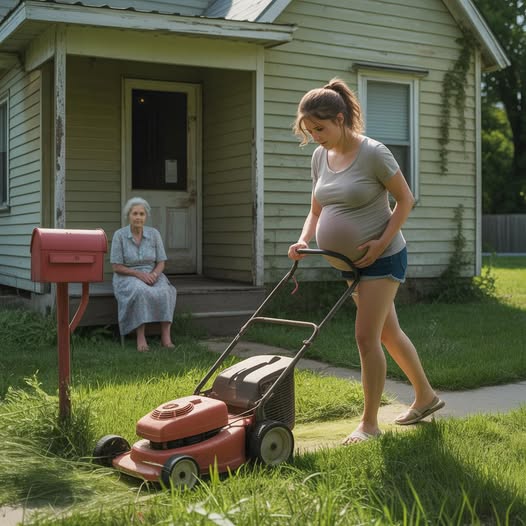
I always thought hitting rock bottom would come with some kind of warning.
It doesn’t.
Rock bottom feels like drowning in silence—like lying awake at two in the morning with your hand pressed flat against your belly, listening to the house settle around you, every creak sounding like something else is about to give way. Like standing in your kitchen staring at a stack of unopened envelopes and telling yourself you’ll deal with them tomorrow, only for tomorrow to become next week, next week to become a month, and the pile just keeps growing anyway.
I was thirty-four weeks pregnant and completely, terrifyingly alone.
That wasn’t how any of this was supposed to go. I used to be a planner. Color-coded calendars. Six-month budgets. An emergency fund built slowly and carefully over years because I grew up watching my mother panic every time an unexpected bill arrived, and I promised myself I would never live like that. I had a good job in medical billing. I had a house I was proud of—a small two-bedroom on a quiet street with a yard I actually maintained and neighbors I actually knew. I had Lee, who was funny and warm and made elaborate Sunday breakfasts and said he wanted kids someday, someday, someday—right up until the moment someday arrived and turned into right now.
He left on a Thursday. Packed two bags while I was at work, left his key on the kitchen counter, and sent a text saying he wasn’t ready, he was sorry, and he hoped I would understand.
I didn’t understand. I still don’t.
What I understood was that I was suddenly one income in a two-income house, with a baby coming in six weeks and a mortgage that didn’t care about any of it. I burned through the emergency fund faster than I thought possible. I asked for more hours at work, and they gave me what they could. I sold things. I applied for assistance programs that had waiting lists three months long. I told myself every day that I would figure it out, because what else do you do? You keep going. You keep telling yourself it’s temporary.
That Tuesday was the kind of hot that felt personal. Not just warm or uncomfortable, but angry. The air sat on everything—thick, still, pressing down. I’d been shuffling around the living room trying to make myself fold laundry that had been sitting on the couch for three days, which sounds small, but when you’re exhausted, frightened, and thirty-four weeks pregnant, folding laundry becomes a negotiation you don’t always win.
The phone rang and sent half the pile sliding to the floor.
The caller ID said Bank.
I stood there for three full rings, just staring at it. Part of me knew. Some quiet, tired part of me had known for weeks this call was coming, had been holding its breath waiting for it—and now it was here.
I answered.
“Ariel, this is Brenda.” Her voice had that careful, practiced tone of someone who has made a thousand calls like this and learned how not to let it show. She told me her department, the past-due balance, then said, “I’m afraid I have some difficult news regarding your mortgage. Foreclosure proceedings are starting as of today.”
I didn’t say anything. I didn’t even say goodbye. I just hung up and stood in the middle of my living room, laundry on the floor around my feet, one hand pressed to my belly.
“I’m so sorry, baby,” I whispered. “I’m trying, I promise.”
She kicked—hard and deliberate—right under my ribs, like an answer.
I needed air. Just one breath that didn’t taste like fear. I pulled on my shoes, grabbed the mail from the counter, and stepped outside into the brutal morning light. The heat hit instantly, but at least it was a different kind of terrible than the one inside.
That’s when I saw Mrs. Higgins.
She had lived next door for as long as I had been on the street. Eighty-two years old, always neatly put together, hair pinned even on the hottest days—the kind of woman who made you feel underdressed just by existing near her. Most mornings she sat on her porch with a crossword puzzle and sweet tea and greeted everyone who passed. She knew names. She remembered birthdays. She once told me she’d lived in that house for fifty-one years and planned to die there, and she said it like a fact, not a sadness.
But today she wasn’t on her porch.
She was on her lawn, hunched behind the oldest push mower I had ever seen, both hands gripping the handles, fighting through grass that had grown past her shins. She was sweating through her blouse. The mower hit a thick patch, groaned, and died.
She looked up, saw me on my porch, wiped her forehead, and gave a wobbly smile. “Morning, Ariel. Beautiful day for a little yard work, isn’t it?”
Her voice was cheerful. Her chest was rising too fast.
I hesitated. My back had been aching since I woke up. I was already dizzy from the heat. I had a stack of mail in my hand that I knew contained nothing good and every reason in the world to go back inside and not take on anyone else’s problems when my own were already swallowing me whole.
But Mrs. Higgins had one hand pressed to her chest and was blinking faster than she should have been.
I stepped into the grass.
“Let me get you some water,” I said. “You shouldn’t be out here in this heat.”
She waved me off immediately. Pride was structural in that woman. “Oh, I’m fine. I just need to finish before the HOA comes around. You know how they are.”
“Seriously,” I said. “Let me do it. Go sit down.”
She frowned at my belly with concern. “It’s too much for you, dear. You should be resting.”
“Resting is overrated,” I said. “And I need the distraction.”
Something shifted in her face. The cheerful mask softened. “Trouble at home?”
I shook my head, forcing a smile. “Nothing I can’t handle.”
She looked at me like she had seen enough life to recognize a lie immediately. Then she let go of the mower and sat down on her porch steps with a long breath that sounded like relief she had been holding for too long.
I started the mower.
My feet sank into the grass with every pass. The heat was relentless. My ankles were so swollen I hadn’t seen their shape in weeks. I was nauseated, dizzy in waves, but I kept going because stopping didn’t feel like an option.
Every few passes I noticed her watching me—not just watching a task, but watching me.
Halfway through, my vision went soft at the edges and I had to stop. I leaned on the mower handle, pressing my hand to my forehead, just breathing. She was beside me faster than I expected, pressing a cold glass of lemonade into my hand.
“Sit,” she said. Not a suggestion.
I sat on her steps and drank in three long swallows while my pulse slowly stopped trying to escape my throat. She sat beside me, not speaking unnecessarily, just resting a hand on my knee for a moment.
After a while she asked, “How much longer?”
“Six weeks,” I said. “If she lets me go that far.”
She smiled faintly. “I remember those weeks. My Walter packed the hospital bag a month early. Checked it like something might disappear.” Her hand trembled slightly. “He was a good man.”
“He sounds like it.”
“He was.” She went quiet. “It’s lonely when you lose the person who remembers your stories. Who was there.” She looked at me. “Who’s in your corner, Ariel?”
I stared down the street. “Nobody,” I said finally. “Not anymore. My ex left when I told him I was keeping her. And then I got the call this morning.” I swallowed. “Foreclosure. I don’t know what comes next.”
She didn’t offer comfort clichés. She just studied me and said, “You’ve been doing all of this alone.”
“Looks that way.”
“You’ve been strong,” she said. “But even strong women need a break sometimes.”
The second half of the lawn took everything I had. My body protested constantly, but I finished it. I pushed the mower back, turned it off, and stood in silence with sweat running down my back.
She took my hands. Her grip was firmer than expected.
“You’re a good girl, Ariel,” she said. “Don’t let this world take that from you.”
I joked that the world would have to take a number. She laughed and told me to rest.
I walked home through the heat, finally grateful for my porch shade.
That night I lay on my back, one hand on my belly, staring at ceiling cracks. I thought about the foreclosure notice, the bills, the shrinking account, all the fears I had been stacking for months.
But underneath it, something else had started to form. Lighter. Like a window had been cracked open in a sealed room.
I fell asleep before I could understand it.
The siren woke me before sunrise.
Blue and red light cut through my blinds and painted the bedroom walls in stripes of panic. I sat up too fast, heart already slamming, mind cycling through every possible explanation. Lee, causing some kind of trouble. The bank, though banks don’t send patrol cars. Some catastrophe on the street that was going to somehow make everything worse.
I pulled on the first cardigan I found and stepped outside into the early morning dark.
There were two patrol cars and a sheriff’s SUV at odd angles in the street. Neighbors stood in clusters on their lawns in pajamas and robes, faces tight with the particular expression people get when something has gone wrong right next door. I stood on my porch and wrapped my arms around myself and tried to look steadier than I felt.
A tall man in uniform came toward me. Broad shoulders, serious face, the kind of presence that makes you want to stand up straighter without quite knowing why.
“Are you Ariel?” His voice was clipped but not unkind. “I’m Sheriff Holt. Could we step inside for a moment?”
The living room felt very small with him standing in it. His radio crackled softly. His gaze moved over the family photos on the wall, the stack of mail on the counter, the baby gear I had slowly been accumulating in the corner of the room, and then settled back on me with something careful in it.
“Is everything okay?” I asked, though I already knew it wasn’t.
He lowered his voice. “I wish it was. Mrs. Higgins collapsed on her porch early this morning. A neighbor saw her from the street and called it in. Paramedics got there as fast as they could.” He paused. “She didn’t make it, Ariel. I’m sorry.”
I sat down on the sofa before my legs made the decision for me.
I thought about the lemonade. Her hand on my knee. Don’t let this world take that from you. The way she’d looked at me when I left, like she was memorizing something.
Holt waited. He was good at waiting.
“We checked her porch camera to confirm her last movements,” he said after a moment. “We saw her put something in your mailbox. Right before she sat down for the last time.”
I looked up at him. “She put something in my mailbox?”
He nodded.
I couldn’t make sense of it. “What would she have left me?”
He offered a small, quiet smile. “Let’s find out together.”
Outside, a neighbor’s kid was already riding his bike up and down the sidewalk, stealing glances at my house. Ms. Pearson from across the street stood on her porch with her arms crossed. The whole street felt like it was holding its breath.
My hands shook as I worked the mailbox key. The metal bit into my palm. I pulled the door open and found a thick manila envelope inside, my name written across the front in slow, careful script. Behind it, a thinner envelope stamped with the bank’s logo.
The words PAID IN FULL were printed across it in red.
My knees went out from under me.
Holt caught my arm. “Steady. You alright?”
“I don’t understand,” I whispered. I actually could not form a sentence larger than that.
He nodded toward the envelope in my hands. “Open it.”
My fingers fumbled with the flap. Papers slid out onto my palm. Legal forms. The deed to my house. And a folded note with my name written on the outside in that same careful hand. I passed it to Holt because my eyes had gone completely useless and I couldn’t have read a single word of it.
He looked at it for a moment. Then he took off his hat.
“Ariel,” he read quietly.
After you left, I noticed one of your letters had slipped from the stack you were carrying. I know I shouldn’t have read it, but when I saw the word foreclosure, I couldn’t ignore it.
After you went home for your nap, I called my banker and took Walter’s rainy day fund straight to the bank. I signed the papers myself.
You gave me kindness when you had nothing left. You saw me as a person. That’s why I wanted to see you safe, too.
You don’t owe me anything. Just promise me you’ll be as good to yourself as you were to me. Women look out for women, especially when nobody else will.
Be brave. Be kind. And always remember: what you did mattered.
P.S. I love the name Will for a boy. Mabel for a girl.
With love, Mrs. Higgins.
The sob that came out of me was sharp and sudden and completely beyond my control. Holt put a hand on my shoulder and left it there and nobody said anything for a long time.
I pressed my palm flat against my belly.
“We’re staying,” I whispered. “We’re home, baby.”
Holt walked me back inside, set the envelope carefully on the kitchen table like it was something that deserved handling gently, and told me to call the station and ask for him if I needed anything at all.
Around noon, Lee’s name lit up my phone.
Someone on the street had probably already told him about the sheriff’s cars. Maybe he thought I needed him now. Maybe he thought this was an opening.
I watched his name on the screen until it stopped.
For the first time in months, not answering felt like peace instead of defeat.
The rest of the day moved in a blur of paperwork and phone calls and neighbors slowing near my porch like they were only now learning my name after years of living on the same street. Ms. Pearson caught my eye at one point and gave me a small, awkward nod that I understood completely. Sometimes you witness something that rearranges your sense of the people around you and you don’t quite know what to do with that yet.
By evening the street had gone quiet. I sat on my porch steps with Mrs. Higgins’ letter in my lap and the deed to my house on the step beside me and watched the light shift through the trees.
My daughter kicked, slow and steady, like a reminder.
I looked up at Mrs. Higgins’ porch. The crossword puzzle was probably still on the table where she’d left it. The sweet tea glass. All the ordinary objects of an ordinary morning she had not known would be her last.
She had used Walter’s rainy day fund. The savings she had been keeping for fifty-one years in a house she had shared with a man who packed hospital bags a month early and who she still talked about like he was standing just around the corner. She had taken that money to a bank and signed papers for a neighbor she had known only well enough to wave to in the mornings. Because one letter slipped from a stack and she saw the word foreclosure and she could not ignore it.
Because I had taken an hour out of the worst morning of my year to mow her lawn.
“Thank you,” I said into the dusk. “I’ll pay it forward. I promise.”
A warm breeze moved through the leaves overhead. It was probably just wind. I chose to take it as acknowledgment anyway.
I looked down at my belly and smiled through the last of my tears.
I already knew her name.