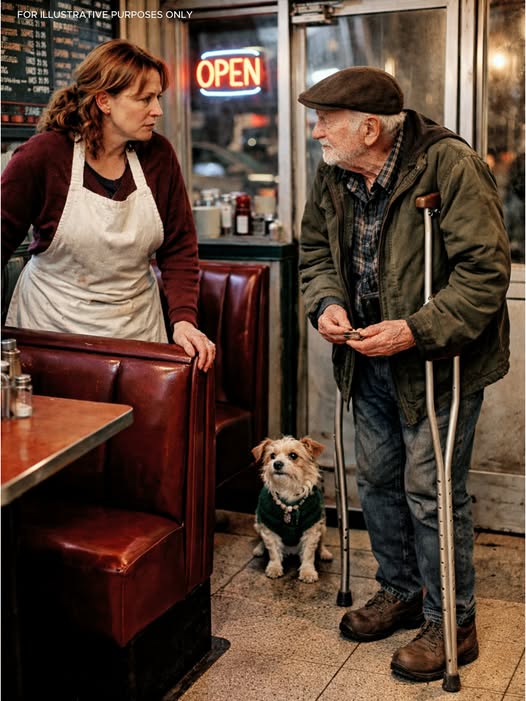
The diner was an island of dim light in the pre-dawn chill, the sky still a bruised, swollen purple. I unlocked the front door just as the first sharp rays of sun began to pierce the air, my breath blooming in white clouds. That’s when I saw it: an envelope, pristine and stark white, taped to the glass at eye level. No stamp. No return address. Nothing to indicate how long it had been waiting there. Only my name, Laura, written across the front in careful, elegant, almost painfully formal handwriting.
In the small-business world, an anonymous envelope is rarely good news. Running this diner—a legacy passed down from my grandfather—had taught me to brace for bad news. I expected a final notice from the utility company, a stern warning from the health department, or a bank letter denying my latest plea for a loan extension. I peeled the envelope from the glass with stiff fingers and slid it into my apron pocket, deciding I’d face its contents only after the coffee brewed and the grills hummed to life. I needed the familiar armor of routine before handling another blow.
But the envelope felt heavy, as if weighted by more than paper. Once the diner was ready and the first pot of dark roast steamed, I retreated to the far end of the counter and opened it. My hands trembled as a cashier’s check slid out, followed by a handwritten letter.
I looked at the check first. My knees buckled. I gripped the edge of the stainless-steel counter to keep from collapsing onto the linoleum. The number was clear, unambiguous, life-changing: $150,000.
I forced my gaze away from the figure and toward the letter, my heart hammering like a trapped bird.
Laura, it began. Last night, you fed me when you had every reason not to. You didn’t ask questions that would have humiliated a man in my position. You didn’t rush me into the cold, or treat me like a problem to be solved. You treated me like a person.
The writer identified himself as Henry Caldwell. For decades, he had been wealthy, owning multiple high-value properties across the city. But the death of his wife had triggered a slow, agonizing unraveling. Grief, he wrote, makes fools of the wise, and pride had kept him in poverty far longer than any lack of money. The small, scruffy dog I had fed alongside him—a terrier mix named Oliver—had been his late wife’s final gift. He hadn’t been homeless from misfortune; he had chosen to disappear because facing the world as a broken man was unbearable.
Your grandfather was right, the letter continued. Food keeps people alive in more ways than one. Please accept this not as charity, but as gratitude—and as an investment in a place that still believes people matter. If you refuse it, I will understand. But I hope you won’t.
I read the words until they blurred. Relief didn’t come. Only cold, paralyzing fear. My life had become a series of transactions where every blessing came with a hidden invoice. My daughter’s long illness had drained my bank account and spirit; my husband’s departure had drained my faith in permanence. I didn’t believe in miracles—I believed in interest rates and inevitable loss. I locked the check in the floor safe and moved through the morning like a ghost, cracking eggs, pouring refills, taking orders, while my mind raced over what this money might eventually cost me.
At noon, the bell above the door chimed. Henry stood in the entryway, hat in hand. He looked different than the disheveled man I’d served the night before—straighter posture, clearer eyes. Oliver’s little head peeked from the fold of his coat, tail thumping.
“You found it,” he said, voice soft but steady.
“I can’t take this, Henry,” I blurted, gesturing to a booth. He slid in. I poured him coffee—black, just as before—and sat across from him. “I don’t trust gifts. Every good thing I’ve ever had was eventually taken back with interest.”
Henry didn’t argue. He simply looked at me with eyes that had seen the same darkness. “I lost a daughter too,” he said quietly.
The diner seemed to still. He spoke of losing his adult daughter, then his wife. He sold his empire for pennies, let partners rob him, and eventually retreated to the streets. He wasn’t foolish—just numb.
“The night I walked in here,” Henry said, leaning forward, “I was at my lowest. Cold, starving, ashamed. You fed me without judgment. You gave me a bowl of stew, a warm corner, and reminded me who I used to be. You didn’t just make dinner, Laura. You restored my dignity.”
We sat in silence. I looked at the counter where my grandfather once stood, hands dusted with flour. He had said the diner was the heart of a neighborhood—the only place where everyone sat at the same level.
“What if I mess it up?” I asked, voice small.
“You will,” Henry said with a faint smile. “The only question is whether you have to face it alone.”
I took the money—not for greed, but to honor the legacy my grandfather had left. Over the next months, the diner quietly transformed. Predatory calls stopped. The leaky roof was repaired. Wages rose for my loyal staff, and I hired two more locals. I fixed the neon sign outside, so it glowed steady instead of flickering like a distress signal.
I added a small, hand-painted sign near the cash register: If you’re hungry and short on change, talk to us.
Henry became a fixture, appearing twice a week. He always paid full price and tipped generously. Oliver became the diner’s unofficial mascot, napping under a corner booth as if he owned the place.
A year later, the diner thrived—not as a five-star restaurant, but as the sanctuary it was always meant to be. Late at night, when locking up, a customer might ask why I help drifters or keep prices low. I think of Henry and the envelope. I tell them the truth: once, when I was starving in ways no one could see, someone fed me hope. Sometimes, that’s the only ingredient you need to change the world.