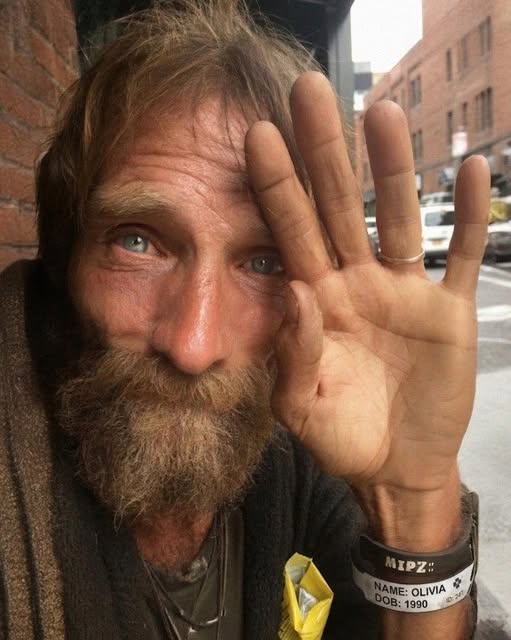
I found a homeless man while I was out taking photos—and by the next morning, I was standing face to face with the father I had spent my whole life believing had abandoned me.
I’m 35, and until recently, I thought I fully understood the worst thing my father had ever done.
When I was eight years old, I was diagnosed with leukemia.
And around that same time, he disappeared.
My mother never spoke about him with anger. She didn’t call him cruel or selfish. She would simply go quiet and say, “He left.”
Eventually, I stopped asking questions.
That became my truth growing up: he walked away when I needed him most. He left my mother to carry everything alone—the hospital visits, the bills, the fear.
I survived.
She didn’t.
She passed away six years ago, and with her went any chance of hearing the full story.
So I stopped looking for answers.
Instead, I built a life around noticing the people others ignore. I became a documentary photographer, focusing on those who live on the margins—on sidewalks, under bridges, outside shelters, in bus stations late at night.
Yesterday, after a rainstorm, I was working under an overpass. A small group had taken shelter there. One woman was sorting through cans. Another man was asleep under a blanket. And then there was an older man sitting against a concrete pillar, a worn canvas bag resting beside him.
When he noticed my camera, he turned his face away.
That’s when something caught my eye.
Attached to the strap of his bag was a hospital bracelet—old, faded, worn down by time.
Something about it felt familiar.
I took the photo because of that. Hospitals have always stayed with me. My mother had kept a box from my treatment years—documents, photos, little pieces of a time I barely remember. In one of those photos, I’m in a hospital bed, smiling, holding up my wrist with a bracelet just like that one. My name isn’t common. I had never seen it anywhere else.
Later that night, as I reviewed the photos, I zoomed in.
My name.
My childhood patient number.
My breath caught in my throat.
I zoomed in further, moving up to his face.
Older. Worn. Changed by life.
But unmistakable.
My father.
Alive.
I drove back to the overpass immediately, but he was gone. The woman sorting cans was still there. When I asked, she said, “You mean Daniel? Ambulance took him before sunrise.”
The name hit me hard.
I asked which hospital, then went straight there.
At the emergency desk, I gave his name. The nurse checked the system, then looked at me and asked, “What’s your relationship to him?”
I hesitated before answering, “I think I’m his daughter.”
She studied me for a moment, then said, “He’s awake. I can ask if he wants visitors.”
A minute later, she returned.
“He asked if your name is Ava.”
My legs nearly gave out beneath me.
She led me to his room.
He looked smaller in the hospital bed than he had under the overpass—pale, weak, surrounded by machines and tubes. His eyes were closed.
I stood there, staring at the man I had resented for most of my life.
Then I spoke.
“Dad?”
His eyes opened slowly.
And just like that, the anger came rushing back.
I didn’t hold anything back.
“Why did you leave?”
He looked at me quietly before answering, “I didn’t leave the way you think.”
That only made it worse.
“Oh, great. So now it’s a mystery?”
“It’s not,” he said softly.
He struggled to breathe.
“You disappeared. I had cancer.”
“I know.”
“You let me believe you walked away.”
His jaw tightened. “Yes.”
“Then explain.”
He took a slow, painful breath.
“Your mother was offered treatment through a donor-funded program. It gave access to medications we couldn’t afford. But there was a condition—one legal guardian, one stable household. No complications.”
I crossed my arms. “And?”
“I wasn’t stable,” he said. “I had a record. Nothing violent, but enough to complicate things. I was drinking. Inconsistent. The program required your mother to be your sole parent on paper.”
“So you gave up your rights.”
“Temporarily.”
“But I grew up without you.”
“Yes.”
“That’s not temporary.”
He gave a hollow laugh.
“It was supposed to be just paperwork. I was meant to stay nearby… come back when things were better.”
I stepped closer. “So what happened?”
“Fear,” he said. “Pride. Shame. Your mother got used to doing everything alone. I got worse before I got better. And then we made a mistake we couldn’t fix.”
“What mistake?”
He met my eyes.
“You asked where I was. And your mother told you I left.”
I froze.
“She told me later,” he continued. “You were already scared. She didn’t want you waiting for someone who might come and go. We said we’d explain it later.”
“But you never did.”
“No.”
“Why?”
“Because once a child believes her father chose to leave… it’s hard to undo that.”
I shook my head. “That wasn’t part of the program.”
“No.”
“Then why stay away?”
His eyes filled with tears.
“Because every year made it harder. I told myself I’d come back when I was better… when I was someone worth coming back as. But time kept passing.”
I picked up his bag and opened it.
Inside were letters.
All addressed to me.
Different ages written in the corners.
“I sent some,” he said. “Some came back. After that, I stopped trusting the address… and eventually, I stopped trusting myself.”
I held one but didn’t open it.
“You could have come to me.”
“I tried once,” he said.
I looked at him sharply.
“When you were 23. Outside a gallery. You were laughing with friends. Then you saw a man asking for money, and your expression changed—not disgust, just guarded. I realized if I walked up… I wouldn’t be your father. Just another man asking for something.”
“That’s not fair.”
“I know.”
He paused.
“I got sober. Lost it again. Got sick. Lost everything. And the shame just kept growing.”
I sat down, my legs no longer steady.
“How do I know you were really there?”
He didn’t hesitate.
“When you were 11, you hid your hand in your sleeve before they put the cast on. At 17, you cut a slit in your eyebrow and pretended it was on purpose. At graduation, you argued with your mom, then sat on the curb for ten minutes. I was in the back row.”
I closed my eyes.
“You stayed on the edges.”
“Yes.”
I looked at the bracelet.
“Why keep it?”
“The night you were admitted, they replaced it. I kept the old one. After your mother died… I carried it with me.”
“You knew she died?”
“Yes.”
“Did you come to the funeral?”
He nodded. “I stayed in the back.”
Of course he did.
Sitting there, with those letters in my hands, everything I thought I knew started to shift.
He hadn’t abandoned me the way I believed.
But he had still failed me.
Both were true.
“Did she love you?” I asked quietly.
“Yes.”
That hurt the most.
Because it would have been easier if she hadn’t.
He looked at me. “Don’t make her the villain. She chose your life first. The lie came later. That part… was ours.”
“Ours?”
“Mine too. Every day I stayed silent.”
I had to leave. I couldn’t breathe.
I came back the next morning.
He was weaker.
“I’m here,” I said.
A tear rolled down his face. He tried to speak but couldn’t.
So I said what I could.
“I don’t forgive you.”
His hand tightened around mine.
“But now I know… you didn’t leave because you didn’t care.”
Another tear fell.
Two days later, I stood at my mother’s grave.
“I understand some of it now,” I said.
But understanding isn’t the same as peace.
Last night, I printed the photo from under the overpass.
Now when I look at it, I see it differently.
A man who was meant to disappear only on paper.
A father who turned that into reality—because of fear, shame, and time.
That’s what I’m still trying to understand.
Not whether he loved me.
He did.