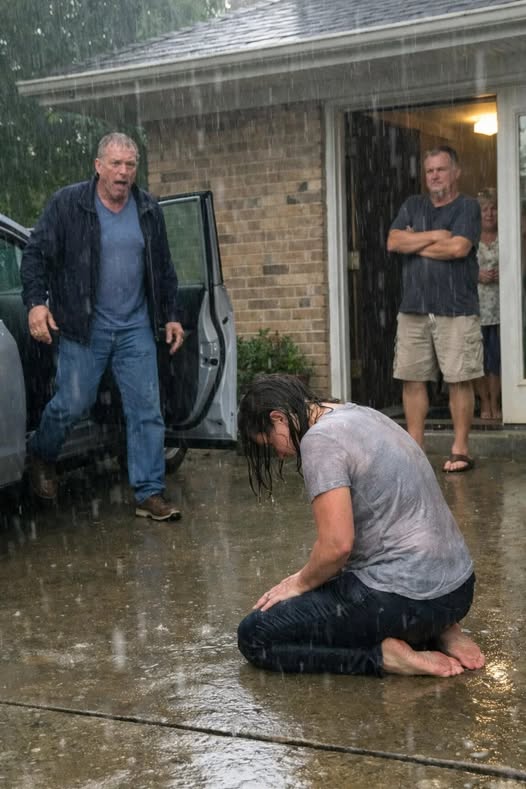
The rain had been falling since early afternoon—a quiet, patient drizzle that didn’t announce itself but lingered, making the world feel heavy and claustrophobic. The sky was a flat, endless gray, muting the neighborhood sounds as I drove to my daughter’s home. My mind wandered through the mundane trivia of a Saturday: grocery lists, unreturned voicemails, half-finished errands. Like most parents, I believed the people I loved were safe and stable.
I turned onto Maple Ridge Drive without slowing down—but seconds later, my foot slammed on the brake, sending the car jerking and hissing against the wet asphalt.
At the end of the driveway, where gravel met manicured lawn, a figure knelt in the dirt. A woman, back to the road, shoulders hunched, head bowed. Rain plastered her hair to her scalp; a thin blouse clung to her shivering frame. Her hands rested folded in her lap, pale and stiff. No parent expects to see their grown daughter reduced to such a shape. Claire, once vibrant and independent, looked like a broken statue.
I stepped out, legs unsteady. The cold rain barely registered. Only the surreal horror of the moment mattered.
“Claire,” I whispered. My voice cracked. She flinched violently. Shoulders jerked as if struck. When she turned, her eyes met mine—wide, raw, filled with unmistakable fear.
“Dad, please,” she whispered, barely audible over the rain. “Please go. I’m fine. Just go.”
That word—fine—hit harder than a blow. It had been her shield at twelve when bullied, at seventeen when her heart broke. Always fine to protect others from her pain. I crouched in front of her, ignoring the mud soaking my trousers, and wrapped my coat around her. She was freezing—not just from the cold, but fragile, as if she might dissolve into the gray mist.
“Talk to me,” I said softly. “What’s happening?”
Her eyes flicked toward the house, warm light spilling from the windows, distant laughter faintly audible. “I bought a dress,” she whispered, voice cracking. “For a charity event. Mark said it was disrespectful. His mother said I was wasting money that wasn’t mine. They said I needed to learn humility.” Rain and tears streaked her cheeks. “They told me to kneel out here until I understood.”
Something snapped inside me. Not just rage—a terrifying, crystalline clarity. From inside the house, careless laughter drifted out. People enjoying a dinner party while my daughter was being broken outside.
“How long?” I asked.
“I don’t know,” she whispered. “An hour? Maybe more.”
I didn’t wait. I slid my arms under her knees and back, lifting her effortlessly. She stiffened, then sagged against me, clutching my shirt like a drowning person. As I carried her toward the porch, she whispered one last, haunting detail: “Dad, they said this was discipline.”
It wasn’t discipline. It was control. I didn’t knock. I shoved the door open with my foot, wood slamming against the wall. Music stopped. Laughter died in their throats.
Mark froze, drink in hand, stupid smile frozen. His mother sat poised, sharp-eyed. His father leaned back, annoyed by the draft more than the scene. Rainwater dripped from me onto the pristine floor. I didn’t apologize.
“What the hell is this?” Mark blurted, trying to reclaim authority.
“This,” I said, voice low and dangerous, “is me taking my daughter home.”
“You can’t just barge in here,” his mother interjected, cool and patronizing. “Young women need guidance. Bad behavior must be corrected—it teaches humility.”
I looked at her, perfectly coiffed, sipping wine while her daughter-in-law knelt in mud. “She is not a dog, and she is not a child,” I said. “Kneeling in the rain is not guidance. It’s a crime against the spirit.”
Mark stepped forward, face flushed. “This is private. You’re crossing a line.”
“No,” I said, staring him down. “You crossed it an hour ago. If you follow us, or ever touch her again, this ends with police and a restraining order. Understood?”
Claire sobbed against me. I didn’t wait for their excuses. I turned, carrying her into the rain. The door remained open behind us, but no laughter followed.
The drive was silent except for the clicking turn signal and her ragged breaths. At her childhood home, her shoulders finally relaxed. She slept in her old room. Over the next days, the truth emerged in agonizing pieces: rules disguised as “tradition” or “values,” controls on her clothing, messages, and paycheck. Every act of independence was called “ungrateful.”
Healing wasn’t linear. Mornings came with panic, nights with deep crying. Slowly, her “fine” shield cracked, replaced by real emotion. She met lawyers. Changed passwords. Reclaimed life piece by piece.
Weeks later, Mark sent a non-apology message about “stress” and “misunderstandings.” Claire stared, then deleted it. Silence became her victory.
By early fall, the charity event finally arrived. The dress still hung in her closet, a symbol of the conflict she survived. Hands trembling, she considered wearing it.
“Do you want to wear it?” I asked.
Looking at her reflection—shorter hair, brighter eyes, reclaimed posture—she nodded. “Yes. I do.”
That night, she stood tall among people. Not a shadow, not a possession—she was a survivor. When a friend asked how she found courage to leave a marriage that seemed perfect, she glanced at me.
“Someone reminded me I didn’t belong on my knees,” she said firmly.
Love isn’t always patience or soft words. Sometimes it’s a hammer. Sometimes it shows up in the rain to break doors and lift you when you’ve been taught to stay down. Humility is earned through service, not humiliation. And the greatest lesson Claire learned—and I will keep reinforcing—is this: no one who truly loves you will ever ask you to kneel.