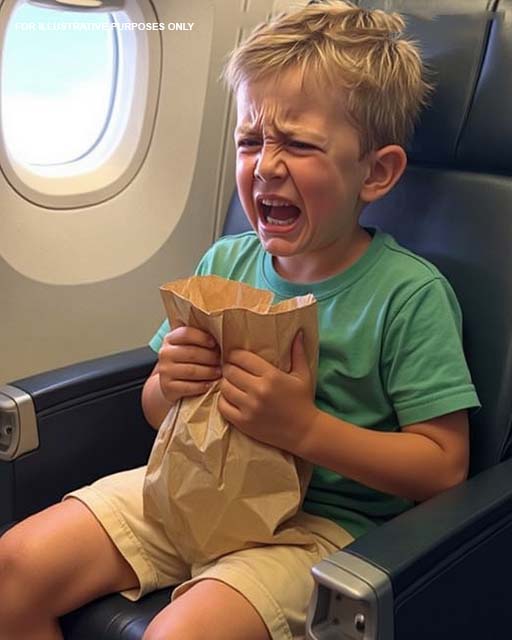
I’ve been a flight attendant for nearly fourteen years, and in that time I’ve dealt with everything from panicked passengers convinced the plane is “tilting wrong” to a goose that somehow ended up in the cargo hold on a return flight from Toronto. But nothing—absolutely nothing—ever came close to the day I found a crying little boy with a crumpled paper bag hiding in the airplane bathroom. And the strangest part? He wasn’t even on the passenger list.
We had just taken off from Chicago en route to Los Angeles. My coworker, Nessa, and I had finished the safety demonstration, done the usual aisle checks, and confirmed all latches, tray tables, and overhead bins. Everything felt like normal routine—almost boring. I remember thinking I’d finally get a quiet shift for once.
So much for that.
As I headed back toward the rear galley to grab my water bottle, I passed the mid-cabin lavatory and heard a soft, high-pitched sound. At first, I genuinely thought it was a kitten, like someone had smuggled their pet onboard and it had escaped mid-climb toward the sink. I stopped, eyebrows raised, listening again. A tiny, trembling whimper followed, then something like a hiccup.
Not a cat.
A child.
I knocked. “Hello? Is everything all right in there?”
No response.
I waited a couple of seconds, then knocked again, harder. “Can you answer me? Are you okay?”
Still nothing.
A twinge of panic tightened my chest. For safety reasons, we can open lavatory doors if we suspect a medical emergency, so I grabbed the latch override, exhaled, and cracked the door open.
And there he was.
A little boy, maybe eight or nine, curled up on the floor, knees to chest, cheeks streaked with tears. His shoulders trembled as he tried to stifle a sob, and a small brown paper bag was clutched tightly against his chest like a shield.
I nearly stumbled backward from the shock.
“Oh—oh goodness.” I crouched, forcing my voice to gentleness. “Hey there, sweetheart. You scared me. My name’s Mara. What’s yours?”
The boy sniffled hard and whispered, “Roscoe.”
I smiled softly. “Hi, Roscoe. Mind if I help you up so we can talk somewhere more comfortable?”
He nodded slowly, reluctant. His hand slipped into mine—small, damp, trembling—and I guided him out of the bathroom, keeping my voice light so he wouldn’t feel ashamed or threatened. “It’s okay. You’re safe. You didn’t do anything wrong.”
I settled him into the aft jump seat, then walked over to the nearest panel to check the passenger manifest on my tablet. I typed in R-O-S-C-O-E.
Nothing.
Typed the name again, just in case I’d mistyped.
Still nothing.
“Uh… okay,” I muttered under my breath.
Nobody named Roscoe was booked on this flight. No unaccompanied minors either. That alone made my pulse spike. A child can’t simply appear on a plane. There are tickets, gate agents, boarding passes—whole systems designed specifically to prevent this exact situation.
I crouched again. “Roscoe, honey… where are your parents? Were you traveling with a grown-up?”
He shook his head, clutching the paper bag even tighter.
Nessa appeared behind me, eyebrows raised. “Everything okay back here?”
“No clue,” I mouthed, then whispered, “I found him in the lavatory. But he’s not on the list.”
Nessa’s confusion mirrored mine. “What? How? Did he sneak on?”
I sighed. “That’s what I’m trying to figure out.”
She knelt beside me. “Hi, Roscoe. I’m Nessa. Want some juice?”
Roscoe nodded faintly. Nessa slipped away to grab a small bottle of apple juice and some crackers. When she returned, Roscoe accepted them politely, quiet and wary, like he wasn’t used to people offering him anything.
“Roscoe,” I said gently, “can you tell us how you got on the plane? Do you remember anything from the airport?”
He stared at his sneakers and whispered, “Mama told me to go. She brought me there. She said I had to find my aunt.”
“Your aunt?” Nessa prompted. “What’s her name?”
“Aunt Maribel,” he murmured. “That’s what Mama calls her.”
The name wasn’t on the passenger list either. And if Roscoe had been booked under her last name, we would’ve seen him.
“Do you know her last name?” Nessa asked.
He shook his head.
“Do you know where in Los Angeles she lives?”
“By the ocean,” he whispered. “She paints pictures. Mama said she paints everything.”
I exchanged a look with Nessa, equal parts concern and disbelief.
This was becoming less like a routine stowaway incident and more like the beginning of a story nobody wants to imagine.
I stood. “Nessa, stay with him. I’m going to talk to the captain.”
Captain Durand, who had flown commercial jets for three decades and had a reputation for handling chaos with monk-like calm, went pale as I relayed the situation.
“A child not on the manifest?” he murmured, rubbing his forehead. “That’s… extremely serious.”
“I know.”
“We’ll alert ground control,” he said. “But for now, keep him calm. Make sure he’s safe. Authorities will meet us at the gate.”
I returned to the galley. Roscoe had finished his juice and was nibbling on a cracker. He looked exhausted, like he’d been crying long before he ever stepped on the plane.
I knelt beside him again. “Roscoe, sweetheart, can you tell me what’s in the bag?”
His grip tightened. “It’s mine.”
“I know. And you don’t have to show me unless you want to. But maybe it could help us find your aunt.”
He didn’t answer. Instead, he stared at the crumpled bag for a long moment. Then, in a tiny, cracking voice, he whispered, “Mama said… I could open it when we were in the air.”
Nessa and I exchanged a slow, solemn glance.
“Do you want to open it now?” I asked.
Roscoe swallowed hard, then nodded.
He peeled back the top of the bag with trembling fingers. Inside was a small stuffed dog, matted, missing one ear, and a folded letter.
He removed the letter, opened it carefully, and began to read. His lips moved silently over each line. Halfway through, tears welled up in his eyes again.
He held the paper out to me. “Mama wrote it this morning.”
My throat tightened as I read.
It was from his mother, explaining in shaky, desperate handwriting that she was sick—very sick. She couldn’t take care of him anymore. She wanted Roscoe to find her estranged sister, Maribel, an artist in Los Angeles. She apologized for everything and begged him to be brave.
I swallowed around the lump forming in my throat. “Thank you for sharing this with me,” I whispered.
Roscoe wiped his face with the back of his hand. “Mama said Aunt Maribel will know what to do. Mama said she always knows what to do.”
I touched his shoulder lightly. “We’re going to help you. I promise.”
For the next couple of hours, Nessa and I rotated duties so one of us could stay close to him at all times. He dozed off for a bit, his little stuffed dog pressed to his chest, the open letter lying next to him like a fragile lifeline.
When we were about half an hour from landing, I gently woke him. “Hey, buddy. Look at you—almost there.”
His eyes blinked open, heavy with sleep. “What’s going to happen?”
“Well,” I said carefully, “when we land, some people whose job is to help kids will come talk to you. They’re very kind. They’ll make sure you’re safe and warm, and they’ll help find your aunt.”
His lower lip trembled. “I’m scared.”
I squeezed his hand. “It’s okay to be scared. But you’re not alone.”
Nessa pinned a pair of junior flight wings onto his shirt. “Now you’re official crew. We look after our own.”
He managed a shy smile.
When the plane touched down, Nessa stayed seated with him while I directed passengers out. Most had no idea what had happened. To them, it was just another flight.
Once the cabin was empty, two people entered: Officer Prentiss and a child services representative named Liora Menendez. They knelt in front of Roscoe, introduced themselves gently, and assured him he’d be taken care of.
He looked back at me, eyes pleading.
“You’re okay,” I whispered. “You’re in good hands.”
Before leaving, he rushed forward and wrapped his arms around my waist. “Thank you,” he choked out. “For finding me.”
I hugged him tightly. “Anytime, sweetheart.”
And then he walked away, clutching his stuffed dog and paper bag.