I was forty years old, working the late shift behind the register at a small neighborhood grocery store—the kind that stays open just long enough for worn-out people to grab whatever they forgot earlier in the day. It wasn’t the life I once imagined, but it covered most of the bills, and by then, “most” felt like a quiet victory.
When you spend enough time ringing people up, you learn how to read them. You know who’s in a rush, who’s lonely, who’s silently calculating every cent while pretending they’re fine. Parents are always the most obvious. They smile for their kids while their eyes do stressful math no one ever taught them.
It was nearly eleven that night—ten minutes to closing. Half the lights were off, the aisles empty, the low hum of the refrigerators louder than the background music. My feet hurt, my patience was worn thin, and I was already thinking about the uninspiring snack waiting for me at home.
Then she stepped up to my register.
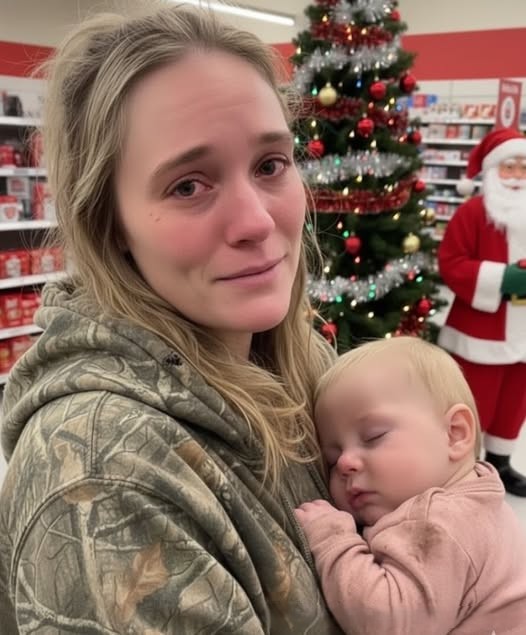
She looked to be in her early thirties. Her hair was tied up messily, her hoodie faded from too many washes, leggings stretched thin, sneakers clearly well used. A baby was strapped against her chest, his face tucked into her shoulder. She looked exhausted in a way that sleep alone doesn’t fix.
She smiled politely. I returned it.
“You’re our last customer,” I said. “Lucky timing.”
She gave a small, tired laugh. “Lucky probably isn’t the word, but at least we made it.”
She unloaded her cart. It was quick. Bread. Eggs. Milk. One large container of baby formula. Nothing extra. No treats. Just necessities. I scanned the items and gave her the total.
“Thirty-two forty-seven.”
She opened her wallet and began counting. I watched her lips move silently. Her brow tightened. She checked another pocket. Then a small pouch. Then the back of her wallet, as if hoping money might appear.
Her shoulders sank.
“Oh no,” she whispered.
“How much are you short?” I asked softly.
“Six dollars,” she said. “I’m sorry. Could you take off the formula? I’ll just get the rest.”
She couldn’t bring herself to look at me. Her eyes stayed on the can. The baby stirred, made a quiet sound, then settled again.
I’d seen people put things back countless times—steaks, snacks, even medicine. But formula was different.
I reached into my apron and pulled out the crumpled tip money from earlier that day. Mostly singles. I counted out six dollars and slid it toward the register.
“I’ll cover it.”
She looked up fast. “No, you don’t have to—”
“I know,” I said. “I want to.”
“I can pay you back,” she said quickly. “Next time I come in—”
“You don’t owe me anything,” I told her. “Take the formula. Go home.”
Her eyes filled instantly. “Thank you,” she said. “You have no idea.”
She hugged her baby closer, grabbed her bag, and walked out as the doors opened and cold air rushed in. Then she was gone.
I dropped the money into the register, finished closing, clocked out, and went home. By the time I reheated leftovers and crawled into bed, it already felt like a small moment in a long day. Six dollars. Nothing life-changing.
The next morning, the store was packed. Morning rush—coffee, cereal, energy drinks. I tied on my apron and started scanning like always.
Then the loudspeaker crackled.
“Amelia to the manager’s office. Amelia, please.”
Never good.
As I walked back, my mind replayed the night before. The woman. The money. The cameras overhead.
My manager had the security footage paused on his screen when I walked in—me at the register, the baby in frame.
“Did you pay for part of a customer’s groceries last night?” he asked.
“Yes,” I said. “It was my own money. I know it probably breaks policy.”
He raised a hand. “That’s not why you’re here.”
He opened a drawer and slid a white envelope across the desk.
“She came back this morning. Asked me to give you this.”
My name was written on the front.
I returned to my register, the envelope heavy in my pocket. After my shift ended, I went straight to my car and opened it.
Inside was a handwritten letter.
She thanked me for the money—but more than that, for not making her feel embarrassed. She wrote about counting every dollar, about the shame that flooded her when she realized she didn’t have enough.
Then the letter changed.
She wrote that she’d been adopted as a baby. That after having her own child, she began searching for answers—records, names.
Mine.
And our biological mother’s.
Scarlett.
My mother.
She had passed away five years earlier. I had always known there was another child before me—one my mother gave up when she was young and alone. We never talked about it much. It was something fragile that lived between us.
The letter ended with one sentence that made my hands shake.
“My sister.”
She included her number.
I didn’t hesitate. I called.
We met the next day at a café. She walked in with the same tired eyes, the same baby. We hugged awkwardly, then sat down.
“This is Elijah,” she said softly. “Your nephew.”
The word felt unfamiliar—and completely right.
We talked for hours. About our mother. About our lives. About how fate bends in ways no one can predict.
Weeks later, a DNA test confirmed it. Full siblings.
Now she stops by the store sometimes. Elijah reaches for me when he sees me. I keep his photo in my locker.
I went to work thinking I was just a cashier.
I walked out with a sister—and a family I never knew existed.
All because one night, someone was six dollars short.