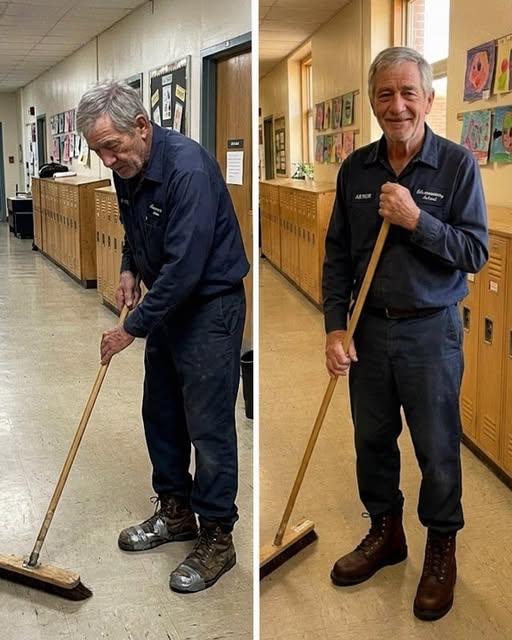
I bought a new pair of work boots for the janitor at my school after weeks of watching him shuffle through the halls in ones that were barely holding together. I thought it was a simple act of kindness—something small that might make his life easier.
I had no idea those boots carried a meaning I had no right to replace… until he showed up at my door that night.
I’ve been teaching second grade for six years, and every morning starts the same way—noise, energy, and a dozen tiny voices calling my name before I’ve even set my bag down.
“Miss Angie, he took my eraser!”
“Miss Angie, I need help!”
Amid that chaos, there’s always Harris.
He moves quietly through the building, steady and unassuming, like something you don’t notice until it’s gone. The kids adore him—not because he tries to impress them, but because he treats them with patience and warmth that feels real.
He fixes things without being asked. Tightens screws on chairs. Picks up dropped crayons. Ties shoelaces.
He never complains.
He just shows up and does what needs to be done.
That’s why his boots started to bother me.
They were old—far past worn-out. Brown leather cracked from years of use, soles bound with layers of silver tape, overlapping strips that held them together more by will than by material. On rainy mornings, the tape sagged and darkened, and by recess, the boots looked like they might give out completely.
At first, I told myself he was just waiting until payday.
But payday came and went. Then another week. Then another. The boots stayed the same.
Wanting to help was easy. Helping without making him feel embarrassed… that was harder.
So that Friday, while my class worked quietly, I called Mia to my desk.
Mia was fearless—the kind of eight-year-old who treated any task as a personal mission.
“Mia,” I whispered, lowering my voice, “can you do me a favor?”
Her eyes lit up. “A real one?”
“A real one. Go ask Mr. Harris what size shoes he wears. But don’t tell him I asked.”
She nodded like I’d just given her top-secret clearance and skipped off.
I watched as she approached him near the water fountain.
“Mr. Harris, what size shoes do you wear?”
He paused, leaning on his broom, amused. “What do you need that for?”
Mia shrugged. “My dad might be the same size.”
“Eleven,” he said. “Still holding on somehow.”
That last part stuck with me.
That weekend, I drove across town and bought a sturdy pair of boots. Nothing flashy—just warm, durable, practical. At home, I added a simple note:
“For everything you do. Thank you.”
No name. I wanted it to feel like quiet appreciation.
Monday morning, I slipped into the janitor’s closet early and left the box in his cubby. My heart raced like I’d done something reckless. But really, I had just bought a man a decent pair of boots.
I thought that would be the end of it.
I was wrong.
That night, rain pounded against my windows as I sat grading papers. Dan, my husband, was out of town, so the house felt especially quiet.
At exactly 9:03 p.m., someone knocked.
When I opened the door, Harris stood there—soaked through, holding the shoebox carefully under his coat like it mattered more than anything else.
“I kept them dry,” he said gently. “But I can’t accept them.”
I brought him inside, handed him a towel and a cup of coffee. He held the mug but didn’t drink. The box rested in his lap like it carried weight beyond what it should.
“How did you know it was me?” I asked.
“I saw you,” he admitted. “You meant well.”
“Then why return them?”
He hesitated.
“Some things aren’t mine to replace.”
At first, I didn’t understand.
“They’re just boots,” I said.
He shook his head.
“No… not these.”
There was something in his voice that told me this wasn’t about money. It was about something deeper—something I hadn’t considered.
The next day, he didn’t come to work. By afternoon, I found out he’d taken the week off. That had never happened before.
So after school, I drove to his house with groceries. The house was small. Quiet. Worn down.
Inside, something hit me immediately—the smell. Old wood… and marigolds. And suddenly, I wasn’t standing in his home anymore. I was standing in my childhood.
On a table near the stairs was a photograph. A woman. Candles. Fresh flowers. And I knew her instantly.
“Catherine…” I whispered.
I climbed the stairs, my heart racing. Harris sat in bed, pale and feverish.
“Miss Angela?” he said, surprised.
I didn’t ease into it.
“Why is Catherine’s picture downstairs?”
The silence that followed felt heavy. Then he said it:
“She was my wife.”
Everything shifted. Catherine—the woman who had cared for me when I was sick as a child. The woman who had made me feel safe when my world fell apart. She hadn’t just been kind. She had been his.
Then he told me about the boots.
“They were the last pair she bought me,” he said quietly. She had made him try on different pairs, insisted on the best one. “And after she was gone… I just kept fixing them.”
The tape wasn’t about practicality. It was about memory. About holding on.
Then he said something that broke me completely.
“She never forgot you.”
He showed me a drawer. Inside was a small doll made of candy wrappers—I had made it. I had given it to Catherine the day I left. He had kept it all these years. And suddenly, everything made sense.
Why he recognized me. Why he never said anything. Why he looked at me the way he did. He had been carrying pieces of my past in silence… while I walked past him every day.
A week later, I came back—with my husband, groceries, medicine… and new boots.
This time, I did it differently.
“You don’t have to wear the old ones to remember her,” I said gently. “We can keep them safe.”
He looked at the new boots again. Then nodded. We placed the old boots carefully in a box—not thrown away, not replaced, but preserved.
Before I left, I placed fresh marigolds beside Catherine’s photo.
“You’re not alone anymore,” I told him. “If you want… you can think of me as your daughter.”
He broke down. And we stayed there—together—letting the past and present meet in a way neither of us expected.
The following Sunday, we visited Catherine’s resting place. Harris wore the new boots. The old ones stayed safe at home. He looked at the flowers and smiled.
“She would’ve loved this,” he said.
I squeezed his arm.
“I think she does.”