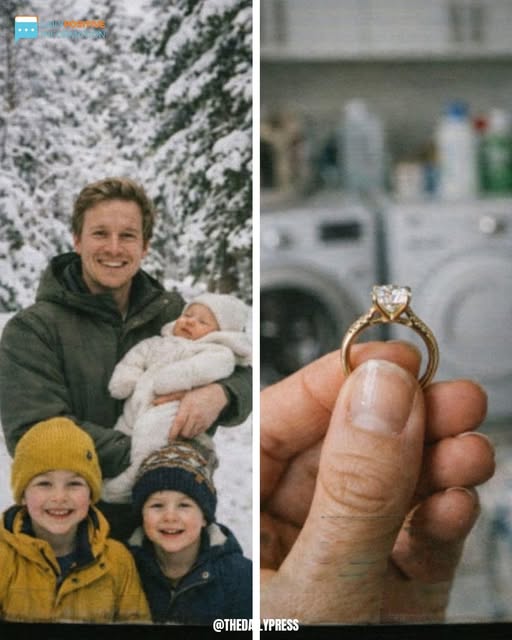
I was thirty years old, a single dad of three, and tired in a way that sleep couldn’t fix.
My name is Graham, and when you’re raising kids alone, you learn fast what actually matters in life: food on the table, rent paid on time, clean clothes for school, and whether your kids trust you when you say everything’s going to be okay.
Everything else is just background noise.
Our apartment was a second-floor walk-up in Tacoma, Washington—one of those early-1980s complexes with thin walls and carpet that had probably been replaced only once since Reagan was president. Two bedrooms, one bathroom, and a galley kitchen where you couldn’t open the fridge and the dishwasher at the same time. The parking lot had more potholes than asphalt, and the “fitness center” listed in the lease was just a broken treadmill and a set of free weights someone had donated years ago.
But it was ours. It was affordable. And it was three blocks from the elementary school my kids attended, which meant I didn’t have to worry about transportation every morning.
I worked as a line cook at a family restaurant called The Copper Kettle—nothing fancy, just honest food for working people. My shift started at five a.m., which meant I was up at four, packing lunches and laying out clothes before my neighbor Mrs. Chen came over to help get the kids ready for school.
Money was tight. Always tight. But we were managing.
Until the washing machine died.
The Moment Everything Fell Apart in Sudsy Water
It happened on a Tuesday evening, right in the middle of washing Milo’s bedsheets after he’d had an accident the night before and was already embarrassed enough without sleeping on bare plastic.
I loaded the washer—an ancient Kenmore that came with the apartment and sounded like it was grinding rocks even on good days—added detergent, selected the cycle, and pressed start.
At first, everything seemed normal. Water filled. The drum started turning. Regular washing machine sounds.
Then came a groan—deep, mechanical, wrong.
Then a clank, like metal hitting metal inside the machine.
Then nothing. Just silence, and a drum half-filled with soapy water that wasn’t going anywhere.
“Is it dead?” Milo asked from the bathroom doorway. He was four years old, with my ex-wife’s dark hair and a tendency toward pessimism that felt way too advanced for his age. “Did it die, Dad?”
I stared at the washer, my hand still on the dial I’d been twisting through different settings. Nothing responded. The machine was completely dead, and the water just sat there soaking the sheets.
“Yeah, bud,” I said, sitting back on my heels. “It fought the good fight, but I think this is the end.”
Nora appeared behind Milo—eight years old, practical to a fault, already crossing her arms the way her mother used to when she was about to deliver bad news.
“We can’t not have a washer, Dad,” she said, as if I hadn’t already understood. “We have to do laundry. That’s not optional.”
“I know,” I said.
Hazel, my six-year-old middle child, clutched her stuffed rabbit—a threadbare toy she’d named Professor Carrots for reasons she never fully explained—and asked the question I’d been dreading: “Are we poor?”
The words hit harder than they should have. Kids aren’t supposed to worry about money. They’re supposed to worry about which cup they get at dinner, not whether the family can afford basic appliances.
“We’re resourceful,” I said, which was true, but also a dodge. “We’ll figure it out.”
But figuring it out wasn’t going to be easy.
We didn’t have “new appliance” money. We barely had “unexpected car repair” money. My last paycheck went to rent, groceries, Nora’s field trip fee, and Hazel’s prescription for an ear infection. I had maybe three hundred dollars in checking and two hundred in savings I absolutely couldn’t touch unless it was an emergency.
A new washing machine—even a basic one—cost four or five hundred dollars. Used ones were still two-fifty, three hundred.
I didn’t have it.
The Thrift Store That Smelled Like Disappointment and Possibilities
That Saturday, I took all three kids to a place called Thrift Barn on the south side of Tacoma—one of those huge warehouse thrift stores selling everything from furniture to clothes to appliances, all donated or pulled from estate sales.
It smelled like dust, old books, and the faint scent of other people’s lives being sold off. Fluorescent lights buzzed overhead. Nothing was neatly organized—winter coats beside garden tools, dishes stacked next to random hardware.
“This place is weird,” Milo said, holding my hand tightly.
“This place is cheap,” I corrected. “Which is what we need.”
The appliances were in the back corner—refrigerators, stoves, dishwashers, and, thankfully, three washing machines in various states of wear.
Two already had “SOLD” signs.
The third had a cardboard sign: “$60. AS IS. NO RETURNS.”
I walked around it, inspecting it. Early 2000s model, white top-loader, rust spots on the corners, a dent on the side, one missing detergent door, and a knob that looked glued back on.
But it was sixty dollars. And it was either this or hand-washing clothes for three kids who changed outfits like it was a sport.
“Does it work?” I asked the clerk, Ron, a man in his fifties who looked like he’d answered this question too many times.
“It ran last week when we tested it,” he said with a shrug. “As-is means as-is.”
“Right.”
I did the math. Sixty dollars. If it lasted six months, it was worth it. If it died immediately, I’d just lost money I couldn’t afford.
“It’s this or hand wash,” I muttered.
“Dad, can we leave?” Hazel asked. “This place smells funny.”
“Five minutes. We’re buying this.”
Getting it home was a struggle. Ron helped load it into my old Honda CR-V—2004, over 200,000 miles, check engine light permanently on. It barely fit, and I had to tie the hatch down with bungee cords.
The kids argued the whole drive home about who got the middle seat.
“You’re so strong, Dad,” Nora said as we pulled into the lot.
I looked at her in the mirror. “You’re trying to distract me so you don’t have to help carry it.”
“Is it working?”
“No. Grab that side.”
We hauled it upstairs together—me, Nora, and a lot of awkward lifting—and set it up in the apartment. I connected the water lines, leveled it with cardboard shims, and wiped sweat from my forehead.
“Test run. Empty load. If it explodes, we run.”
“That’s terrifying,” Milo said, hiding behind the couch.
I added detergent, closed the lid, and turned the dial.
Water filled the drum. The cycle started.
The drum began to spin.
Everything seemed fine.
Then I heard it.
The Sound That Changed Everything
A sharp metallic clink.
I froze, my hand still on the dial. “Back up,” I told the kids.
“Is it going to explode?” Hazel whispered, clutching Professor Carrots.
The drum made another rotation. Another clink—clearer this time.
“It’s the big one!” Milo yelled, and all three kids bolted into the hallway, peeking around the doorframe like they were watching a bomb squad at work.
Another rotation. Another clink—louder now. And then I saw it: something catching the light inside the machine, a small glint of metal tumbling in the drum.
“Hold on,” I said, hitting pause.
“What is it?” Nora asked, stepping a little closer.
“I don’t know yet. Stay back while I drain it.”
I let the water drain properly—no need to flood the apartment on top of everything else—then carefully reached inside the drum, feeling along the bottom and sides.
My fingers touched something small, smooth, and definitely not supposed to be there.
I pinched it carefully and pulled it out, water dripping from my hand.
It was a ring.
A gold ring. A single diamond set in the center—small but clear. The band was worn thin in places, the gold scratched and dulled from years—decades, probably—of being worn.
“Treasure,” Nora whispered, stepping fully into the room now.
“It’s pretty,” Hazel said, standing on her toes to see better.
“Is it real?” Milo asked, his usual pessimism briefly replaced by excitement.
“Feels real,” I said, turning it over in my palm.
That’s when I saw the engraving inside the band—tiny letters, almost worn away with time, but still readable if I held it to the light:
To Claire, with love. Always. – L
I read it out loud without thinking.
“Always?” Milo asked. “Like forever?”
“Yeah,” I said quietly, something tightening in my chest. “Exactly like forever.”
I stood there in our cramped laundry nook, water still dripping from the machine, holding someone else’s wedding ring while my three kids gathered around me.
And I’d be lying—completely lying—if I said my mind didn’t immediately go to one ugly, desperate place.
Pawn shop.
I could see it clearly: walking into one of those places on Pacific Avenue with neon signs and barred windows, placing the ring on the counter, walking out with cash. Not a fortune, but enough. Enough to buy groceries without checking my balance first. Enough to get the kids shoes without holes. Enough to pay the electric bill before the disconnect notice arrived.
Enough to breathe for a minute.
I stared at the ring, my thumb brushing over the engraving.
Someone had saved for this. Someone had proposed with it, nervous and hopeful, believing in forever. Someone named Claire had worn it for years—decades—taking it off for dishes, for gardening, for showers, then putting it back on again. A ritual. A promise made physical.
This wasn’t just jewelry.
This was someone’s entire life story.
“Dad?” Nora said quietly, watching my face with that too-perceptive look she sometimes had.
“Yeah, honey?”
She looked at the ring, then back at me. “Is that someone’s forever ring?”
The way she said it—forever ring, like it belonged to a category of sacred objects—hit me harder than I expected.
“Yeah,” I said, my voice rough. “I think it is.”
“Then we can’t keep it,” she said, as if it was the most obvious thing in the world.
I looked at her—my eight-year-old daughter in a slightly too-small sweater and patched jeans, standing in our tiny apartment where the washing machine was held together by hope and duct tape—and felt something inside me crack open.
“No,” I agreed. “We can’t.”
The Phone Call That Made Me Question Everything
That night, after the kids were finally asleep—Milo and Hazel sharing a room, Nora in her own, the usual chaos of baths, teeth brushing, stories, and negotiations finally settled—I sat at the kitchen table with my phone and the ring.
I’d dried it off with a dish towel and placed it on top of the refrigerator, out of reach, while I tried to decide what to do.
The smart thing—the practical thing—would have been to keep it. Or sell it. Nobody would know. Nobody would blame me. Single dad, three kids, barely getting by—it would make sense.
But Nora’s words kept echoing in my head: Then we can’t keep it.
I picked up the phone and called Thrift Barn before I could change my mind.
Three rings. Then: “Thrift Barn, this is Ron.”
“Hey, it’s Graham. I bought a washing machine from you today. Sixty bucks, as-is, white top-loader.”
He snorted. “It already die?”
“No,” I said. “It’s fine. But I found something inside it. A wedding ring. Gold, diamond, engraved. I’m trying to return it to whoever donated the washer.”
Silence.
“You serious?” Ron asked.
“Pretty sure,” I said.
“Most people would keep that.”
“I know.”
More silence. Then: “We don’t usually give donor info. Privacy policy.”
“I understand,” I said. “But my kid called it a forever ring, and I can’t shake it. I need to try to return it.”
I heard papers shifting.
“Hang on,” Ron said. “I remember that pickup. Older lady, late seventies. Her son arranged the donation. She didn’t even want money for it—just wanted it gone. Let me check.”
He put the phone down. I heard drawers, papers, muttering.
A minute later: “Got it. Claire Henderson. Address is—”
He gave me the address on the north side of town.
I wrote it down on an envelope. “Thank you. Seriously.”
“I’m not supposed to do this,” Ron said. “But if it were my ring, I’d want it back. You’re doing the right thing.”
“I hope so,” I said.
When I hung up, I just stared at the address. Thirty-minute drive. Gas I didn’t really have. Time I didn’t really have. A life I didn’t really have space to pause.
And for what? To return a ring someone might not even remember losing.
But I kept thinking about one word engraved inside it:
Always.
Someone had meant that. Someone had believed it.
And I knew I couldn’t ignore it.
I owed it—to Leo, to Claire, to whatever story still lived behind that ring—to make sure that promise found its way home.