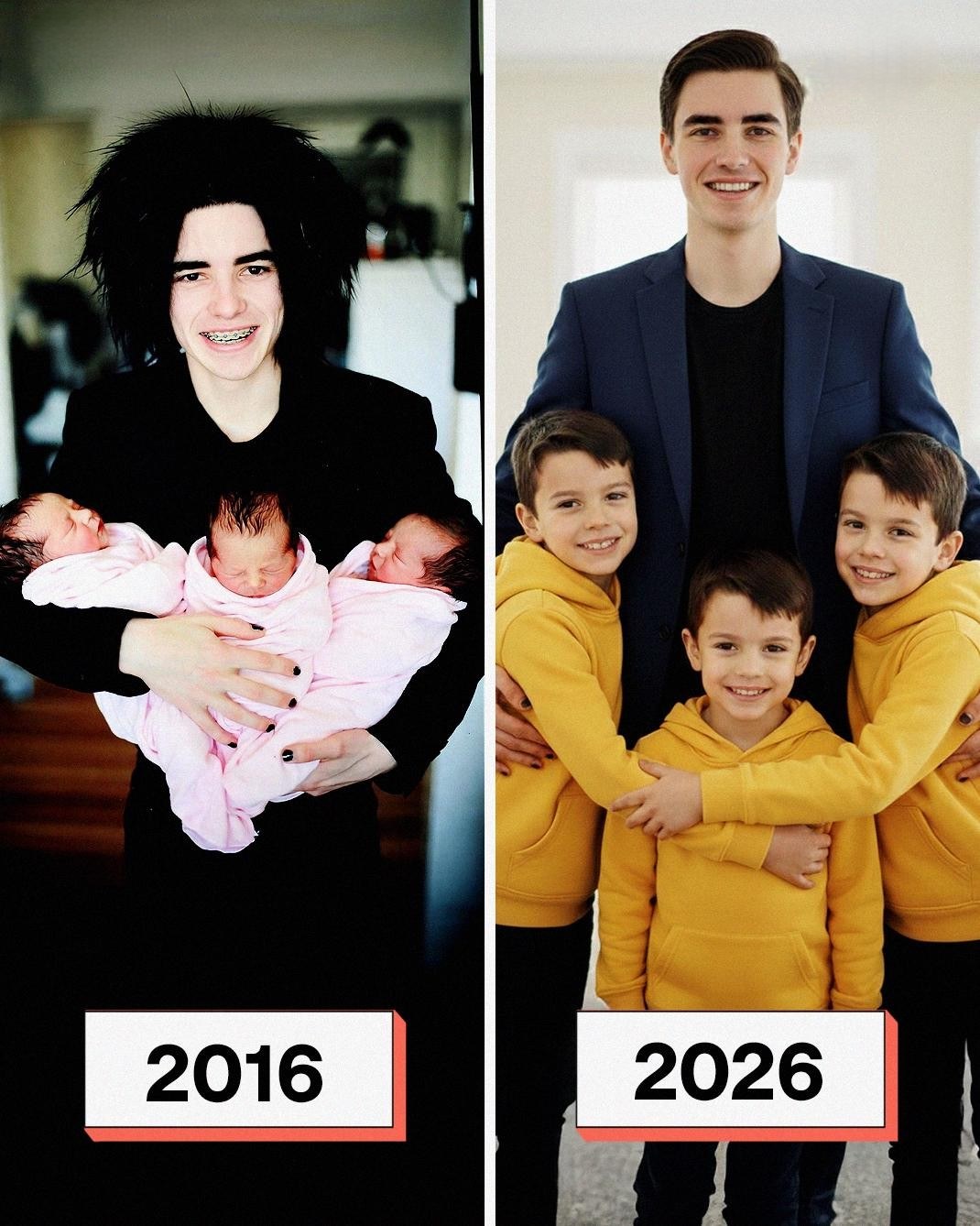
I was eighteen when my mother passed, and in that instant between heartbeats, my world stopped being mine.
She didn’t leave a house buzzing with family or a crowd ready to step in. She left three newborn boys—my brothers—triplets so tiny they seemed like they belonged in the palm of a hand, not in life. Fragile, fresh from the NICU, still learning to breathe properly. And suddenly, keeping them alive became my responsibility.
People always ask the obvious question first: where was our father?
I asked that question too. Late at night, while sterilizing bottles, counting pennies at the store, holding three screaming infants and feeling my mind dissolve into fog—I asked it constantly.
The answer was simple. He had left, because leaving was what he did best.
My father was the type who stayed just long enough to leave a mark of pain, then vanished before anyone could hold him accountable. As a teenager, I was his entertainment, someone to mock, humiliate, and diminish in front of my mother so he could feel larger.
I wore black. Painted my nails sometimes. Played music he didn’t understand. That was enough for him to mark me as a target.
“What are you, some kind of goth?” he snapped one day, jabbing at my hoodie.
I said nothing.
“Not a son,” he added with a cruel laugh. “Just a shadow.”
My mother’s voice cut through him immediately. “Enough, James. He’s your son.”
He shrugged, pretending innocence. “Relax. Just joking.”
That was the pattern. He attacked verbally, and she shielded me quietly, without drama. My mother had a calm, steadfast strength—protective, unyielding.
Then she became pregnant.
I remember the doctor staring at the ultrasound screen as if it might all change if he squinted hard enough.
“Triplets,” he said at last.
My mother’s face went pale, eyes wide—not with joy, but shock. Her life was about to be utterly transformed. She looked at my father, who didn’t flinch. He simply turned and walked away.
That was his first disappearance.
It started slow—late nights at work, long errands, weekend absences. Eventually, he was just gone, as if responsibility existed in a parallel universe he refused to enter.
I stepped in wherever I could. Helping Mom shop, clean, prep rooms, research premature births. She never admitted fear, but I could see it. Anyone would be terrified. Triplets aren’t a whimsical surprise when you’re staring down sleepless nights, endless diapers, and mounting bills.
Then she got sick.
At first, it was dismissed as exhaustion. Then complications. Then the doctor sitting down with a tone that changes everything.
My mother absorbed it silently, like she was taking in a weather report. I felt the floor crumble beneath me while she remained steady as stone.
That’s when my father disappeared for good. No warning. No confrontation. Just gone.
Later, my mother called me in.
“Cade,” she said, voice tired, “he’s not coming back.”
I expected anger, grief, something to shatter in me. Instead, I felt hollow, as if hope for a father had quietly died.
The triplets came early, too early.
In incubators, tiny and fragile, hooked to machines. My mother watched for hours, memorizing every movement, never shedding tears, only focusing.
Our father never appeared—not once. No call, no visit, no “How are they?”
A year later, she was gone.
The funeral was quiet. I kept glancing at the door, expecting him to appear with some feigned sorrow. He didn’t.
That same week, social services arrived.
“You’re not required to do this,” one said gently. “You’re eighteen. You have your life ahead.”
I looked at the cribs in the spare room—three small lives depending on me.
“I can do it,” I said.
They exchanged a glance, then nodded.
“Then we’ll support you,” she said.
That was the day I stopped being a teenager.
No heroics, no applause. Just a harsh reality: jobs, diapers, appointments, exhaustion that sank into my bones. Online classes balanced on my lap while cradling a bottle in one arm.
One night, at 3 a.m., back against the kitchen cabinet, one of them screaming red-faced, I whispered, “I don’t know what I’m doing.”
He fell asleep anyway. He trusted me, even when I couldn’t trust myself.
Years blurred together—flu shots, school forms, birthday cakes from box mix, hand-me-downs, scraping pennies. Every day, I chose them, even when fatigue consumed me.
Eleven years passed.
Then the knock came.
My father, older, thinner, wearing arrogance like a mask, stood at the door.
“Cade,” he said, “I’m their father. I want to explain. Your mom made me promise…”
He handed me an envelope, yellowed with age.
I let him in but didn’t open it immediately.
He glanced at the photos on the wall.
“They look… good,” he muttered.
“What’s in the envelope?” I asked.
“Read it,” he said.
It was my mother’s handwriting, clear and unflinching. She had prepared a trust for the boys’ future, accessible only to their guardian. She had hoped he would care for them.
I folded the letter slowly, carefully.
“She knew the only way you’d act as a father was if money was involved,” I said. “And you didn’t.”
He flinched.
“Not—”
“It is. Don’t lie.”
“I tried to do better,” he muttered.
“Eleven years,” I said. “Why now?”
“The trust,” he said. “I wanted to make sure they were taken care of.”
“They are,” I said. “So tell me—what do you really want?”
“I’m not asking for all. Just some—medical expenses…”
I laughed softly, not amused, just resigned.
“Even if I wanted to, you get nothing. The trust is theirs. Not for you, not for the man who abandoned them in diapers.”
He tried to appear helpless. “Wouldn’t it be better for them if I was… handled?”
“Handled?” I echoed. “You mean paid?”
He nodded.
I exhaled, clarity flooding me. The years of wondering, waiting, hoping—it all ended. He wasn’t complex. He was small, selfish, greedy.
“You know what’s wild?” I said. “For one second, I thought you came back to see us.”
He tried an excuse. I didn’t let him. I opened the door wide.
“You don’t get the money. You don’t get to rewrite history. You left because you were selfish. You came back because you were greedy.”
He lingered, cornered. Then he left. I watched him disappear into the night and locked the door.
Later, I put the trust documents in the lockbox with their birth certificates, school records, and the house deed.
It wasn’t anger that made me keep them. It was protection.
One day, the boys will understand who stayed when life became brutal—and who only returned with an envelope and empty promises.