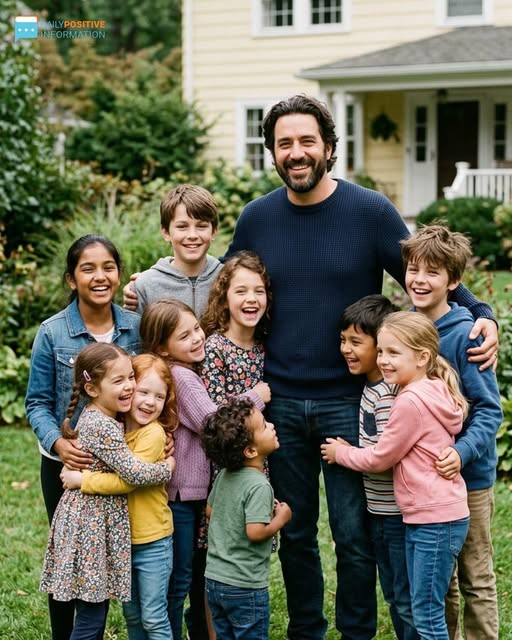
By 7 a.m., the house was already in chaos. I had burned a batch of toast, signed three school permission slips, found Sophie’s missing shoe in the freezer, and had to explain—again—to Jason and Evan that a spoon is not a weapon, no matter how aggressively you hold it.
I’m forty-four years old, and for seven years I’ve been raising ten children who are not biologically mine.
“Dad!” Katie shouted from the hallway. “Sophie says my braid looks like a mop!”
I glanced up while packing lunches. “That’s because Sophie is nine and a menace.”
Sophie appeared in the kitchen doorway, cereal bowl in hand, completely unfazed.
“I didn’t say mop,” she corrected. “I said tired mop.”
This is my life now. On good days, it feels like the best thing I’ve ever done. On hard days—and there are still plenty—I go back to the beginning, to the night that split everything into before and after.
What the police found that night—and the little girl walking barefoot
Calla was supposed to be my wife.
Seven years ago, she was the center of our loud, messy, beautiful household in rural Tennessee—the woman who could quiet a crying child with a hum and end a fight between siblings with just a look. Ten kids. A blended family we were still building. A wedding that wasn’t official yet but already felt real.
Then one November night, everything fell apart.
Police found Calla’s car near a river bridge. The driver’s door was open, her purse was inside, and her coat was carefully placed on the railing. Everything about it pointed to a single conclusion.
They found Mara hours later, walking barefoot down a road in the dark. She was eleven. Silent. Shaking.
She didn’t speak for weeks.
When she finally did, it was always the same words.
“I don’t remember, Dad.”
The search lasted ten days. No body was ever found. Still, we held a funeral. A symbolic goodbye surrounded by ten children trying to understand something that didn’t make sense. And I stood there trying to hold all of them—and myself—together.
My brother told me I was destroying my life by keeping them.
“Loving them is one thing,” he said. “Raising ten kids alone is another.”
He wasn’t wrong about the difficulty. But I couldn’t abandon them. So I learned everything on the fly—braiding hair at midnight, cutting boys’ hair badly until I got better, memorizing schedules, managing chaos, figuring out which child needed silence and which needed comfort food cut into shapes.
I didn’t replace Calla. I just stayed.
The morning Mara asked to talk
Seven years later, life wasn’t easier—but it was familiar.
While making lunches, Mara came beside me, quietly helping Sophie’s bag. She wasn’t like the others in that moment. Something was off.
“Dad,” she said. “Can we talk tonight?”
I looked at her. “Of course. Everything okay?”
She held my eyes a little too long.
“Tonight,” she repeated.
Then she walked away.
That single word stayed with me all day.
What she told me in the laundry room
After dinner, I found her sitting in the laundry room, curled on top of the dryer. She looked steady on the outside, but I knew that expression—she was carrying something heavy.
“Dad,” she said softly.
“What is it, sweetheart?”
She took a slow breath.
“This is about Mom.”
My chest tightened. “What about her?”
Her voice shook slightly. “Not everything I told you back then was true.”
I froze. “What do you mean?”
She looked down. “I didn’t forget, Dad.”
The words hit harder than anything else.
“I remember everything.”
A silence filled the room.
“She wasn’t in the river,” Mara said. “That’s not what happened.”
My mouth went dry. “Then what are you saying?”
Her voice broke, but she kept going.
“She left.”
She explained it piece by piece—how Calla had parked near the bridge, staged the scene, left her coat and purse behind. How she told Mara she needed her to be brave. How she said she was leaving because she couldn’t fix her life anymore, that someone else would help her start over.
“She told me if anyone knew she left on purpose, they would hate her forever,” Mara whispered.
I couldn’t move.
“She made me swear,” she said. “I was eleven. I thought I was protecting everyone.”
I pulled her into my arms as she finally broke down.
And everything I believed about those years began to shift.
The box
“When did you know she was alive?” I asked quietly.
“Three weeks ago.”
Mara pointed to a shelf above the washer. “There’s a box.”
Inside was an envelope and a photo.
Calla.
Older. Changed. Standing next to a man I didn’t recognize, smiling like someone who had escaped a life she didn’t want to be part of anymore.
“She contacted you?” I asked.
Mara nodded. “She said she was sick. She wanted to explain before things got worse.”
I closed the box slowly.
“I’ll handle it,” I said. “I promise.”
Mara looked at me for a long moment—still unsure, still wounded.
Then she nodded.
What the Family Lawyer Said the Next Morning — and the Motion That Changed Everything
After school drop-off the next day, I sat across from a family attorney named Denise and recounted everything in barely ten minutes. When I finished, she stayed quiet for a moment, then folded her hands neatly on the desk.
“You are their legal guardian,” she said at last. “Calla has been legally presumed dead. If she tries to re-enter the children’s lives, you have the right to set strict boundaries. Especially with minors involved. Their emotional stability carries real legal weight.”
“So I can protect them from this?”
“Absolutely. I’ll prepare the paperwork tonight.”
By the next afternoon, Denise had filed official notice: any communication involving the minor children would go through her office first. Not through Mara. Not through me directly. Through legal channels only—on paper, documented, controlled, and paced in a way the children could emotionally handle, if that moment ever came.
It wasn’t a wall. It was a gate—and I was the one holding it closed.
The Meeting in the Church Parking Lot — and What Calla Said That Told Me Everything
Three days later, I met Calla in a church parking lot halfway between our town and wherever she now lived. I chose the place carefully. Neutral ground. Far from my kids, my home, my life.
She stepped out of a silver sedan and looked at me like someone facing a reflection they had long avoided.
“Hank.”
“You don’t get to say my name like that, Calla.”
She looked older. Worn in a way that offered no satisfaction—only distance.
“I know you hate me,” she said quietly.
“Hate would be simpler.”
Tears gathered in her eyes. “I thought they would move on. The kids. And you—I thought you could give them the kind of life I couldn’t.”
Something bitter rose in me, but I kept my voice steady.
“You don’t get to call this sacrifice. You didn’t just leave ten children. You made one of them carry your lie and called it love.”
She went still.
“I never wanted to hurt Mara.”
“Then why contact her first?” I asked.
Her face collapsed.
“Because I knew she might respond.”
And that said everything. She hadn’t reached out to Mara out of love or instinct. She had chosen her because, years ago, she had already conditioned that child to carry unbearable truths alone. She picked the one she knew would answer.
“Of course,” I said. “You went back to the child you trained to hold your guilt.”
She began crying, but I could still see the same fragility she had always known how to use. Then I saw Mara at eleven again—barefoot, shaking on a dark road, swallowing a secret no child should ever carry.
That memory steadied me.
“You let us bury you without a body,” I said. “You let ten children grow up believing their mother drowned. You let one of them carry that lie through every birthday, every nightmare, every year of her childhood.”
“I was drowning,” she whispered. “In debt, in mistakes—”
“You were an adult. She was eleven.”
Silence stretched between us.
“If the kids ever hear anything,” I said, “they hear the full truth. Not the version that makes you easier to forgive. And all contact goes through my attorney.”
Her hand went to her mouth. “Can I explain to them someday?”
“Maybe,” I said. “When it serves them more than it serves you. Are you actually sick? Or did you lie to her about that too?”
She broke down harder. That was answer enough.
“I’m not sick,” she admitted. “I just… I’ve been thinking about them. Dreaming about them. I wanted—”
I turned and walked back to my truck. I drove home with the windows cracked open despite the cold, just to breathe something real.
That Night at the Kitchen Table — and What Mara Finally Heard
That evening, Mara sat beside me while the younger kids colored placemats at the table, the kind of quiet activity that fills a house when adults are trying to hold themselves together.
“What did she say?” she asked.
“She thought you’d all move on.”
Mara stared at her hands. “I never did, Dad.”
I placed my hand over hers.
“You don’t have to carry her anymore.”
“But she said she was sick.”
“That wasn’t true. I asked her directly. She admitted it.”
Mara exhaled slowly, then squeezed my hand.
“Thanks, Dad.”
Just two words—but they sounded like someone finally putting down a weight they had carried for years.
The Conversation in the Living Room — Seven Years of Truth, Finally Spoken
Two weeks later, after Denise helped me figure out how to speak to them honestly, I gathered all the kids in the living room.
Jason picked at a seam in the couch. Katie clutched a stuffed rabbit so tightly its ear bent. Sophie stayed pressed against Mara’s side. Evan stood near the wall with his arms crossed, bracing himself the way he always did.
“I need to tell you something about Mom,” I said.
No one moved.
Sophie whispered, “Did she die again?”
My chest tightened. Even Mara almost laughed through tears at that.
“No, sweetheart,” I said gently. “But she made a very bad choice a long time ago, and you deserve the truth.”
I told them plainly: Calla hadn’t drowned. She had left. She had made us believe something else because she was overwhelmed, afraid, and not thinking about the cost to the people she left behind. I didn’t soften it. I didn’t decorate it.
Evan’s jaw tightened. “She didn’t love us, did she?”
“That’s not the lesson here,” I said. “People can fail in huge ways. They can make selfish choices and leave. But none of that defines you. None of it is your fault.”
“Is she coming back?” he asked.
“Not unless it’s something that actually helps you. And that’s my decision to make—not hers.”
Then I turned to Mara and took her hand in front of everyone.
“And I need you all to understand something. Mara was a child. She was asked to carry a lie that was never hers. Nobody in this house blames her. Ever.”
Evan looked at her for a long moment, then said quietly:
“I’m glad she’s gone. We’ve got you, Dad.”
Katie stood up first and hugged Mara. Jason followed. Sophie climbed into her lap without hesitation. One by one, they gathered around her.
And I stood there, watching my kids hold each other, realizing something simple and true:
The life we built after Calla wasn’t a replacement.
It was its own story.
And it was ours.
What Mara Asked Me Later That Night — and the Only Answer That Felt True
Later, after the little ones were finally asleep and the house had settled into silence, Mara found me in the kitchen rinsing out the last of the dinner dishes. She lingered in the doorway for a moment before speaking.
“If she comes back someday and asks to be Mom again… what do I say?”
I turned off the faucet and dried my hands slowly.
“The truth,” I said.
“Which is?”
I looked at her for a moment.
“She gave birth to you. But I raised you. Those are not the same thing, sweetheart.”
Mara nodded slowly, as if something inside her was quietly falling into place after being unsteady for a long time.
By then, everyone in that house understood what actually makes a parent.
It isn’t biology. It’s the burned toast on busy mornings. It’s the shoe in the freezer, the spoon that isn’t a weapon, the lunches packed day after day for years. It’s showing up in the laundry room when someone finally decides they’re ready to speak. It’s staying when someone else chose to leave.
I have ten children. I didn’t raise a single one of them by blood, and in seven years I have never once felt that as something missing.
Sometimes a family isn’t something you plan. Sometimes it’s something that arrives in the middle of chaos and you choose to stay anyway.
And that… is the whole story.