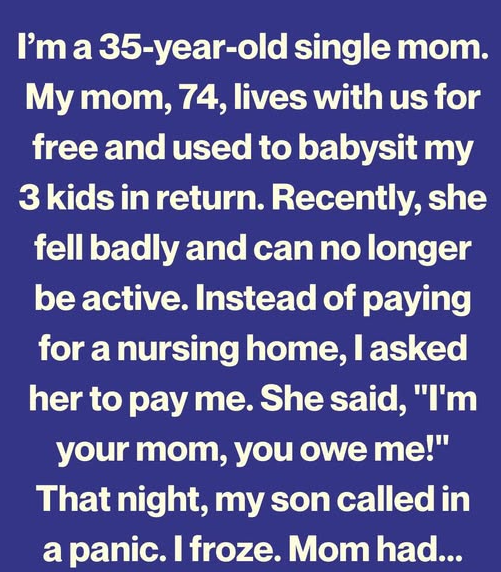
My name is Nancy. I’m thirty-five, raising three kids by myself — a seven-year-old, a three-year-old, and a baby who still wakes twice before morning. My life hasn’t felt steady in years; it has always been a storm I learned to walk through, step by step, the way tired mothers do: paying one bill, calming one tantrum, solving one emergency at a time. My seventy-four-year-old mother lived with us, stubborn, opinionated, and set in her ways. She watched the kids while I worked, and in return she stayed here without paying rent. It wasn’t ideal, but it was the small, fragile balance we’d built — a home held together by routine, sacrifice, and a love so constant we rarely named it aloud.
Then she slipped.
Just a bit of water on the kitchen floor, a fall that happened in seconds — but the consequences unfolded like an earthquake. Pain struck her back and hip so sharply she could barely move. In a single night, I went from caring for three children to caring for four — except this time the adult needed as much help as the toddler. I wanted to be capable of everything, but the truth was cruel: I was cracking under the weight.
Our home turned into a one-woman emergency ward. Feed the baby. Help my mother sit up. Mediate an argument. Try to answer work emails with one hand. Guide my mother to the bathroom. Rock the baby with my foot while folding laundry. Wipe away tears — theirs, and sometimes mine. My energy, already stretched thin, finally began to tear.
I suggested a nursing home gently — not as abandonment, but as support. She refused instantly.
“I’m not being dumped somewhere to die,” she snapped.
So I tried another way. “Mom, maybe you could help financially? Just enough so I can hire someone a few hours a week. I need to keep working. I can’t manage this alone.”
Her face hardened. Her voice shook with something sharp and ancient.
“I’m your mother. You owe me. After everything I’ve done for you.”
Those words hit harder than if she’d shouted. Not because they were cutting, but because they were familiar. My whole adulthood, I’d tried to ignore the unspoken truth that in my family, love was often tangled with obligation.
We didn’t fight after that. We simply drifted away from each other in the same house. She barely talked. I walked on eggshells, terrified that any wrong step would make things worse.
And then everything fell apart at once.
One evening, I was feeding the baby when my seven-year-old came racing downstairs, breathless.
“Mom! Grandma’s leaving!”
I ran up the stairs. Through the window, headlights splashed across the driveway. A transport van from a nursing home waited outside. My mother stood beside it, gripping her purse, one hand shaking on the railing. She had called them herself.
I rushed down — and then stopped cold.
Something about the hallway felt… wrong. Oddly empty. Too empty.
Her bedroom door was open.
Half her things were gone.
Her boxes, her scarves, her framed photographs — everything had vanished. But it wasn’t just her belongings. The baby’s crib — the one she had gifted us years ago — was gone too. She had taken back everything she saw as “hers,” as if trying to rebuild proof that she still mattered.
Movers had come while I was out buying groceries. She hadn’t said a single word.
I ran outside. “Mom, what is going on? Why didn’t you talk to me?”
She kept her gaze fixed straight ahead, jaw tight. “This is what you wanted,” she said. “You asked me for money because you wanted me gone. So I made it easier for you.”
“That’s not true,” I said, voice cracking. “I was begging you for help because I can’t care for everyone alone. I’m trying to keep us all afloat.”
She finally looked at me — her expression a storm of sadness and wounded pride. “I took care of your children for years. I gave you a place to land when your husband left. And the moment I can’t carry the load anymore, you want me to pay for existing. You’re ungrateful, Nancy.”
Her voice broke. Beneath the anger, I heard it clearly — the fear that she was becoming useless. That losing her independence meant losing her place in my life.
The van door closed. The engine rumbled. And she was gone.
The house afterward felt wrong — as if the walls themselves had sagged. The kids kept asking when Grandma would come back. I didn’t have an answer. I wasn’t sure she ever would.
That night, I wandered through the rooms, staring at the empty spaces, the missing crib, the blank spots where her slippers used to rest. Grief and resentment twisted together inside me so tightly I wasn’t sure which feeling belonged to me anymore.
Had I pushed her away?
Had she misunderstood everything?
Or had years of exhaustion turned our love into something brittle?
The truth settled in slowly, painfully: my mother had acted out of fear, not cruelty. Losing independence is terrifying. Being asked to contribute financially — even reasonably — pierced something deep and vulnerable in her, something tied to aging, usefulness, identity.
But there was another truth: I hadn’t acted out of selfishness. I was drowning. Exhaustion had become my default state. I needed help, not accusations. Support, not guilt.
Love between us had stretched too far, frayed until it finally snapped.
Now she is in a room somewhere being tended by strangers, and I’m here trying to keep the house running without her steady presence. Neither of us wanted this ending. Neither of us knew how to stop the collapse.
So I replay everything — the fall, the words, the silences — asking myself impossible questions:
Was I wrong for needing help?
Or was she wrong for turning love into a ledger?
Maybe neither of us was wrong.
Maybe we were simply human.
Two women carrying too much.
Two hearts overwhelmed by different kinds of fear.
Two lives colliding at the breaking point.
And maybe that’s what love sometimes becomes when life pushes it past its limits — not hatred, not abandonment, but heartbreak shaped like anger, silence filled with longing, and two people wishing they had found softer words before everything fell apart.