Two years after losing my wife and my six-year-old son, I was still breathing—but that was about all I could say for myself.
I went to work. I answered emails. I paid bills. I moved through each day like someone completing a list of tasks that no longer meant anything. People told me I was strong. They said I was “holding it together.”
I wasn’t.
I was just still here.
My name is David Ross. I’m forty years old, and everything I once called my life ended in a single moment—a moment that began in a hospital hallway, when a doctor walked toward me, removed his glasses, and said the words no one is ever ready to hear:
“I’m so sorry.”
Before that moment, my world was full.
There was laughter in my kitchen. My wife, Lauren, humming softly while making coffee. My son, Jacob, leaving Lego pieces scattered across the floor like tiny landmines. Bedtime arguments. Weekend routines. Small, ordinary frustrations that didn’t seem important then—but meant everything later.
After that moment, there was only silence.
Lauren and Jacob had been driving home from a birthday party when a drunk driver ran a red light. The impact was immediate. Final.
“They didn’t suffer,” the doctor told me.
People always say that.
As if it helps.
It doesn’t.
After the funeral, the house no longer felt like home. It felt like a place frozen in time. Lauren’s mug still sat beside the coffee maker. Jacob’s shoes were still by the door. His drawings were still on the fridge—bright and innocent in a space that had gone completely still.
I couldn’t sleep in our bed.
It was too quiet.
Too empty.
So I moved to the couch. Every night, I left the TV on—not to watch it, but to fill the silence. Any noise was better than the emptiness that had settled into every room.
That’s how I lived for a year.
Not healing.
Not moving forward.
Just existing.
Then one night, sometime after 2 a.m., I was scrolling through social media without thinking, without purpose—until something stopped me.
A post.
“Four siblings urgently need a home.”
There was a photo.
Four kids sitting close together, almost pressed into one another, like they were trying to take up less space in the world. None of them were smiling. The oldest boy had his arm wrapped protectively around the others. The youngest clutched a stuffed toy like it was the only thing keeping them steady.
I read the caption.
Their parents had died.
There were no relatives willing to take all four.
If no one stepped forward, they would be separated.
That word hit me harder than anything else.
Separated.
I zoomed in on the picture.
They weren’t just scared.
They were preparing.
For another loss.
I kept scrolling through the comments.
“Praying.”
“So heartbreaking.”
“Shared.”
But no one said what actually mattered.
No one said, “I’ll take them.”
I stared at that screen longer than I expected.
Because I knew what it felt like to lose everything in a single moment.
And I couldn’t ignore it.
The next morning, I made the call.
“Are they still available?” I asked.
“Yes,” the woman replied.
“I’ll take them.”
There was a pause.
“All four?”
“Yes.”
“Why?”
I didn’t tell her the truth—that my house felt like it was closing in on me, that the silence was suffocating, that I needed something to keep me from disappearing into it.
I just said, “They’ve already lost enough. They shouldn’t lose each other too.”
The process wasn’t easy.
There were background checks, home inspections, interviews, therapy sessions.
“Do you really think you can handle four grieving children?” a counselor asked.
“I don’t know,” I said honestly.
“But I can love them.”
The first time I met them, they sat close together, like a single unit—quiet, guarded, watching me carefully.
“Are you taking all of us?” the oldest boy asked.
“If you want me to,” I said.
The girl next to him looked at me skeptically. “What if you change your mind?”
“I won’t,” I said.
“You’ve had enough people do that already.”
Months later, it became official.
The day they moved in, everything changed.
Shoes piled up by the door. Backpacks landed in the hallway. Voices filled rooms that had been silent for far too long.
It wasn’t peaceful.
It was loud.
Messy.
Alive.
But it wasn’t easy.
Emma cried herself to sleep some nights.
Miles tested every limit, like he was waiting for me to give up.
Aria watched everything I did, as if expecting me to fail.
Lucas, the oldest, carried too much—trying to be strong in ways no child should have to.
There were moments I doubted everything.
Nights I locked myself in the bathroom just to breathe.
Moments when I thought, I’m not enough for this.
But slowly, things began to change.
Emma fell asleep on my chest one night, her breathing calm, trusting.
Miles handed me a drawing—five stick figures holding hands.
Aria asked me to sign a school paper… with my last name.
Lucas said, “Goodnight, Dad,” then froze, like he wasn’t supposed to say it.
I pretended not to notice.
But later, when I was alone, I broke down.
Because something had shifted.
We weren’t just surviving anymore.
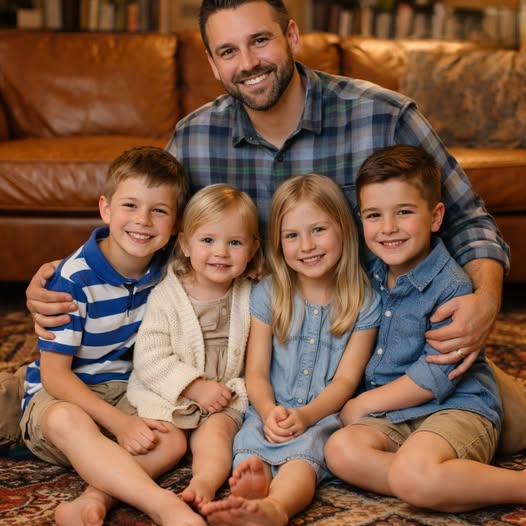
We were becoming a family.
A year passed.
It wasn’t perfect.
But it was full.
Then one morning, everything shifted again.
There was a knock on the door.
A woman stood there in a suit, holding a folder.
“I’m the attorney for their biological parents,” she said.
My chest tightened.
“They left a trust,” she explained. “A house. Savings. It all belongs to the children.”
I nodded, trying to take it in.
Then she added, “They made one thing very clear… they never wanted their children to be separated.”
I stood there, speechless.
Because without even knowing…
I had done exactly that.
I had honored their final wish.
That weekend, I took the kids to see the house.
Their house.
“I remember this,” Aria said quietly.
Lucas stood still, taking it all in. “This was our home.”
They walked through slowly, touching walls, remembering pieces of a life they had lost.
“Do we have to move back?” Lucas asked softly.
I looked at him.
“No,” I said. “We stay together. That’s what matters.”
That night, I sat on the couch, listening to the sound of four kids sleeping down the hall.
Breathing.
Alive.
Together.
I lost everything once.
And that loss will always stay with me.
But now, there are four toothbrushes in the bathroom.
Four voices calling, “Dad!”
Four lives that somehow found their way back to something whole.
I didn’t do this for money.
I didn’t know about the house.
I did it because four siblings were about to lose each other.
Their parents made a final wish.
And somehow…
Without ever hearing it…
I answered.
Now, when they pile onto the couch during movie nights—arguing over popcorn, laughing too loud, turning chaos into something beautiful—I look around and understand something I never expected.
This isn’t what I lost.
This is what I found.
A second chance.
A different kind of love.
And a promise that was kept.
Because in the end…
It was never just about saving them.
We saved each other.