Two years after losing my wife and my six-year-old son, I was still alive—but that was about all I could say with certainty.
I functioned.
I went to work. Answered emails. Paid my bills. From the outside, it probably looked like I was holding everything together. People called me strong. They said I was “moving on.”
They were wrong.
I wasn’t moving forward.
I was just… existing.
My name is David Ross. I’m forty years old, and the life I once knew ended in a single moment—one that began in a hospital hallway, when a doctor walked toward me, took off his glasses, and said words that don’t just break you… they erase you.
“I’m so sorry.”
Before that, my life had been full.
My wife, Lauren, used to hum while making coffee. My son, Jacob, left Lego pieces scattered across the floor like little traps I never minded stepping on. We had routines—simple, ordinary ones—that I never realized meant everything.
After that moment, there was nothing.
Lauren and Jacob were driving home from a birthday party when a drunk driver ran a red light. The crash was instant. Final.
“They didn’t suffer,” the doctor said.
People always say that, as if it helps.
It doesn’t.
After the funeral, the house stopped feeling like home. It felt frozen. Untouched.
Lauren’s mug stayed beside the coffee machine. Jacob’s shoes were still by the door. His drawings hung on the fridge—bright colors in a place that had gone completely silent.
I couldn’t sleep in our bed.
It felt wrong.
Too empty. Too big.
So I moved to the couch, leaving the TV on every night—not to watch, but just to create noise. Anything to break the silence that had taken over my life.
That’s how I lived for a year.
Not healing.
Not rebuilding.
Just… staying alive.
Then one night, sometime after two in the morning, I was scrolling through my phone without thinking—just passing time—when something stopped me.
A post.
“Four siblings urgently need a home.”
There was a photo.
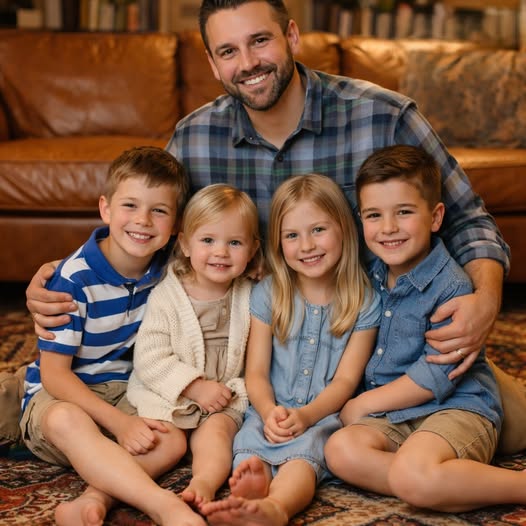
Four children sitting close together, almost pressed into one another, like they were trying to disappear. None of them were smiling. The oldest boy had his arm wrapped around the others, holding them like it was his responsibility. The youngest held a stuffed animal tightly, like it was the only thing keeping her steady.
I read the caption.
Their parents had died.
No relatives were willing to take all four.
If no one stepped forward, they would be separated.
That word hit me hard.
Separated.
I zoomed in on their faces.
They weren’t just scared.
They were bracing for another loss.
I looked through the comments.
“Praying.”
“So sad.”
“Shared.”
Plenty of sympathy.
No action.
No one saying, “I’ll take them.”
I stared at the screen longer than I expected.
Because I knew exactly what it felt like to lose everything in a single moment.
And I couldn’t ignore it.
The next morning, I made the call.
“Are they still available?”
“Yes,” the woman said.
“I’ll take them.”
There was a pause.
“All four?”
“Yes.”
Another pause.
“Why?”
I didn’t tell her the truth—that my house felt empty, that silence was slowly breaking me, that I needed something to hold onto.
I just said, “They’ve already lost enough. They shouldn’t lose each other too.”
The process wasn’t easy.
Background checks. Home visits. Interviews. Counseling.
“Do you really think you can handle four grieving children?” a counselor asked me.
“I don’t know,” I admitted.
“But I know I can love them.”
The first time I met them, they sat close together—quiet, guarded, watching me carefully.
“Are you taking all of us?” the oldest boy asked.
“If you want me to,” I said.
The girl beside him frowned. “What if you change your mind?”
“I won’t,” I told her. “You’ve had enough people do that already.”
It took time, but eventually, everything became official.
The day they moved in, the house changed instantly.
Shoes by the door. Backpacks in the hallway. Voices filling rooms that had been silent for too long.
It wasn’t calm.
It was loud.
Messy.
Alive.
But it wasn’t easy.
Emma cried herself to sleep some nights.
Miles tested every limit, like he was waiting for me to give up.
Aria watched me constantly, waiting for proof that I was like everyone else who had left.
Lucas, the oldest, carried too much—trying to be strong in ways no child should.
There were nights I locked myself in the bathroom just to breathe.
Moments I thought, I can’t do this.
But then, slowly, things began to change.
Emma fell asleep on my chest one evening, calm and trusting.
Miles gave me a drawing—five stick figures holding hands.
Aria asked me to sign a school form… with my last name.
Lucas said, “Goodnight, Dad,” then froze, unsure if he’d gone too far.
I pretended not to react.
But later, I broke down.
Because something had shifted.
We weren’t just getting by anymore.
We were becoming something real.
A family.
A year passed.
Not perfect.
But full.
Then one morning, there was a knock at the door.
A woman stood there, dressed professionally, holding a folder.
“I’m the attorney for their biological parents,” she said.
My chest tightened.
“They left behind a trust,” she continued. “A home. Savings. It all belongs to the children.”
I nodded, trying to take it in.
Then she added, “They made one thing very clear—they never wanted their children separated.”
I couldn’t speak.
Because without knowing it…
I had honored their final wish.
That weekend, I took the kids to see the house.
Their house.
Aria walked in slowly, touching the walls.
“I remember this,” she whispered.
Lucas stood in the doorway.
“This was our home.”
They moved through each room carefully, piecing together memories.
“Do we have to move back?” Lucas asked quietly.
I looked at him.
“No,” I said. “We stay together. That’s what matters.”
That night, I sat on the couch, listening to four kids sleeping down the hall.
Breathing.
Safe.
Together.
I lost everything once.
And that loss will always stay with me.
But now there are four toothbrushes in the bathroom.
Four voices calling me “Dad.”
Four lives that found their way back to something whole.
I didn’t do this for money.
I didn’t know about the house.
I did it because four kids were about to lose each other.
Their parents had a final wish.
And somehow…
Without ever hearing it…
I fulfilled it.
Now, when we sit together during movie nights—arguing over snacks, laughing too loud, turning chaos into something beautiful—I look around and understand something I never expected.
This isn’t what I lost.
This is what I found.
A second chance.
A different kind of love.
And a promise that was kept.
Because in the end…
It was never just about saving them.
We saved each other.