The alarm rang at 4:30 a.m., just like it had every weekday for the past six years. I shut it off, swung out of bed, and walked barefoot through our small house in the dark. Steven was still recovering from his hernia surgery, and I could hear his quiet breathing from the bedroom while I pulled on my work boots in the kitchen.
I’m Abbie. I’m 41 now, but this story begins when I was 29, working in city sanitation. Yes, I drive one of those large garbage trucks—the kind that rumbles through your street at ungodly hours and wakes up every dog in the neighborhood. It’s not glamorous work, but it’s steady, and it paid our bills when Steven was between jobs or dealing with health problems.
That Tuesday morning in particular was the kind of cold that makes you question every decision that led you to be outside before sunrise. The kind where your breath freezes in the air and your fingers go numb even through gloves. I had already changed Steven’s bandages, made sure he had water and his pain medication within reach, and kissed his forehead before I left.
“Go save the city from banana peels, Abbie,” he had mumbled, trying to smile through the pain.
I remember laughing, grabbing my thermos of coffee, and stepping into the freezing darkness. Life was simple then. Exhausting, yes—but simple. We had our little house with the dripping bathroom faucet we kept meaning to fix. We had bills that always seemed to arrive faster than our paychecks. We had each other.
What we didn’t have were children. And there was a quiet, constant ache between us about that—the kind of sadness you learn to carry like a stone in your pocket, always there, always heavy, but something you just live with.
The Stroller That Changed Everything
I was about two hours into my route, humming along to an old country station on the radio, when I turned onto Maple Street. It was a quiet residential neighborhood, the kind where lawns are neatly trimmed and trash bins are always put out on time. Nothing ever happened there.
That’s why the stroller stopped me instantly.
It was sitting right in the middle of the sidewalk. Not beside a house. Not near a car. Just left there in the cold, dark pre-dawn air.
My stomach dropped immediately. You don’t work early mornings in this job without developing a sense for when something is very, very wrong.
I slammed the truck into park, turned on the hazard lights, and climbed down quickly, my hands already shaking as I stepped into the freezing air, my breath disappearing in white clouds.
As I got closer, my heart started pounding so hard I thought it would break my ribs.
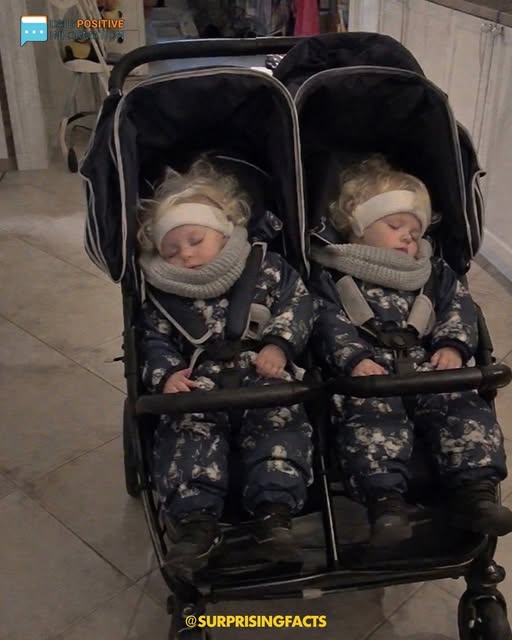
Two babies. Twin girls, I guessed—maybe six months old. They were wrapped in mismatched blankets, one covered in cartoon elephants, the other plain blue. Their cheeks were pink from the cold, and tiny puffs of breath escaped their lips.
They were alive. Thank God—they were alive.
“Hey, sweet girls,” I whispered, my voice breaking. “Where’s your mom?”
I looked up and down the street. Nothing. No cars. No open doors. No running footsteps. No sign of anyone. Just silence, streetlights, and these two tiny human beings left behind as if they were nothing.
One of the babies opened her eyes and looked straight at me. Just stared—those huge dark eyes studying me as if trying to decide whether I was safe.
My hands shook as I reached for the diaper bag hanging on the stroller handle. Inside was half a can of formula, maybe three diapers, and nothing else. No note. No ID. No explanation. Nothing to tell me who they were or why they were there.
Nothing to tell me where their mother had gone.
The Call That Changed Everything
I pulled out my phone with trembling hands and called 911. The dispatcher picked up on the second ring.
“Hi, I’m on my garbage route,” I said, my voice shaking. “There’s a stroller on Maple Street with two babies inside. They’re alone. It’s freezing outside.”
The tone on the other end changed immediately—from routine to urgent focus.
“Stay with them,” she said firmly. “Police and Child Protective Services are on the way. Are they breathing?”
“Yes,” I said, looking down at their tiny faces. “But they’re so small. I don’t know how long they’ve been out here.”
She guided me through what to do. I carefully pushed the stroller against a brick wall to shield them from the wind, then started knocking on nearby doors.
Several houses had lights on. I saw curtains move as people peeked out. But no one opened their door. No one came outside. No one wanted to get involved.
So I went back to the stroller and sat on the freezing curb beside it. I pulled my knees to my chest and began speaking softly to the two babies who, somehow, had become the most important thing in my life within minutes.
“It’s okay,” I whispered, even though they couldn’t understand me. “You’re not alone anymore. I’m here. I’m not leaving.”
They stared at me with those wide eyes, and I swear something passed between us in that moment. Something unspoken. Something real that I can’t explain but could absolutely feel.
Police arrived first—two officers in a patrol car who took my statement while checking the babies. Then came CPS, a woman named Sandra, tired-eyed and wearing a beige coat, holding a clipboard and carrying the look of someone who had seen too much of this kind of thing.
She carefully examined the babies and asked me detailed questions about when I found them and their condition. I answered like I was in a fog, feeling as though I was watching everything happen to someone else.
When she lifted one baby in each arm and carried them toward her car, something inside my chest physically broke. Like my heart had been grabbed and squeezed.
“Where are they going?” I asked, hating how desperate my voice sounded.
“To a temporary foster placement,” Sandra said gently. “We’ll try to locate family. They’ll be safe tonight, I promise.”
The car doors shut. The vehicle drove away. And the stroller remained there, empty on the sidewalk—a silent reminder that someone’s children had been discarded like they meant nothing.
I stood there a long time, watching my breath fade into the cold air, feeling something inside me split wide open.
I Couldn’t Stop Thinking About Them
I finished my route on autopilot. I picked up trash, drove the truck, went through every motion I’d done a thousand times before. But my mind wasn’t there. It was stuck in that moment—two tiny faces staring up at me from under mismatched blankets.
That evening at dinner, I kept pushing food around my plate until Steven finally set his fork down and looked at me properly.
“Alright,” he said. “What’s going on? You’ve been miles away all day.”
So I told him. The stroller. The freezing air. The babies. The way it felt watching CPS drive off with them.
“I can’t stop thinking about them,” I said, my voice cracking. “They’re out there somewhere now. What if no one takes them? What if they’re separated? What if they spend their whole lives bouncing from home to home?”
Steven went quiet. He had that habit of turning things over carefully before speaking, like he was weighing stones in his hands.
“Abbie,” he finally said, “we’ve always talked about wanting kids.”
I gave a short, humorless laugh. “Yeah. And then reality shows up in the form of our bank account.”
“True,” he admitted. “But… what if we tried to foster them? Just asked.”
I stared at him like he’d suggested something impossible.
“They’re babies, Steven. Twins. We’re barely holding things together as it is.”
He reached across the worn kitchen table and took my hand. His grip was steady.
“You already love them,” he said quietly. “I can see it. Let’s at least try.”
The Process of Becoming Their Family
That night we didn’t sleep. We stayed up until nearly 3 a.m., switching between tears, planning, and sheer panic about whether we were completely out of our minds. By morning, we were exhausted—but certain.
I called CPS as soon as the office opened. The process began immediately: home inspections, interviews, background checks, financial reviews. They asked about everything—our marriage, our upbringing, our struggles, our support system. They checked our fridge, our medicine cabinet, even the cracked tile in the bathroom.
Nothing was too small. Everything mattered.
A week later, Sandra returned to our worn couch, clipboard in hand. But her expression was different this time—more careful. Heavier.
“There’s something you need to know about the twins,” she said.
My stomach tightened. Steven instinctively reached for my hand.
“What is it?” I asked.
“They’re deaf,” she said gently. “Profoundly deaf. Both of them. They’ll need early intervention, speech therapy, sign language, specialized schooling. A lot of families back out when they hear that.”
I looked at Steven.
He didn’t hesitate.
I turned back to her.
“I don’t care that they’re deaf,” I said firmly. “I care that someone left them in the cold. We’ll learn whatever they need.”
Steven nodded. “We still want them. If you’ll let us.”
Sandra’s shoulders eased slightly, relief showing in her face.
“Alright,” she said softly. “Then we move forward.”
Welcome Home, Hannah and Diana
A week later, they brought the girls to us. Two car seats. Two diaper bags. Two wide, curious pairs of eyes taking in everything at once.
“We’re naming them Hannah and Diana,” I said, my hands trembling as I tried to sign it. I’d been practicing for days, but my fingers still felt stiff and unsure.
“Get ready for no sleep,” Sandra said with a tired smile. “And a lot of paperwork. A lot.”
The first months were chaos—but the kind that slowly turns into love.
Two babies who didn’t react to sound. Who slept through sirens and barking dogs. But who noticed everything else—the movement of hands, expressions, light, touch.
We dove headfirst into learning American Sign Language. Classes three nights a week. Late-night YouTube tutorials. Repeating the same signs over and over until our hands finally understood what our minds were trying to say.
“Milk. More. Sleep. Mom. Dad.”
Sometimes I got it wrong. Steven once laughed so hard he had to pause when I accidentally signed “potato” instead of “pacifier” to Diana.
We learned to laugh. And keep going.
Hannah was the quiet observer, always studying faces like they were books she was trying to understand. Diana was pure motion—grabbing, kicking, exploring everything without hesitation.
Money got tighter. I worked extra shifts. Steven did freelance data entry at home, one hand on the keyboard, the other holding a baby. We sold furniture. Bought secondhand clothes. Learned how to stretch every dollar until it hurt.
We were exhausted in a way I didn’t know was possible.
And somehow… happier than I had ever been.
Watching Them Grow Into Themselves
The first time they signed “Mom” and “Dad,” I almost collapsed from emotion.
Hannah touched her chin—the sign for mother—and pointed at me, smiling so wide her whole face lit up.
Diana copied her sister immediately, clumsy but proud, her tiny hands full of determination.
“They know,” Steven signed, tears on his face. “They know we’re theirs.”
We celebrated their first birthday with too many cupcakes and too many photos. Their drawings went on the fridge. We fought for interpreters in school, for proper accommodations, for people to take them seriously.
We fought a lot.
Once, a woman in a store watched us signing and asked, “What’s wrong with them?”
I stood up straight and looked at her.
“Nothing,” I said. “They’re deaf. Not broken.”
Years later, when the girls were old enough to understand, I signed that moment to them. They laughed so hard they nearly fell off the couch.
Time moved fast after that. School, friendships, growth. Hannah fell in love with fashion design—her walls filled with sketches. Diana leaned toward engineering, building things constantly out of whatever she could find.
They signed constantly. Fast, expressive, alive. They had their own private language even within ASL, jokes only they understood. Sometimes they’d glance at each other and break into silent laughter that filled the room without sound.
By twelve years old, they weren’t just growing up.
They were becoming their own storm.
The School Project That Changed Our Lives
They came home one afternoon with papers spilling out of their backpacks, excitement practically vibrating through them.
“We’re doing a contest at school,” Hannah signed, spreading her sketches across the kitchen table. “Design clothes for kids with disabilities.”
“We’re a team,” Diana added quickly, her hands moving with energy. “Her art. My ideas.”
They showed us what they’d been working on—hoodies designed with hidden pockets for hearing devices so they wouldn’t be visible or get tangled. Pants with side zippers for kids who struggled with buttons. Shirt tags placed in a way that wouldn’t irritate sensitive skin. Everything bright, fun, wearable. Not clinical. Not “medical.” Just clothes kids would actually want to wear.
“We won’t win,” Hannah signed with a shrug, though I could see the hope she was trying to hide. “But it’s still cool.”
They worked on it for weeks. Diana handled measurements and practical structure, figuring out fabrics and function. Hannah transformed those ideas into designs that looked like something you’d see in a store window—not a special category.
Then they submitted it, and life moved on. Trash routes. Bills. Homework. Dishes. ASL flying across the dinner table so fast I sometimes only caught fragments.
Until one Tuesday afternoon—exactly twelve years after I first found them—my phone rang while I was cooking.
Unknown number. I almost didn’t answer. Something made me pick up anyway.
“Hello?” I said, wooden spoon still in my hand.
“Hi, is this Mrs. Lester?” a woman asked warmly. “This is Bethany from BrightSteps.”
I froze. “Yes… that’s me. What is BrightSteps?”
“We’re an adaptive clothing company for children,” she explained. “We partnered with your daughters’ school for the design challenge. Hannah and Diana submitted a joint project.”
My chest tightened. “Yes. Did something happen? Are they in trouble?”
She gave a small laugh. “No, quite the opposite. Their work was exceptional. Our design team was genuinely impressed.”
I sank into a chair.
“They were just doing a school assignment,” I said slowly.
“Well,” she continued, “we’d like to turn that assignment into something real. A collaborative clothing line based on their designs—adaptive clothing for children with different needs.”
My mind went blank.
“A real line?” I repeated. “Like… actual products people would buy?”
“Yes, ma’am. It would be a paid collaboration. Design compensation plus projected royalties. Based on our current estimates, the total could be around $530,000 over time.”
I nearly dropped the phone. Everything blurred for a second.
“I’m sorry,” I whispered. “Did you say five hundred thirty thousand dollars?”
“That is our projection, yes,” she confirmed. “Final numbers depend on sales, of course. But that is the estimated range.”
All I could hear was my heartbeat.
“My daughters did that?” I said quietly.
“Yes,” she replied. “You’ve raised very talented young women. We would love to schedule a meeting—with certified interpreters so they can fully participate.”
The Moment We Told Them
I somehow finished the call. Wrote down the details. Asked for emails. My hands were shaking the entire time. Then I just sat there, staring at the kitchen wall.
Steven came in from the garage and stopped immediately.
“Abbie? You look like you’ve seen a ghost.”
I laughed, but it came out broken. “Closer to something impossible.”
He sat down next to me. “What happened?”
“That school project,” I said slowly. “A company wants it. A real contract. Real money. Life-changing money.”
I signed the number for him.
His mouth actually fell open.
“You’re kidding,” he said. “Please tell me this isn’t some scam.”
“I wish I was,” I said. “Steven… our girls—the ones someone once left in a stroller—they just changed their future.”
He pulled me into him, and we both started laughing and crying at the same time.
The back door slammed open.
Hannah and Diana came rushing in, backpacks hitting the floor, already signing complaints.
“We’re starving,” Diana signed dramatically. “Food. Now.”
“What’s wrong with your face?” Hannah signed, frowning at me. “You’ve been crying.”
I took a breath and signed: “Sit down. Both of you.”
They hesitated, exchanged a look, then sat—suddenly worried they were in trouble.
I signed carefully, slowly.
“Your school sent your project to a company. BrightSteps. They called me today.”
Their expressions changed instantly.
“Are we in trouble?” Hannah signed quickly. “Did we break a rule?”
“No,” I signed, shaking my head. “They loved it. They want to turn your designs into real clothes. And they want to pay you.”
“Pay us?” Diana signed, narrowing her eyes. “How much?”
I signed the number.
Silence.
Then, together:
“WHAT?!”
Hannah leaned forward. “You’re serious? You’re not joking?”
“Completely serious,” I signed. “There will be meetings, lawyers, interpreters—everything. Because you designed something that actually solves problems for kids like you.”
Diana’s eyes filled with tears.
“We just wanted to make clothes that don’t hurt,” she signed. “That don’t get in the way.”
“And that’s exactly why it matters,” I signed back. “You didn’t just design clothes. You made life easier for someone else.”
Two Girls Who Saved Me Right Back
They both threw themselves at me at once, nearly tipping the chair over. Arms tangled everywhere, three people trying to hold each other at the same time, tears spilling down all of our faces.
“I love you,” Hannah signed against my shoulder. “Thank you for learning our language.”
“Thank you for taking us in,” Diana signed. “For never saying we were too much.”
I pulled back just enough to look at them both and signed slowly, making sure they understood every word.
“I found you in a stroller on a frozen sidewalk,” I signed. “And I made myself a promise that day—I would never leave you. I meant it. Deaf, hearing, rich, broke… none of it matters. I’m your mom. Always.”
That made them cry even harder. And me too. Steven was barely holding it together. We were all crying, and somehow it felt exactly right.
We stayed at that kitchen table the entire evening, going through emails, writing questions, and contacting a lawyer a friend had recommended. We talked about saving for college. About donating back to the deaf education program at their school. About maybe finally fixing that leaky bathroom faucet. About whether I could leave the brutal 4:30 a.m. shifts behind and find something more humane.
Later that night, after everyone had gone to bed, I sat alone in the dark living room with my phone, scrolling through old photos.
Two tiny babies wrapped in mismatched blankets, staring up at me with those huge, uncertain eyes.
Two strong, brilliant twelve-year-olds designing solutions that could make life easier for kids just like them.
People have told me many times over the years, “You saved those girls. You’re a hero.”
They couldn’t be more wrong.
Those girls saved me. They gave me purpose. They made me braver. They showed me what strength really looks like. They taught me a new language—not just ASL, but the language of unconditional love, of fierce protection, of believing in people when the world has already given up on them.
Twelve years ago, I thought the most extraordinary part of our story was finding them on that frozen sidewalk.
I was wrong.
The most extraordinary part is that two unwanted babies grew into exactly the kind of people the world needed most—and I got to be their mother through every step of it.