Grief has a strange way of emptying a life from the inside without asking permission or giving any warning.
More than thirty years ago, I was an ordinary man living what I believed was a stable life. I was a husband and a father. Every night I tucked my daughter into bed, told her a short story, and turned off the light while she hugged me goodnight. I knew the sound of my wife’s laughter by heart and the way her presence filled our home with warmth. Back then, I believed that if you worked hard and cared for your family, you could protect your happiness.
But one rainy night, a single phone call changed everything.
A drunk driver ran a red light. In an instant, my wife was gone. My little girl was gone too. When I returned home after that night, everything felt frozen in time—my daughter’s pink shoes by the door, her crayons scattered on the table, a mug still sitting by the sink. It felt like I was living inside a memory that refused to disappear.
At first, people came to support me. They brought food, hugged me, and offered words of sympathy. Their intentions were good. But as time passed, the visits became fewer, and everyone slowly returned to their own lives. What remained was the silence.
I didn’t really move forward. I simply continued existing. Work. Sleep. The same routine every day. Years passed like that, and slowly I realized something I had never thought about before: grief isn’t just pain. It’s love that no longer has anywhere to go.
That realization is what led me, many years later, to an orphanage.
I told myself I was only going there to look around, just out of curiosity. But deep down I knew something else had brought me there.
At the end of a quiet hallway, I saw a little girl.
She was sitting alone in a wheelchair near a window, staring outside as if she had already learned not to expect too much from the world. When she turned and looked at me, I felt a tightness in my chest. There was something familiar in her eyes—something that reminded me of my daughter.
Her name was Lily. She was five years old. Her father had died in an accident, and her mother had been forced to give her up. Many families passed by without stopping, mostly because of her disability.
When I introduced myself, she asked me a single question.
“Do you talk loudly?” she asked.
I told her I didn’t.
She nodded gently and said, “Good. People who talk loudly usually don’t stay.”
In that moment, I decided to become her father.
Raising Lily was never about rescuing someone. It was about commitment. It meant proving again and again that love doesn’t disappear when life becomes difficult. I adjusted my home so it would fit her needs. I learned patience, discovered joy in small moments, and realized that healing happens slowly through little victories.
With time, the silence in my home softened. Laughter returned. Life began to grow again.
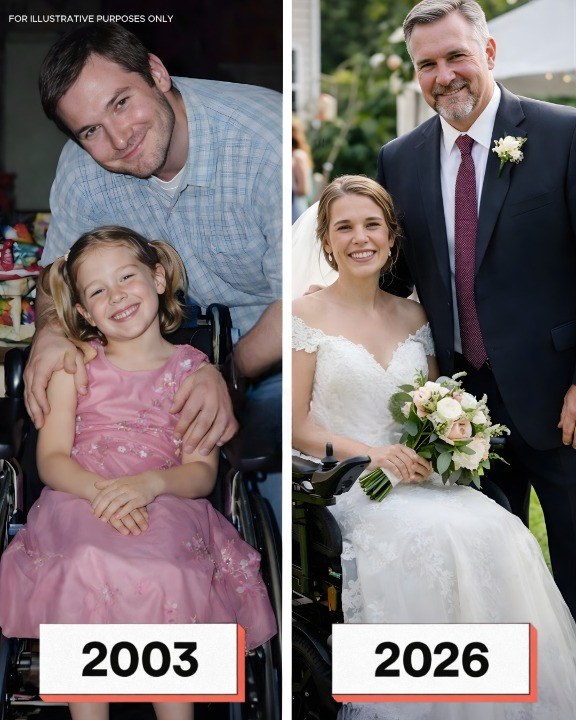
Lily grew into an incredible young woman—kind, determined, and full of compassion for others. She never allowed her wheelchair to limit her dreams. She chose to study social work and dreamed of creating places where children like her would feel accepted and valued, not like a burden.
Then Evan came into her life.
He loved Lily quietly and sincerely. One day he thanked me for raising her, and in that moment I knew my daughter had chosen a good man.
On her wedding day, I walked her down the aisle with pride and deep emotion. I believed my heart was already full—until, during the reception, a stranger approached me.
Her words sent a chill through me.
“You have no idea what she’s been hiding from you,” she said.
She handed me an old envelope and then told me the truth.
She was Lily’s biological mother.
It turned out that Lily had found her several years earlier. She had read the letter explaining everything—the poverty, the impossible choice, and the love that had been behind the decision to give her up. Lily never told me because she was afraid I would feel like I had been replaced.
Instead, she planned something else.
During the reception, a video began to play.
In the video, Lily looked directly into the camera and spoke about me. She explained that she had searched for answers not because she lacked love, but because she wanted to understand her own story. She said I was her father, her home, and the foundation of her life.
She said everything good inside her had grown because I stayed.
When the video ended, I realized Lily hadn’t been hiding shame or secrets.
She had been carrying everyone else’s pain so that we wouldn’t have to.
That night, I danced with my daughter—without fear, without doubt, and without bitterness. There was only love.
And in that moment, I understood something I had never expected:
Healing doesn’t come from erasing the past.
It comes from telling the truth—and choosing love anyway.