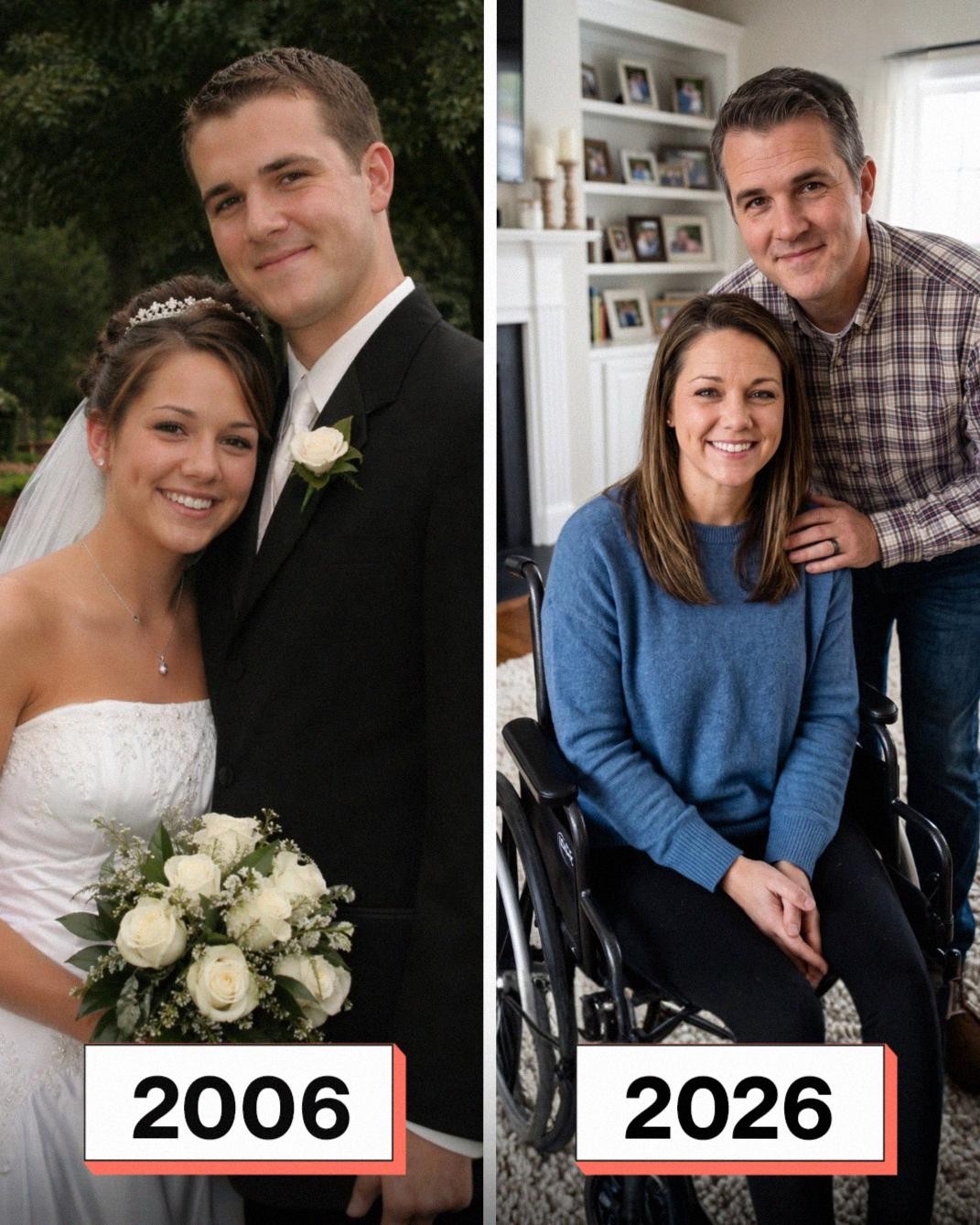
The silence that filled our bedroom on the morning of our fifteenth wedding anniversary felt heavier than any argument we had ever survived together. Since the accident a year earlier, mornings had become rituals of adjustment — careful movements, controlled breathing, and the familiar reach toward the wheelchair waiting beside the bed. That chair was no longer just equipment. It was my legs, my freedom, my connection to the rest of the house and the world beyond it. Every day began with the cold touch of its metal frame beneath my fingers. But that Tuesday morning, when my hand reached automatically into the empty space beside the mattress, I touched nothing at all.
At first, confusion came before fear.
I leaned awkwardly over the edge of the bed, expecting maybe the chair had rolled slightly away during the night. But the hardwood floor beside me sat completely empty. No chair. No explanation. Just a widening sense of panic creeping through my chest.
“Terry?” I called out.
My voice sounded smaller than I intended, fragile in a way I hated hearing from myself. Since the accident, I had worked desperately to hold onto pieces of dignity and independence wherever I could find them. Vulnerability no longer felt temporary. It felt constant.
There was no answer.
Yet I could hear faint movement elsewhere in the house. Terry’s phone buzzed repeatedly on the kitchen counter. His truck remained parked in the driveway outside the bedroom window. He was home. Which meant one horrifying thing:
He had taken my wheelchair.
For nearly thirty minutes, I sat stranded on the edge of the mattress feeling humiliation slowly curdle into anger. The accident had already stolen enough from me — my mobility, my career, my confidence, the effortless rhythm of ordinary life. Losing independence is not one dramatic moment. It is a thousand tiny humiliations repeated every day. Asking for help reaching cabinets. Waiting for someone to open doors. Planning every movement around physical limitations you never asked for.
And now even my ability to leave the bedroom had apparently become something controlled by someone else.
My mind spiraled quickly toward darker possibilities.
Maybe Terry was overwhelmed.
Maybe caregiving had finally broken him.
Maybe resentment had been quietly growing behind all the patient smiles and reassurances.
Then another thought emerged — colder and far more painful.
What if he was hiding something?
That possibility settled into my stomach like ice.
The late nights in the garage.
The distracted conversations.
The exhaustion in his face recently.
Had I mistaken emotional distance for stress when it was actually guilt?
The helplessness became unbearable.
I refused to remain trapped waiting passively for answers in my own bedroom. So despite the terror and physical difficulty, I made a decision that would leave bruises on my arms for days afterward.
I lowered myself onto the floor.
The impact jarred painfully through my hips and shoulders, stealing my breath for a moment. But I kept moving. Hooking my forearms against the hardwood, I dragged myself inch by inch toward the doorway. Every movement burned. My elbows scraped raw against the floorboards while frustration and shame mixed into something almost unbearable.
Crawling changes the way you experience space.
Hallways become endless.
Doorframes feel enormous.
Distances once meaningless suddenly demand enormous physical effort.
Halfway down the hallway, I froze.
A woman’s voice drifted softly through the house from somewhere near the garage. Then came Terry’s laughter — low, warm, intimate. The sound hit me harder than the physical pain. I hadn’t heard that version of his laugh in months.
Suddenly everything inside my head rearranged itself into a terrible explanation.
He had hidden my wheelchair so I wouldn’t interrupt.
Someone was here.
Adrenaline surged through me instantly, numbing the pain in my arms and shoulders. I dragged myself faster toward the garage door fueled entirely by betrayal and fury. By the time I reached the handle, I was shaking from both exhaustion and emotional devastation.
I yanked the door open.
And everything I thought I understood shattered immediately.
Terry spun around looking startled and pale, but not guilty in the way I expected. Beside him stood a middle-aged woman surrounded by professional tools, wiring equipment, and scattered mechanical parts. My old wheelchair rested on a large workbench completely dismantled, its pieces spread across the garage like parts of a machine under reconstruction.
For several seconds, nobody spoke.
Then all the fear and humiliation inside me exploded outward at once.
I demanded to know what was happening. My voice cracked violently between anger and leftover panic while Terry rushed toward me instinctively. I shoved his hands away, furious that he had left me stranded and terrified without explanation.
The woman introduced herself quickly as Dana, a mobility specialist.
And then Terry finally explained.
For months, while I assumed he was retreating emotionally into the garage each night, he had actually been secretly planning an anniversary surprise. He’d spent nearly a year researching advanced mobility equipment after noticing how much physical strain my current wheelchair caused. The old chair wasn’t just inconvenient — it exhausted my shoulders, trapped me inside the house more often than I admitted, and constantly reminded me of limitations instead of possibilities.
Dana had been helping customize a state-of-the-art power-assist chair designed specifically for my body and injury.
Terry had taken my old wheelchair into the garage early that morning because they needed the molded seat measurements transferred before I woke up. Dana arrived late because of traffic, throwing off the timing completely. Terry became so focused on finishing the installation before I noticed that he never realized I was trapped upstairs panicking and dragging myself across the floor searching for him.
Then he quietly reminded me what day it was.
Our anniversary.
The realization hit me with crushing force.
In the middle of grief, pain, therapy appointments, medications, and constant adaptation, I had completely forgotten. While I was upstairs imagining betrayal and abandonment, Terry had been downstairs trying to give me back pieces of independence the accident stole from both of us.
The shame burned deeper than the raw skin on my elbows.
But Terry didn’t react with anger.
He apologized immediately — not defensively, not dismissively, but sincerely. He admitted he handled the surprise terribly and should never have left me stranded without explanation no matter how good his intentions were.
Then Dana finished assembling the new chair.
And suddenly the entire garage seemed to change.
The wheelchair waiting in front of me barely resembled the clunky medical device I had spent the last year resenting. This chair looked sleek, modern, almost futuristic with its matte-black frame and responsive controls. It didn’t feel like a symbol of disability. It felt like technology designed for freedom.
The moment I settled into it, I understood the difference instantly.
Movement became effortless.
A slight touch of the joystick sent me gliding smoothly across the garage floor without the constant strain tearing through my shoulders. The chair adjusted height automatically for transfers. It handled thresholds and uneven flooring seamlessly. For the first time since the accident, I didn’t feel trapped inside fragile machinery that constantly reminded me what I lost.
I felt capable again.
But Terry still wasn’t finished.
He led me deeper into the garage toward the old vintage vehicle he’d supposedly been “restoring” for over a year. Normally I ignored it completely because I assumed it was simply another hobby project helping distract him from our new reality.
Then he pulled away the tarp.
And I started crying instantly.
The vehicle had been fully modified for accessibility.
A side-entry lift folded smoothly from beneath the frame. Hand controls replaced traditional pedals. The interior space had been widened carefully to fit my new chair. Terry explained he spent months working quietly with a mechanic specializing in adaptive driving modifications because he couldn’t stand watching me lose more independence every day.
He didn’t want me to remain a passenger in life forever.
He wanted me driving again.
Standing there in that garage — bruised, exhausted, emotionally wrecked — I suddenly saw the last year differently. While I mourned the loss of my old life, Terry had been secretly building bridges toward a new one.
That afternoon, after giving him the concert tickets I had completely forgotten to wrap, we took the modified vehicle out for its first drive together. Sliding behind the wheel using the adaptive controls felt surreal. Terrifying at first. Then exhilarating.
For the first time since the accident, I wasn’t being transported somewhere.
I was driving myself there.
We ended the evening at an outdoor music festival beneath strings of glowing lights while his favorite band played through the warm summer air. Terry held my hand tightly as the sun disappeared behind the trees, and I realized something profoundly important in that moment.
The accident changed our bodies, routines, and future plans.
But it did not destroy the foundation beneath our marriage.
Love was still there.
Patience was still there.
And even during the moments when fear convinced me I was abandoned, Terry had been quietly fighting to pull me back toward life.
I spent that morning crawling across hardwood floors believing I was completely alone.
By nightfall, I understood something entirely different:
No matter how dark life became, I would never have to crawl through it alone again.