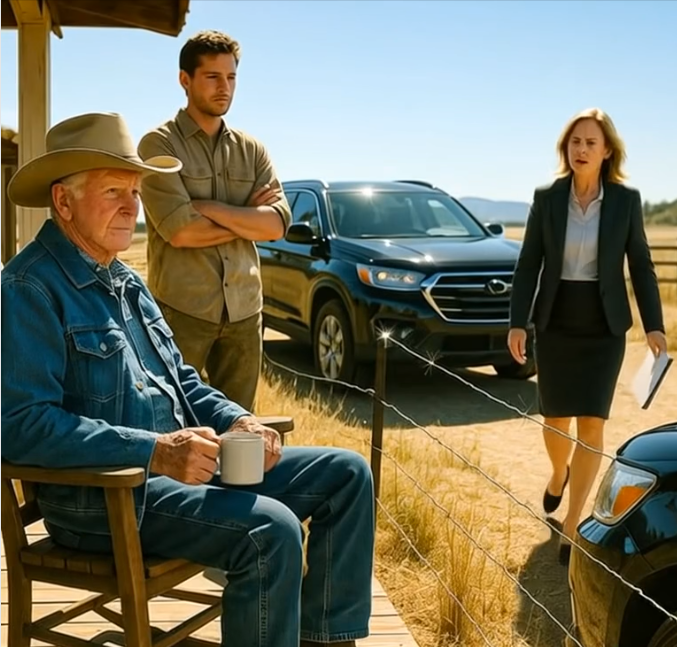
The morning started with a sky so sharp and blue it made the power lines hum, like they had gossip to spill. A black SUV sat nose-to-wire against our cattlegate, its chrome catching the sun as if it were posing for a magazine cover. Granddad stood on the porch with his coffee, hat tipped forward, studying the scene the way he studies weather—quiet, patient, already anticipating the storm to come.
“If they think our driveway is a public pull-off,” he murmured, “they’re about to learn what a boundary really feels like.”
I’d heard the unfamiliar crunch of tires before dawn. By the time I stepped outside, the SUV was angled against the hot wire, close enough to shave it. Tinted windows, high-end finish, and a bumper sticker in gold script: A Neighborhood’s Pride. From Sage Hollow Meadows—the gated HOA kingdom over the ridge, where people believe rules trump decency.
Before I could speak, sharp footsteps clicked down the lane. A woman in a storm-gray blazer marched toward us, chin high, like she was inspecting a crime scene.
“Morning,” she said, voice flat as a parking ticket. “This vehicle is conducting official business. It will be removed shortly.”
Granddad didn’t flinch. He sipped his coffee, letting the silence work its magic.
“Official business on private land,” he finally said. “Is that something new?”
She pointed at our fence, lecturing like to a child. “I’m Lydia Crane, president of Sage Hollow Meadows HOA. Your gate obstructs the community’s easement visibility. Our safety officer had to park here to document the violation. This vehicle is evidence storage.”
Granddad eyed the SUV, then the bright yellow lightning-bolt sign hanging on our fence. “Friendly place to store evidence,” he said. “Two inches from a live line.”
She smiled as if rehearsed. “I assumed your fence is powered down while we’re present, given complaints about distressed animals.”
Granddad leaned back. “I don’t turn off my fence because someone else’s paperwork says so.”
She ignored him. Some people do. “We’ll issue a notice requiring your gate to align with our access apron. Expect it soon.”
She spun on her heel and returned to her sedan, where two men in reflective vests pretended to be official. Gravel spat as they left.
Quiet returned slowly—hawks circling cottonwoods, cattle rolling across the field like distant thunder. Granddad finished his coffee and moved with deliberate purpose, the pace of a man raised on consequences.
“You’re thinking something,” I said.
“I’m thinking they parked close enough to smell the ions,” he said. “Tires help. Side rails don’t.”
He fetched copper wire, loom tubing, and insulated gloves. No rush, no secrecy. Just deliberate, patient preparation. He tested the fence—legal voltage, memorable bite—then rigged a wire under the SUV’s step rail, where a hand naturally reaches. Nothing harmful, just enough to persuade someone to rethink their life choices. A trail camera was mounted on our side of the line, trained on the SUV.
“For the record,” he said, “stories grow legs. Facts keep ’em from running wild.”
It didn’t take long. The HOA sedan returned in a cloud of dust. Lydia hopped out, snapped commands at her vest-clad assistants, and motioned toward the SUV.
Vest One approached cautiously, glanced at the warning sign, glanced at her, and pride overrode instinct. He grabbed the handle.
The jolt popped like tiny thunder. He leapt back, staring at his hand.
“This is exactly what I warned you,” Lydia snapped.
“You parked in a hot zone,” Granddad said calmly. “Shocking, I know.”
Vest Two crouched to inspect the underside, recoiling like a rattler hissed at him. “There’s wiring,” he said.
“Thank you,” Lydia said. “Sheriff will sort this out.”
The first vehicle to arrive, though, wasn’t the sheriff—it was a tow truck. Walt, the driver, surveyed the situation with the judgmental calm of a man who has seen every version of stupid.
Sheriff Colton Daws rolled up behind him, leaned on his cruiser, and took it all in with one slow blink.
Walt asked, “Who’s paying me to be yelled at today?”
“Private property,” Daws said. “Unauthorized vehicle. Tow it.”
“This vehicle belongs to a homeowners association,” Lydia snapped. “It is part of an ongoing compliance operation.”
Walt stared at her. “And you parked it on an electric fence. That’s operator error.”
Sheriff Daws checked the plate. “Leased to Sage Hollow Meadows HOA. Registered to Treasurer Miles Hart. Secondary: President Lydia Elaine Crane. Registration hold for unresolved county tax liens. Accurate?”
She sputtered about clerical errors. Daws didn’t reply.
Compliance Officer Keen arrived, tested the fence, reviewed the trail cam, and shrugged. “Fence is legal. Vehicle contacted an active line. No tampering.”
The SUV was hooked and hauled away.
Word spread faster than prairie fire. By afternoon, Sage Hollow’s porch cams had clipped Vest One getting zapped. Someone added an arrow and caption: CONSEQUENCES. The video blew up locally.
The next day, Nate—one of the vest guys—showed up alone, out of uniform, holding a folder: emails, HOA directives, plans to pressure “recalcitrant landowners,” budget warnings, and a line Lydia wrote: They’ll fold when they see badges and a big truck.
Sheriff Daws quietly thanked him. “Playing cop without authority,” he muttered. “That’s a hole you don’t climb out of.”
Sage Hollow called an emergency meeting. We watched from the back as the treasurer revealed the truth—phony charges, hidden accounts, private LLC siphoning dues. The room sagged. Math kills confidence.
Two days later, Lydia came to our gate with a paper bag of blueberry muffins and a forced smile.
“We can make this easier on you,” she said. “No more inspections. No more letters. Just… let the videos fade.”
“Peace with conditions isn’t peace,” Granddad answered. “It’s a lease. And we don’t lease our principles.”
She left the muffins and drove off into a sunset she didn’t earn.
Life settled. Sage Hollow residents waved instead of glared. The impounded SUV gathered dust. The audit revealed more “creative accounting”—polite for your reputation is cooked.
Evenings found Granddad and me on the porch with the logbook—weather notes, cattle movements, the hum of the fence.
I used to think fences were walls. Turns out, they’re voices. They tell people exactly where respect begins.
And if someone parks their shiny authority against that line?
Well. The fence speaks. And the smart ones listen.