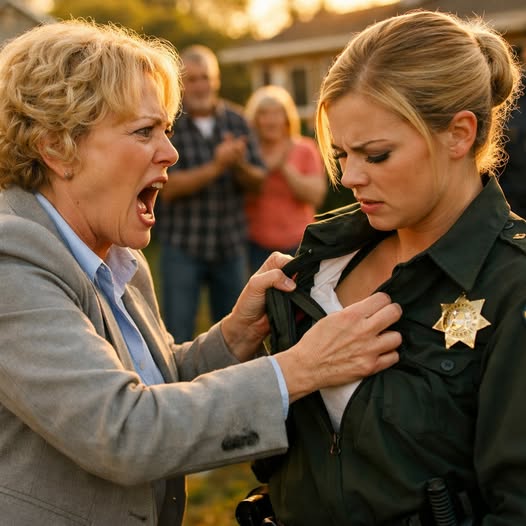
The first thing Karen Thompson did wasn’t call the police.
She put her hands on my wife.
It happened so quickly my mind didn’t even register it as a decision. One moment I was standing on the porch in slippers, a mug of coffee warming my palms, watching Sophia adjust a sprinkler near the curb. The next, Karen stormed across her perfectly manicured lawn like she’d been rehearsing the moment, her yapping white poodle scrambling after her.
“This is fraud!” she screamed. “You’re impersonating a soldier!”
Sophia hadn’t even turned around when Karen seized the shoulder of her worn utility jacket and jerked it hard. The fabric ripped with a sharp, tearing sound—thin, but loud enough to cut through the morning air. Everything shifted instantly. The street seemed to hold its breath, like the temperature dropped all at once.
Sophia turned slowly.
Her face wasn’t startled. It wasn’t angry in the way people usually get angry. It was colder than that—measured, distant, controlled. The look of someone evaluating a situation, not reacting to it. The kind of expression that tells you you’ve crossed into territory you don’t understand.
Karen either didn’t notice—or noticed and decided volume was her best weapon.
“Everyone knows!” she shouted, veins bulging in her neck. “You’re sick! You’re unstable! You’re pretending to be something you’re not!”
Sophia’s voice was calm and flat. “Touch me again,” she said, “and you will regret it.”
That should have been the end.
But Karen thrived on escalation. She was the HOA president of our cul-de-sac, the self-appointed enforcer of lawns, shutters, mailbox colors, and “community standards.” She treated the neighborhood like a courtroom and herself like the judge. In Karen’s world, guilt came first. Proof was optional.
My name is Michael. I’m forty-two, a remote software engineer who prefers predictable mornings and uneventful nights. Six months earlier, my biggest problem was a missed deadline or a router that needed restarting.
Then my wife came home.
Sophia is forty-three—athletic in a way that looks effortless. She doesn’t waste words or movement. Two months earlier, she returned from what she called “an extended overseas assignment.” The way she said it made one thing clear: there were questions I wasn’t meant to ask. She never lied to me. She just didn’t tell me everything, and I’d learned the difference.
Since her return, she’d been quieter. Not sad—contained. Like something heavy had been sealed away and locked tight.
That morning, she’d pulled an old set of fatigues from a storage bin because she wanted something comfortable while fixing the sprinklers. Faded jacket. Worn camo pants. Nothing dramatic. Just clothes.
Karen spotted her from the sidewalk during her daily dog walk and stopped dead. Her stare wasn’t really at the fabric—it was at the meaning she decided it carried. She said nothing then. Just yanked her poodle away like Sophia was contagious and marched off, spine stiff with righteous offense.
By afternoon, a thick HOA notice arrived, Karen’s looping cursive signature at the bottom like a judge’s ruling. Citation: inappropriate attire causing discomfort and unease among residents. Vague by design. Karen loved vague—it gave her room to invent later.
I read it twice and laughed in disbelief.
Sophia glanced at it and shrugged. “Let her waste her time.”
“She can’t enforce this,” I said. “It’s not—”
“Michael,” she interrupted gently, and something in her voice told me she understood this game better than I did. “People like her don’t need rules. They need targets.”
She was right.
Within days, unsigned notes began appearing in our mailbox. Accusations of fake military service. Fraud. Felony. Threat. The handwriting changed, but the voice didn’t—it was Karen’s brand of moral outrage wrapped in small, sharp cruelty.
I wanted to confront her. Storm up her driveway and demand it stop. Sophia told me not to.
“We observe,” she said. “We document. We evaluate.”
The way she said it—like the neighborhood was terrain—made my stomach tighten.
At the next HOA meeting, Karen turned the rec center into a courtroom. She stood at the podium and projected blurry photos of Sophia in fatigues, clearly taken without permission.
“This individual is openly violating our norms,” Karen announced, pausing for effect, “and may be impersonating military service. Deception erodes trust. It threatens our community.”
Murmurs rippled through the room. Some people nodded. Others looked uncomfortable and stayed quiet—which helped Karen just as much.
Sophia sat beside me, hands folded, expression neutral, like she was watching a storm she’d already mapped. But I felt the tension in her—tight, controlled, coiled.
After that, the neighborhood changed. Friendly waves disappeared. Conversations stopped mid-sentence when Sophia walked by. Rumors spread easily. Suspicion always does in places that look perfect.
Then came the day she wore the uniform again.
It wasn’t defiance. It wasn’t a statement.
It was grief.
The air had that sharp early-fall bite. Sophia stood on the porch in the same fatigues, jacket zipped, posture quiet and deliberate. It looked less like clothing and more like ceremony—something done for someone who wasn’t there anymore.
I didn’t ask why. I just gave her space.
Karen saw her and snapped.
She came charging across the lawn screaming about fraud and felonies like she’d been waiting for permission to explode. And that’s when she grabbed Sophia and tore the jacket.
Minutes later, two patrol cars arrived, lights flashing silently. Two officers stepped out, cautious—the stance cops use when they don’t yet know what kind of call this is.
Karen spun toward them eagerly. “Officers! Arrest her! She’s impersonating a soldier! She attacked me!”
I tried to speak, but Karen drowned me out.
Sophia stood still, arms relaxed, expression unreadable—not indifference, but restraint.
The older officer approached. His name tag read Hayes. “Ma’am,” he said firmly, “what’s your name?”
“Sophia Reed,” she replied evenly.
His hand hovered near his cuffs.
Then he really looked at her, and something flickered across his face—recognition colliding with disbelief.
The younger officer, Ruiz, noticed a card partly visible in her jacket pocket. He didn’t grab it. “Do you have identification?” he asked carefully.
Sophia nodded and handed it over.
Ruiz’s eyebrows shot up. “Hayes,” he said quietly, “you need to see this.”
Hayes read it, and his posture changed—authority giving way to caution, command turning into respect.
Karen kept talking. “Fake IDs too! She’s—”
“Ma’am,” Hayes cut in sharply, “step back. Now.”
Karen froze. “Excuse me?”
Hayes ignored her and turned to Sophia. “Is there anyone you’d like us to contact?”
“Yes,” Sophia said calmly. “Call the number on the back. Tell them there’s been an incident.”
Ruiz stepped aside to make the call.
Karen’s voice cracked. “What is happening?”
Hayes finally faced her, disappointment clear. “You need to stop talking.”
“She’s impersonating—”
“She is not,” Hayes said flatly.
Then, loud enough for the watching neighbors to hear, he added:
“This is Lieutenant General Sophia Reed. Her file is sealed. Her work is classified.”
The street went completely silent. Even the poodle stopped barking.
My world tilted. I knew Sophia was important. I knew she lived in a world I didn’t fully see. But a general? Here?
Sophia looked at Karen—not smug, not cruel. Just steady truth in a space built on lies.
Black SUVs arrived within minutes. Plainclothes agents took control without raising their voices. Karen was told to sit on the curb. This time, she obeyed.
That evening, the rec center filled for an emergency HOA meeting. Karen sat at the front, shaken, confidence drained.
Sophia entered with our attorney, Lisa Grant—sharp suit, sharper eyes. Lisa laid out the facts: doorbell footage, witness statements, handwriting analysis. The harassment was undeniable.
Sophia spoke quietly. “This was never about my uniform. This was about abuse—about power used to control. And it stops today.”
Neighbors who’d stayed silent began to speak. Veterans. Targets. The room shifted.
Karen’s removal was unanimous.
Afterward, she tried to whisper an apology. “I didn’t know.”
“That’s not an excuse,” Sophia said. “You didn’t need to know who I was to treat me like a human being.”
We went home to a quieter street. But some nights Sophia still sat awake, staring into the dark—not because of Karen, but because of everything Karen could never imagine.
One night I asked, “Why did you wear the uniform that morning?”
Sophia looked out the window. “A friend died,” she said.
And I understood—the uniform had never been about the neighborhood at all. It had been about honoring someone who didn’t make it home.