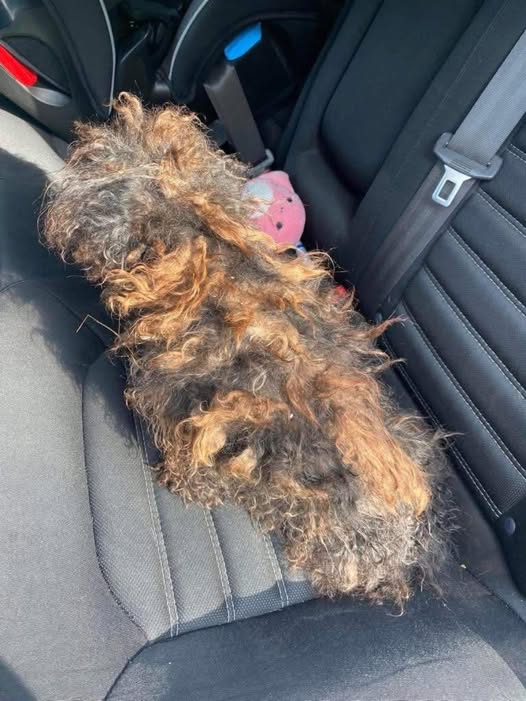
Long before she ever reached a place of safety, the dog had already disappeared beneath neglect.
Along a quiet roadside in Missouri, she barely looked alive—just a hunched shape dragging itself forward, wrapped in layers of hardened filth. Her fur was so thick with mud, debris, and time that her body had lost its outline completely. At first glance, she blended into the roadside waste: broken branches, old tires, things long abandoned. Only when she moved did it become clear that this wasn’t debris—it was a living being still holding on.
When people finally stopped to help, she was almost unrecognizable as a dog. Years of untreated matting had formed a heavy shell around her, pressing down on her body and restricting every movement. The weight bent her frame and slowed her steps, as if she were physically carrying every year she had been ignored. She didn’t bark or resist. She simply endured—silent, exhausted, and withdrawn.
At Mac’s Mission, her rescue didn’t begin with comfort or reassurance. It began with release.
The team had handled severe neglect before—dogs many believed were beyond saving. They approached her calmly, guided by experience rather than shock. In the grooming area, the sound of clippers filled the space, not for appearance, but as an act of medical necessity.
The matting went far beyond surface neglect. It had hardened into thick layers that pulled at her skin and cut off circulation. Embedded inside were stones, burrs, dried mud, oil residue—evidence of years spent exposed to the elements. Every cut had to be slow and precise. One wrong move could cause pain or injury.
As the layers fell away, something shifted. The dog didn’t fight or panic. Instead, her body gradually relaxed. With each heavy clump of fur removed, she seemed to release tension she had carried for years.
What emerged beneath wasn’t just a smaller body—it was a story written in scars. Her skin was fragile and pale, unused to touch. Her muscles shook as though they had forgotten freedom. One eye was gone entirely, a silent reminder of trauma she survived alone. She was thin, cautious, and uncertain, as if the ground itself couldn’t be trusted.
Only after she was freed from the weight did they give her a name.
They called her Pear.
That first night revealed how deeply deprivation had shaped her instincts. When food was offered, she ate urgently, fear driving every bite. Her eyes darted around the room, guarding the bowl even as exhaustion overtook her.
When the food was gone, she collapsed.
It wasn’t ordinary sleep—it was surrender. Her body gave in completely, resting with a depth that suggested she had never truly slept before. For the first time, there was no cold ground, no hunger, no need to stay alert. Only warmth and quiet safety she didn’t yet understand.
Later, photos of her transformation spread online. The “after” images showed a clean dog in a pink harness, her posture lighter, her tail beginning to wag. People commented on the power of rescue and compassion.
But those who were there knew the truth.
The real change couldn’t be photographed. It happened inside—slowly, invisibly—as a being once discarded began to consider trusting the world again.
Trust came cautiously. For weeks, Pear stayed alert, watching every movement, flinching at sudden sounds, learning what touch meant. She had known neglect not through violence, but through absence—and that kind of harm runs deep.
She had to learn that these new “cuts”—the clippers, the care, the exams—were not meant to hurt her.
Her breakthrough came quietly.
One afternoon, a volunteer sat near her bed without reaching out or speaking. Pear watched carefully, body tense. Then, slowly, she stood. Each step forward was deliberate. When she reached the volunteer, she didn’t jump or lick.
She leaned.
Her scarred side pressed gently against the person’s leg—a fragile, trembling choice to trust. In that moment, Pear chose connection over isolation.
From there, healing came in small steps. She learned to navigate the world with one eye, to trust that food would return, that rest didn’t require fear, that pain was no longer constant.
Her recovery wasn’t magical. It was slow and demanding. Care healed her body—but her spirit healed because she chose to try.
Today, Pear runs.
Not from danger, not burdened by neglect, but freely—through grass and open space. Her scars remain. Her missing eye remains. They are no longer marks of suffering, but proof of survival.
Pear is no longer a forgotten shadow on the roadside. She knows her name. She knows her value. And she stands as a reminder that even beneath the heaviest neglect, life can still be waiting—quietly—for the moment it is finally seen.
Her miracle isn’t that she was rescued.
Her miracle is that once she was free, she chose to stay.