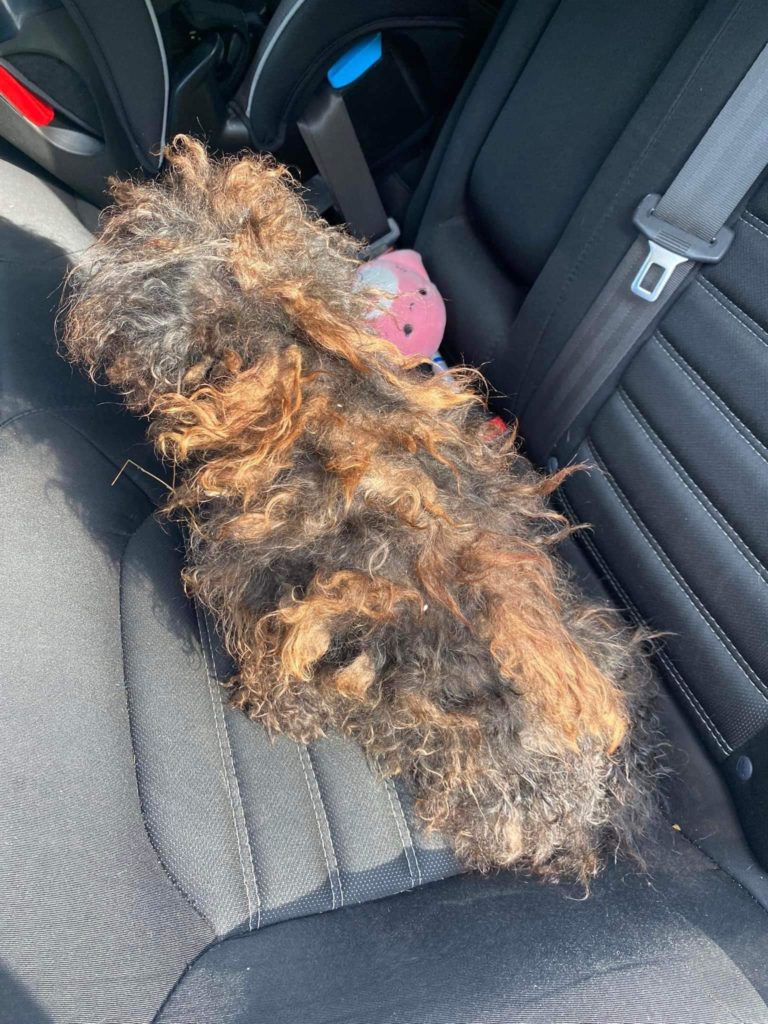
But the moment a rescuer’s hand pushed into that filthy, suffocating coat, everything she’d been hiding—every scar, every tremor, every tiny sigh of resignation—burst into the open. There was a moment, infinitesimal but infinite, when Pear felt the touch, and something in her small, battered chest clicked. She couldn’t have known hope yet, not fully. She had learned that hope was dangerous, a promise that could be cruelly snatched away. And yet, that gentle intrusion, that careful grip, awakened a memory deep in her muscles: a time before fear, before hunger, before abandonment.
They didn’t name her Pear until they’d uncovered the dog beneath the wreckage. At first, she was only a dragging shadow on the shoulder of a Missouri road, more debris than living thing, more ghost than flesh and bone. Her legs, once strong, trembled like brittle twigs under a storm. Her ears drooped, caught in the knots of fur so thick it hid the world and herself alike. When she breathed, it was sharp, cautious, almost apologetic, as if daring the hand that reached for her to withdraw, to leave her in the safety of invisibility.
At Mac’s Mission, the team moved with a tenderness born from repetition, from years of seeing life nearly lost but refusing to let it slip completely away. They knew the language of broken dogs: the subtle shiver, the flinch, the avoidance of eyes, the frozen stillness that screamed both fear and longing. Each member of the team spoke softly, not just to Pear but to each other, a murmur of reassurance and strategy. The clippers hummed through the knots like a lifeline, slicing through years of neglect, peeling away layers that had hardened into prison walls around a body that had once known comfort. Each fallen mat exposed fragile skin and trembling muscle, a living map of survival etched into fur and flesh, and with it, the quiet, stunned relief of a body finally being seen, finally acknowledged.
The first bath was a ceremony, not just a cleaning, but an awakening. Warm water touched her skin, coaxing it from gray and grimy into soft pink tones that had been hidden for months, maybe years. She shook violently at first, as if trying to rid herself not just of dirt but of the memory of being unwanted, of nights spent trembling alone. The soap lathered over her like sunlight, and each rinse washed away not only grime but the invisible weight of neglect. She trembled, yes, but slowly it became a tremor of relief, of disbelief, of a tiny spark of trust flickering in her eyes.
When they were done, Pear stood smaller, broken in places, but unmistakably herself. One eye missing, scars etched into her like a survival ledger, she carried the stories of roads unkind, of people passing without care, of nights spent shivering in the weeds. She ate as if every bite might vanish, wary yet driven by the urgent necessity of nourishment. Then she collapsed into a sleep that looked almost like surrender—but not defeat. It was surrender to safety, to the gentle rhythm of human care finally offered freely, without expectation, without cruelty.
The internet saw her “after” photos: the glossy fur, the bright eye, the poised stance that belied her frailty. But the real miracle was quieter, more profound: a dog who had been discarded, who had learned that people could be dangerous, had chosen to lean, carefully, into a human hand. She learned to trust the cut of kindness over the weight of her past. Every brush of a finger against her scarred shoulder, every soft word whispered in her ear, became a tiny act of reclaiming life. Each day at Mac’s Mission, Pear discovered that the world could be different, that the roads she had once feared were not all roads of despair, and that she had, at last, a place where she belonged.
The staff would later recall the first time she allowed herself to lie fully on the soft blankets of her new bed, curling into the warmth, nose tucked beneath her paw. It was a simple gesture, yet monumental. It was her body remembering safety, her muscles relearning relaxation, her heart daring to beat without tension. And slowly, over days and weeks, the timid whine softened into a playful bark, the wary glance into a trusting gaze. Pear’s journey from the roadside to recovery wasn’t marked by dramatic rescues alone, but by a patient insistence that her life mattered, that her pain would be met not with indifference but with unwavering care.