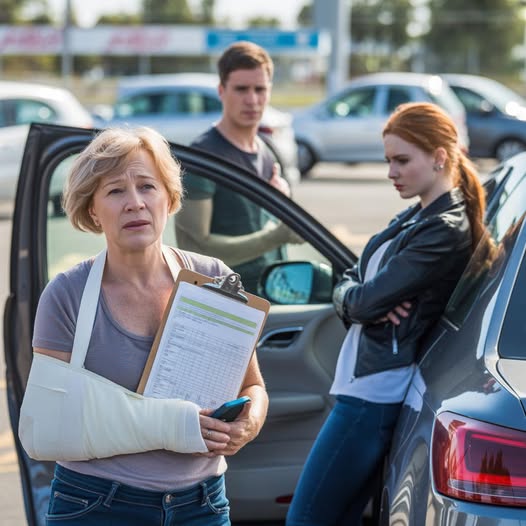
I didn’t think she’d actually hit me.
Not my daughter-in-law. Not the woman I helped pay through nursing school. Not the girl I let live in my guesthouse for free while she figured herself out.
But she did.
She hit me so hard that I fell backward, my wrist slamming against the edge of the kitchen table. A blinding pain shot up to my elbow, my vision blurring, and the room seemed to tilt sideways. She just stood there, eyes cold, jaw clenched, daring me to say a single word.
“You’re not welcome here anymore,” she hissed.
Then she turned and walked away.
I stayed on the floor for several seconds, trying to process what had just happened. I wasn’t clumsy, and I wasn’t frail. I was sixty-two, still sharp as a whip. I just hadn’t expected the rage in her hands—or the silence that followed.
My son Jacob didn’t come downstairs.
The same boy I raised alone after his father left. The same boy who had sat with me through midnight study sessions and called me his superwoman on graduation day. He didn’t even peek out of his upstairs bedroom. No footsteps. No voice asking if I was okay. Just thick, humiliating silence.
I wiped the blood from my lip with my sleeve, used the chair to pull myself upright. My hand was swelling fast; I couldn’t even curl my fingers into a fist. Still, I grabbed my purse and walked out. No shouting. No drama. I wasn’t going to give her that.
Outside, the sun felt too bright, too cheerful, as if the world hadn’t gotten the memo that something inside me had snapped. I got into my car and sat behind the wheel, shaking.
Then my phone buzzed.
A message from Jacob:
“Please don’t come back. It’s better this way. Stay away from us.”
I stared at the words.
Us. Not me. Not “I’m sorry, Mom.” Us. Like they were a team and I was the outsider. Like I had become a stranger in the family I built with my own hands.
I drove straight to an urgent care off the main road—the kind tucked between a pharmacy and a sandwich shop, a faded flag flapping in the winter wind. Fluorescent lights hummed above me while a nurse wrapped my arm and asked me to rate my pain.
Fractured wrist.
They put on a temporary cast and handed me pain meds in a little paper cup. The nurse asked gently if I wanted to report anything.
“Not today,” I said.
But something changed in me that night. Something quiet, but final.
The next morning, while drinking tea at my kitchen table, I pulled out the folder labeled loan co-sign docs, Jacob and Ellie, new mortgage. I opened my laptop and logged into the mortgage application portal.
Let me explain how that folder came to exist.
Last month, they had begged me to co-sign.
“Mom, it’s just until the bank clears our dual income,” Jacob had pleaded. “Ellie starts her new job in two months. Please. It’s our dream home.”
I said yes. I always said yes.
Until now.
My name was still on the application. The final bank check hadn’t gone through yet. They were days away from approval. I clicked withdraw co-signer authorization. Then I clicked confirm.
Done.
Jacob and Ellie would get a call from the bank that afternoon. They would find out their loan had been denied because of me.
I could have warned them. I could have forgiven them.
But Jacob let her hurt me. And then he told me to stay away.
Fine.
I pressed my lips together, reached for my phone, and finally replied to his message:
“Okay.”
Nothing more. No drama, no curses. Just okay. Let him wonder what I meant. Let him wonder what I did.
That afternoon, the loan officer called.
“Mrs. Taylor, we noticed you revoked your co-signature on the Green Leaf mortgage file for Jacob Taylor and Ellie Taylor. Is that correct?”
“Yes,” I said calmly. “That’s correct.”
A polite pause tightened the air on the other end.
“Unfortunately, that will significantly impact their creditworthiness. We’ll have to halt approval pending a new co-signer or full income verification.”
“I understand,” I said. “Have a nice day.”
I hung up.
Less than ten minutes later, Jacob called. I didn’t answer. I sat on the couch, nursing my arm, listening to the phone ring out.
Then Ellie texted:
“What did you do?”
I laughed. Not bitterly, not sharply. A real laugh, the kind that comes from so deep in your chest you forgot it existed.
I typed back one word—the same word I had sent Jacob:
“Okay.”
What I meant was: you made a mistake, and now you’ll learn what it costs.
The next morning, I woke to twenty-three missed calls. Seven voicemails from Jacob, desperate, confused.
But the last one made me freeze.
“Mom, please call me,” he said. “Ellie says she’s pregnant.”
My heart slammed.
Before I could process it, someone knocked on my door—three hard bangs that rattled the frame. I looked through the peephole and opened the door. Jacob stood there, disheveled, shirt wrinkled, hair uncombed, clutching a folder like he had rehearsed what to say. Behind him, Ellie, arms crossed, sunglasses hiding her eyes.
Her first words weren’t “I’m sorry.”
They were: “You just ruined our lives.”
I stepped aside silently and let them in. They sat on the couch. I stood.
The silence stretched. I broke it.
“You hurt me,” I said quietly.
Ellie rolled her eyes. “I tripped. It wasn’t my fault you’re so fragile.”
Jacob interjected, “Ellie—”
But she continued. “She was in our kitchen, judging everything, telling me how to raise a child I haven’t even had yet. You think I’m just going to take that?”
I blinked once, then spoke with the calm of a woman pushed too far:
“You hit me, Ellie. And when I didn’t respond the way you expected, you both shut me out like I was disposable furniture.”
Jacob shifted, uncomfortable. “She said it was an accident,” he muttered.
I raised my cast. The bruising had darkened to purple and blue; the swelling worsened. “You didn’t even come downstairs, Jacob.”
He looked like he’d been slapped.
“Why are you here?” I asked.
Jacob placed the folder on the coffee table, sliding it toward me. “We can’t afford another co-signer,” he said. “They’re giving us seventy-two hours to update the application or the house goes to the next buyer. We’ll lose it.”
I looked down at the folder—mortgage terms, updated rates, a typed plea in desperation.
“Do you want me back in your lives?” I asked.
Jacob hesitated, then nodded.
“Do you want me in this baby’s life?”
Another nod, slower.
I turned to Ellie. “And you?”
She shrugged. “You’re his mom, not mine. I’ll tolerate you if you sign those papers.”
The mask dropped. She didn’t want family. She wanted security. Her voice was hollow of warmth but full of expectation.
I smiled gently, walked to the coffee table, sat down, opened the folder, picked up the pen—and paused.
“I’ll sign it if you apologize out loud, right now.”
Ellie’s face twisted. “You’re seriously going to make this about pride?”
“No,” I replied. “I’m making it about respect.”
Jacob looked at her, pleading without words.
With teeth clenched and lips barely moving, Ellie spat it out: “I’m sorry.”
It wasn’t real. The kind of sorry said when your ego has a knife to its throat.
I hovered the pen over the line. Jacob’s eyes lit up. Ellie exhaled, triumphant.
Then I stood without signing.
“Actually,” I said, “never mind.”
Their faces froze.
“I thought I could do it. But I know that if I help you now, you’ll just forget this ever happened.”
“Wait,” Jacob started, rising.
I raised my good hand. “Jacob, you told me to stay away. You chose your side. Now I’m choosing mine.”
Ellie lunged forward. “We’re pregnant!”
“And?” I asked calmly.
“You’re going to let your grandchild grow up homeless?”
“You’re the one who threw the first punch,” I said. “Literally. And now you want me to forget everything because it’s convenient.”
Jacob’s jaw clenched. “Please, Mom. We need this. Just this once.”
“No,” I replied. “I needed you once, too. The night you said nothing.”
I grabbed the folder, walked to the fireplace, and dropped it into the flames.
Ellie screamed.
Jacob didn’t move. He just stared into the fire, realizing something was truly gone.
They left without another word. I watched from the window as Ellie stormed to the car, slamming the door. Jacob lingered, looked back once, but didn’t come inside.
Three days later, the house listing went back on the market.
They didn’t get it. They moved into a smaller rental across town.
A week later, I received a Facebook message from Rachel, Ellie’s younger sister.
Rachel was softer than Ellie, always nervous, quiet. She once stayed behind to help me clean after a holiday party while Ellie took selfies upstairs. The message was brief but urgent:
“I know you probably don’t believe anything good about me or my family after what Ellie did, but I’ve been holding this in too long. She’s not actually pregnant. She lied to Jacob. She lied to everyone.”
I clicked accept. “I’m listening.”
Another message arrived:
“She found out you canceled the mortgage. She panicked. Told Jacob she was expecting to stop him from cutting her off, but she’s not. I’m sorry. I have proof.”
A photo attached: a screenshot of a text thread between Rachel and Ellie. There it was, in Ellie’s own words:
“If I say I’m pregnant, he’ll beg his mom to forgive me. We’ll get the loan, the house, everything. Then maybe I’ll actually think about getting pregnant.”
I stared at the screen. Cold. Heavy. The last small stubborn part of me that had still hoped I’d overreacted had turned to stone.
Rachel added one more:
“I shouldn’t be sending this, but I couldn’t keep watching. Jacob deserves better. You deserve better. I’m sorry for waiting this long.”
I sat with it a while, then made a call. Not to Jacob. Not to Ellie. To my lawyer.
“Ms. Coleman, remember the trust account for Jacob set up a few years ago?”
“Yes,” she said. “The one meant to release after his first child is born.”
“I want it frozen immediately,” I said. “Put it under review.”
She paused. “Is something wrong?”
“Let’s just say,” I replied, “the birth certificate might be missing a name permanently.”
The next morning, I got a text from Jacob: “Please. Just tell me what you want.”
I didn’t answer. That afternoon, I went to the grocery store. As I reached for a can of soup, I heard a voice behind me.
It was Rachel.
She looked tired but genuine. “Ellie’s done this before. She fakes things. Crises. Drama. Ever since we were teenagers. Once she faked a stalker to get an ex-boyfriend back. Another time she pretended to have a medical scare just to get out of a job she didn’t like. Lying is how she survives. Jacob is in too deep. He thinks it’s normal. But it’s not.”
I studied her. She meant every word.
“Rachel,” I said, “would you testify if it came to that?”
She looked shocked, then nodded slowly. “Yes. If it helps him, I’ll do it.”
That night, I sat alone in my living room with the fire crackling beside me. My phone buzzed with a voicemail from Jacob. His voice was ragged.
“Mom, Ellie’s missing. She left this morning and hasn’t come back. Her phone’s off. I don’t know what to do. I found your old ring box on the dresser. The one Dad gave you. It was open and empty.”
My heart stopped.
I hadn’t seen that ring in years. White gold, rare oval sapphire flanked by tiny diamonds. Priceless to me.
I ran to my bedroom. The small red velvet box—gone.
I called Jacob. He picked up immediately.
“She’s spiraling since the loan fell through. Screaming, throwing things. I found an empty apartment and filed a police report.”
“You didn’t mention her name?” I asked.
“No. She’s still my wife,” he said weakly.
“She’s not pregnant,” I said.
“What?”
I told him about Rachel’s messages. On the other end, I heard him go completely still. Then a grown man began to sob. Quiet, guttural. The kind that builds in the gut and rips through the throat. I let him cry. It was the sound of a man realizing his life had been built on a lie.
“I believed every word,” he said finally. “I gave up my mom. I let her hurt you. And I believed she was carrying my child.”
I drove to a string of cash-for-gold shops along the highway. At the fifth, the woman behind the counter recognized the ring from my photo.
“Lady came in yesterday,” she said. “Said it was a gift from her grandmother. Wanted cash and asked if we could arrange a plane ticket under the table.”
Two hours later, the shop called. Ellie had returned. They stalled her.
I drove there like my tires were on fire.
At the counter, Ellie stood in sunglasses and a hoodie. She turned. Pale.
“Give it back,” I said.
She stared at me, then reached into her bag and pulled out a small box. Her hands trembled as she shoved it toward me.
“Here. Take it. It’s cursed anyway.”
I took it and opened it. The ring was inside—but something felt off. Too light. Too shiny. I held it to the light and knew immediately.
This wasn’t my ring.
She had made a copy.
“Where’s the original?” I asked.
She shrugged, a smirk widening. “I guess you’ll have to find out.” Then she walked past me and out the door.
I stood there staring at the fake in my palm.
The game had changed. Ellie wasn’t just angry. She was strategic. Vindictive. Dangerous.
The next morning, a letter arrived with no return address. Inside, one sentence in thick black ink:
“Next time, it won’t just be a ring.”
For one second, I almost let fear crawl back in. Then I remembered who I was.
I hadn’t survived widowhood, two jobs, and raising a son alone to be bullied by a girl with a tantrum and a fake smile.
I met with my lawyer the next morning.
“I want to revise the trust,” I said.
I slid across the table a printed screenshot of Ellie’s text admitting she had faked the pregnancy. Ms. Coleman read it, lips pressed into a thin professional line.
“I want Jacob to receive the full trust amount,” I said, “but only if he meets me in person to acknowledge what’s happened, and only if he files for divorce.”
She blinked. “Those are strong conditions.”
“She’s a strong threat,” I replied.
“And if he refuses?” she asked.
“The money goes to someone who actually stood up for me. Someone who told me the truth.” I slid another paper forward. Rachel’s name was at the top.
Ms. Coleman smiled. “I’ll draft it today.”
That afternoon, I sent Jacob a photo of the trust paperwork. Five minutes later, he called.
“Come here,” I told him. “Talk to me.”
When he arrived, he looked exhausted, thinner. He stepped inside, closed the door, and stood like a boy about to be scolded.
“I knew about the pregnancy,” he admitted quietly. “I found the test in the trash. It was unused. But I let myself believe anyway, because if she was lying, I’d ruined everything for nothing. If she was telling the truth, maybe you were the problem, not me.”
I said nothing. I waited.
He sank onto the couch. “She changed after we got married. Controlling. Secretive. She didn’t want me talking to you. Said you were manipulating me.” He paused. “I was stupid.”
“No,” I corrected gently. “You were scared.”
He looked up, eyes glassy. “I miss you, Mom.”
Then he reached into his pocket and pulled out something small.
The real ring.
“She mailed it back to me yesterday,” he said, voice tight. “With a note: it didn’t sell, might as well give it back to your mommy.”
The moment my fingers closed around it, I felt whole again.
Jacob told me Ellie had left him, said he was dragging her down. She had moved in with someone from work and had been cheating for months.
He sat forward, looking me in the eyes. “I’ll do anything to make it right.”
I slid the trust paperwork toward him.
“Then start with this,” I said.
He read it, eyes widening. “You’re still giving this to me?”
“If you file for divorce and go to therapy,” I said, “and one more condition…” I paused. “You apologize publicly at our next family gathering. You shamed me with your silence. You stood beside a woman who hurt me and let people think I abandoned you. That ends now.”
He nodded. “Okay.”
As he left, he paused at the door. “Why did you even agree to co-sign in the first place? After everything Ellie said?”
I smiled softly. “Because I wanted to believe the best in you, even when you didn’t.”
Three weeks later, I received court confirmation that Jacob had officially filed for divorce. His therapist emailed to say he attended every session.
On Easter Sunday, at my family potluck, Jacob stood before everyone—cousins, aunts, little nieces—and told the truth. No sugarcoating, no excuses.
“My mother deserved better, and I failed her.”
There wasn’t a dry eye in the room.
When he sat down, I reached across the table and held his hand.
That night, I placed the ring back in its box and set it high on the shelf in my closet—safe, where no one could ever steal it again.
A week later, Rachel visited. We had tea in the garden, the air smelling of fresh-cut grass and spring flowers.
“Do you ever wish you’d handled it differently?” she asked.
I shook my head. “No. Sometimes the only way people learn is when they lose everything they tried to take.”
She nodded.
Then we both turned as Jacob arrived, carrying flowers. We sat together for hours, and for the first time in a long while, it felt like a family again.
No fear. No lies. No manipulation.
Just healing.
Just peace.
The kind you fight for. The kind that comes when you finally stop being afraid to say: you don’t get to hurt me. Not anymore.