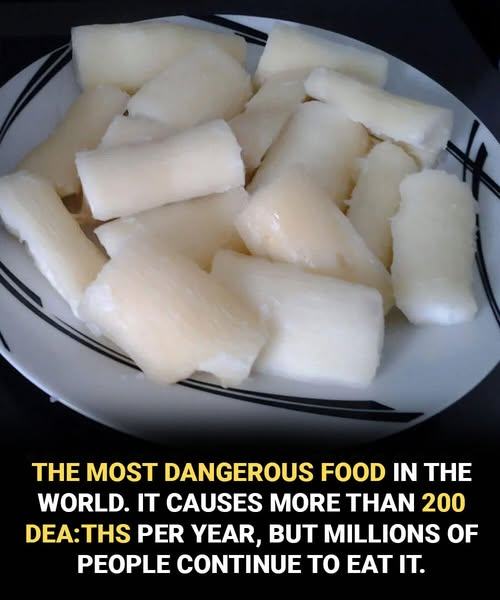
Cassava is one of the most widely consumed staple foods in the world — a root that nourishes entire regions, forms the base of cultural dishes, and thrives in soils where few other crops can grow. Yet within this seemingly ordinary ingredient lies a danger most casual consumers never consider. When prepared correctly, cassava is nutritious, reliable, and versatile. When prepared poorly, it can release enough cyanide to poison individuals, families, or even entire communities over time. The contrast is stark: a food that sustains millions can also quietly harm them if traditional safety steps are ignored.
At first glance, cassava seems harmless — rough-skinned, starchy, and mild in flavor. But certain varieties, especially the bitter strains, contain high levels of cyanogenic compounds. These chemicals remain dormant until the root is damaged. Grating, slicing, or chewing triggers a reaction that releases cyanide. Small amounts can be neutralized by the body, but larger doses are toxic. In industrialized countries, cassava is usually processed into flour, tapioca, or packaged products. In regions where fresh cassava is harvested and cooked at home, the responsibility for safety falls entirely on the household.
Poisonings rarely occur due to ignorance. They happen when circumstances force people to cut corners. Proper preparation requires time, water, firewood, and attention — resources that may be scarce during drought, conflict, or poverty. Families facing hardship might harvest roots too young, skip soaking or fermentation, or shorten cooking times to save fuel. Cyanide that should have been removed remains in the food, and repeated exposure can overwhelm the body’s detox systems, particularly in children or those with low protein intake. Protein provides sulfur-based amino acids that help neutralize cyanide; without it, the toxin lingers longer in the bloodstream.
One of the most severe outcomes of chronic exposure to improperly processed cassava is konzo. This disease strikes suddenly: a child or adolescent may wake up unable to walk properly, legs stiff and weak. Severe cases lead to permanent paralysis. Konzo outbreaks often occur in rural areas during periods of extreme hardship, where families depend almost exclusively on cassava, protein is scarce, and resources for proper processing are limited. Neurologists describe konzo as a preventable disaster linked not to culture, but to circumstance.
Despite its risks, cassava remains vital. When processed carefully, toxins are removed, transforming the root into a safe, nutrient-rich food. The preparation steps are simple but essential:
Peel completely – the highest concentration of cyanogenic compounds is in the skin. Even a thin layer increases risk.
Soak or ferment – slicing or grating exposes the flesh to water, allowing cyanide to leach out over a day or two. In northern Brazil, this forms the base of farinha d’água, a coarse flour. In West Africa, grated cassava is fermented into garri or fufu. Fermentation is both a chemical process and a form of cultural knowledge passed through generations.
Cook thoroughly – boiling for at least 20 minutes destroys remaining cyanide. There are no safe shortcuts. Raw or lightly cooked cassava remains hazardous if soaking or fermentation is skipped.
When these steps are followed, cassava becomes exactly what millions rely on it to be: a hearty, filling, gluten-free carbohydrate high in fiber and easy to digest. It forms the basis for breads, porridges, cakes, and crispy fried dishes. Tapioca, one of the world’s most popular gluten-free flours, comes directly from this careful preparation.
Public health experts note that the most tragic cassava-related poisonings occur where traditional practices are disrupted — during war, famine, or migration. Safe preparation depends on knowledge continuity: mothers teaching daughters, neighbors teaching neighbors, communities preserving wisdom.
Cassava also demonstrates how ancient practices often align with modern science. Long before cyanide was understood, cooks knew the root needed soaking, pressing, or fermenting. Long before konzo was studied, communities warned against eating cassava without protein. Centuries of experience created a system that protected populations without knowledge of molecules. Today, scientists can explain the chemistry, but the safety remains rooted in tradition.
For modern cooks trying cassava: peel thoroughly, soak or ferment properly, cook thoroughly, and pair with protein-rich dishes. Respecting these steps isn’t paranoia; it’s essential for safety. Even highly toxic varieties become harmless when handled correctly.
Cassava’s paradox is only superficial. In practice, it illustrates that food is knowledge, and knowledge is survival. In regions where hunger tempts shortcuts, proper preparation is not just nutrition advice — it’s a public health necessity. In households following traditional methods, cassava remains a dependable, versatile, and nourishing staple.
Handled with care, cassava is not a threat. It is a testament to the power of tradition: a food that requires patience, rewards attention, and, once properly prepared, sustains the world.