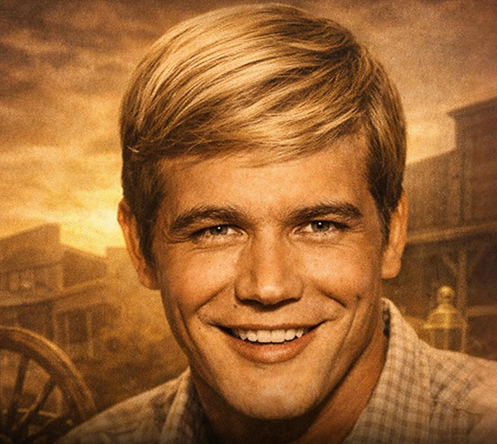
For countless viewers across generations, Gunsmoke was more than just a television show. It was a constant presence in American homes—a steady cadence of justice, resilience, and quiet compassion that unfolded week after week. In many households, Saturday nights belonged to Dodge City. Now, one of the performers who helped bring that town to life has passed away.
Roger Ewing, best known for portraying Deputy Marshal Thad Greenwood on Gunsmoke, has died at the age of 83. His family confirmed that he passed on December 18 at his longtime home in Morro Bay, California—a coastal community he cherished deeply and later served through civic involvement. His passing quietly closes another chapter in television history.
Ewing was never a flashy star or a scene-dominating presence. He didn’t rely on grand speeches or dramatic flourishes to stand out. What he offered instead was something far rarer: consistency, dependability, and calm assurance. When trouble arose in Dodge City, Thad Greenwood was there—steady, capable, and doing his job without fanfare.
Standing 6-foot-4 with an approachable face and an easy, grounded manner, Ewing first appeared on Gunsmoke in February 1965 in the episode “Song for Dying,” playing a minor character named Ben Lukens. Though the role was brief, it left an impression. Just months later, he returned to the series in a more permanent capacity, debuting as Clayton Thaddeus “Thad” Greenwood in the third episode of season eleven.
At only 23 years old, Ewing joined a show that was already a cultural institution. By then, Gunsmoke had been on the air for ten years and was firmly embedded in American television history. Stepping into such an established series was no small challenge, but Ewing blended in almost immediately.
Thad Greenwood was introduced as the son of an aging Oklahoma sheriff, portrayed by the late Paul Fix. The character arrived in Dodge City pursuing men he believed were responsible for his father’s fatal heart attack. Though Thad technically lacked jurisdiction under Marshal Matt Dillon, events unfolded in familiar Gunsmoke fashion: justice prevailed. With the suspects killed or arrested for cattle theft, Thad’s initial mission ended—but his role in the town did not.
Matt Dillon, played by James Arness, recognized the young man’s potential and invited him to remain in Dodge City as a deputy. From that point forward, Thad became part of the town’s emotional framework. He wasn’t the marshal, the doctor, or the saloon owner—but he was always present, learning, assisting, and becoming part of Dodge City’s extended family.
Years later, Ewing reflected on how naturally that dynamic developed. With Thad’s biological family gone, the show’s central characters—Dillon, Kitty, Doc, and Festus—became his surrogate family. If something needed to be done, Thad did it. If backup was required, he was there. That quiet reliability defined the character—and mirrored Ewing himself.
Between 1965 and 1967, Ewing appeared in approximately 50 episodes, during a period when Gunsmoke briefly faced declining ratings. As the series adjusted its direction and later regained momentum, his role was gradually reduced. Eventually, Thad Greenwood was written out, and the deputy position was passed to Buck Taylor’s Newly O’Brien, who remained with the show until its conclusion in 1975.
Behind the scenes, Ewing’s tenure coincided with a transitional period for the series. After Burt Reynolds left the cast, CBS explored ways to attract younger audiences, including introducing younger characters. At one point, internal discussions even questioned the future of James Arness’s role—though those concerns were ultimately resolved, keeping Matt Dillon at the center of the show. Once stability returned, Ewing’s character was phased out—not due to performance, but because the narrative no longer required him.
Roger Lawrence Ewing was born in Los Angeles on January 12, 1942. Long before joining Gunsmoke, he was already a fan. As a high school senior, he once played Chester—Dennis Weaver’s character—in a parody sketch, never imagining that just a few years later he would be wearing a badge on the real set.
After a year of college and a period working as a lifeguard, Ewing committed himself fully to acting. His first screen appearance came in the 1964 film Ensign Pulver, in an uncredited role involving a beer bottle and a duck—an experience he later recalled with amusement. Television work soon followed, including guest appearances on Bewitched, Rawhide, The Bing Crosby Show, and The Baileys of Balboa. He also appeared in None But the Brave, a war film directed by and starring Frank Sinatra.
Ewing often joked about being typecast as tall, slightly awkward young men—roles defined more by sincerity than bravado. That quality, however, made him a perfect fit for Thad Greenwood. He was never meant to replace Matt Dillon, only to support him.
In the late 1960s, Ewing came close to a major film breakthrough when director John Schlesinger reportedly considered him for the role of Joe Buck in Midnight Cowboy. The part ultimately went to Jon Voight, a choice that reshaped both men’s careers. Around the same time, Ewing made a lighthearted appearance on The Dating Game, where future Bionic Woman star Lindsay Wagner chose another contestant.
After leaving Gunsmoke, Ewing continued acting for several years, appearing in Death Valley Days, The Mothers-in-Law, and films such as Smith! (1969) with Glenn Ford and Play It as It Lays (1972). Then, without fanfare, he stepped away from Hollywood.
What followed was a complete reinvention. Ewing became a photographer, traveling widely through Europe, Russia, Mexico, and the South Pacific. He embraced a life far removed from studio schedules, choosing exploration and independence instead.
Later in life, he devoted himself to community service in Morro Bay, becoming involved in local politics and even running for a city council seat in 2003. It was a fitting second chapter for someone who had long portrayed characters rooted in responsibility and service.
To Gunsmoke fans, Roger Ewing will always be Thad Greenwood—the dependable deputy who didn’t need to be the toughest man in the room to matter. He represented the quiet backbone of Dodge City, the kind of presence you often don’t realize the value of until it’s gone.
And for those who grew up watching dusty streets flicker across black-and-white screens, his legacy remains woven into what Gunsmoke symbolized: a place where decency mattered, duty counted, and people showed up for one another.
Roger Ewing showed up.
And that is why he will be remembered.