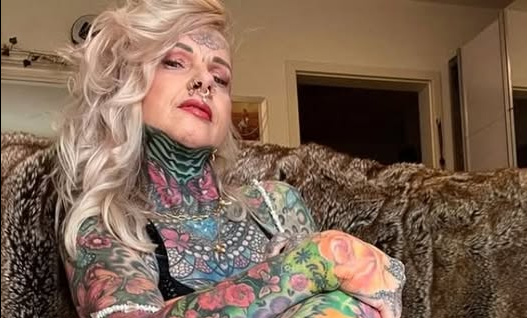
For decades, Kerstin Tristan believed she had a clear stance on tattoos: she disliked them, dismissed them, and never imagined they would play a role in her life. Today, at 56, she is a mother, grandmother, social media personality, and a striking example of how bold self-expression can challenge expectations around age, beauty, and identity. Her body is now fully covered in tattoos, a transformation so dramatic that before-and-after photos continue to captivate audiences worldwide.
Kerstin’s journey didn’t start with rebellion or a lifelong love of ink—it started with restlessness. By her early fifties, she had lived what many would call a complete, responsible life. She raised a family, followed social norms, and played expected roles. But she felt a deep urge for change—not cosmetic, not fleeting, but something real.
In 2015, that desire became action: she booked her first tattoo.
“I simply wanted to try something new,” she later explained. “We only live once, and I felt that at my age, something real had to come.” That first experience shattered her assumptions. What she feared might be uncomfortable or regrettable became empowering. The process, the permanence, and the artistry resonated with her deeply.
From that moment, there was no turning back.
Over the next several years, Kerstin committed fully to her tattoos. Each piece was intentional, part of a larger vision. Vivid roses spread across her legs, leopard patterns covered her shoulders, and detailed portraits, florals, and symbolic designs adorned her arms, torso, and neck. Eventually, there was no untouched skin left.
The financial investment reflected her seriousness. Since 2015, she has spent around €30,000 (over $32,000) on tattoos. For some, that seems shocking; for her, it was an investment in identity, confidence, and freedom. She didn’t see it as money lost—she saw it as reclaimed.
What surprised her most was the public response.
In a world driven by digital platforms and visual storytelling, her transformation quickly found an audience. Her Instagram grew to over 190,000 followers, and her TikTok videos garnered millions of views. People were inspired, not just curious. Many were stunned by the contrast between her previous, tattoo-free self and the bold, fully inked woman she had become.
She often shares comparison photos, showing herself a decade ago alongside her current look. The difference is striking, not only visually but in confidence, expression, and presence. This isn’t about chasing youth—it’s about embracing authenticity.
“When I look at myself in the mirror,” Kerstin says, “I see a beautiful meadow full of flowers that one has to love.” She sees her body as living art, not something to hide or explain.
Her followers share this admiration. Comments describe her as a “work of art” and praise her courage in defying conventional beauty standards. Others thank her for showing that self-expression has no age limit. In a culture that often sidelines older women, Kerstin’s visibility challenges stereotypes.
Her story resonates not just because of the tattoos, but because of timing. Society often frames reinvention as a young person’s pursuit. Midlife and beyond are depicted as times of caution or decline—especially for women. Kerstin’s journey opposes that narrative.
She didn’t get tattoos to shock anyone or gain fame. She did it because she needed to express herself. This distinction reframes body art as alignment, not defiance.
Culturally, her story intersects with discussions on age inclusivity, body positivity, and authenticity. In influencer culture and digital self-expression, authenticity is a prized value—and Kerstin embodies it. She isn’t chasing trends or youth; she is unapologetically herself.
There’s also an economic angle. The tattoo industry, once niche, is now a multi-billion-dollar market. Custom designs and full-body transformations are part of luxury self-expression. Kerstin’s commitment reflects that modern reality, where art, identity, and investment meet.
Criticism exists—some call her choices excessive or inappropriate for her age—but supportive voices far outweigh detractors. She proves that fulfillment has no expiration date.
Kerstin Tristan didn’t lose herself in ink; she found herself.
Her journey sends a clear message: self-expression isn’t limited by age, trend, or approval. It belongs to anyone willing to listen to their inner voice. Whether through tattoos or other forms of self-definition, the courage to evolve is a powerful human trait.
In a world obsessed with conformity and timelines, Kerstin chose transformation on her own terms. She became more than a grandmother with tattoos—she became a symbol of late-blooming freedom, confidence, and the enduring right to live authentically, at any age.