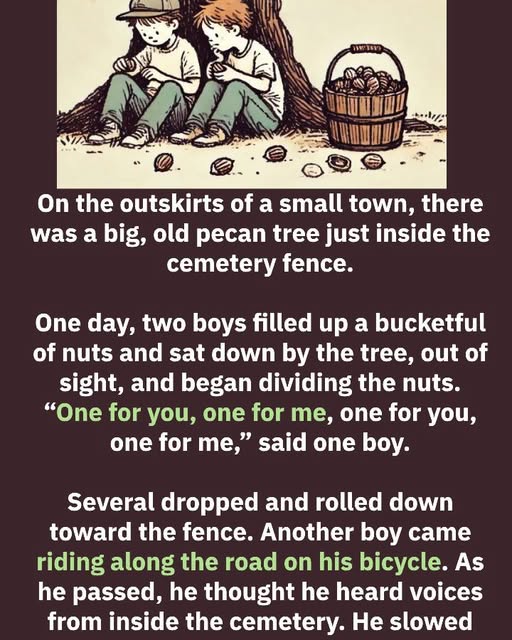
On the very edge of a sleepy little town, where the pavement narrowed and streetlights became few and far between, there was an old cemetery enclosed by a rusted iron fence. Inside that fence stood a huge pecan tree, ancient and generous, its branches spreading wide as though it had been there long before anyone ever thought to mark graves beneath it.
One warm afternoon, when the air felt heavy and the town seemed half-asleep, two boys slipped through a gap in the fence carrying a dented metal bucket. They knew that tree well—everyone did. Its pecans were famous.
They worked quickly, laughing under their breath, shaking branches and gathering nuts until the bucket was full. When they were satisfied, they carried it a short distance away and sat in the shade, hidden from the road.
“All right,” one boy said, tipping the bucket between them. “One for you, one for me.”
He tossed a nut to the left.
“One for you, one for me.”
A few pecans bounced away, rolled through the grass, and came to rest near the fence.
“One for you, one for me…”
Down the road, a third boy rode by on his bike. He wasn’t in a rush, just pedaling for the sake of it, when something made him slow down. Voices. Soft, rhythmic, drifting from inside the cemetery.
“One for you, one for me…”
The boy stopped cold.
He leaned his bike against a fence post and listened more closely.
“One for you… one for me…”
His stomach tightened. He recognized that pattern. He had heard it before—in church, in stories, in warnings whispered by adults who thought children weren’t paying attention.
His eyes widened.
He jumped back on his bike and pedaled as fast as he could, like the devil himself was on his heels.
Just around the bend, he nearly collided with an elderly man walking with a cane, each step careful and slow.
“Mister!” the boy yelled, skidding to a halt. “You’ve got to come quick!”
The old man squinted at him. “Easy there, son. What’s got you shouting?”
“You won’t believe it,” the boy panted. “The Lord and the Devil are down in the cemetery… dividing up the souls!”
The old man frowned. “Boy, don’t make up stories like that.”
“I’m telling the truth! I heard them! They keep saying, ‘One for you, one for me’ over and over!”
The man hesitated, then sighed. “All right. Let’s go look. But if this is nonsense, you’re getting a lecture you won’t forget.”
They made their way toward the cemetery, the boy trembling with fear. When they reached the fence, both of them stopped short.
“One for you, one for me.”
The old man tightened his grip on the iron bars. “Well, I’ll be…”
They leaned forward, peering into the shadows, hearts pounding.
“One for you, one for me.”
They couldn’t see anything—just the tree, the grass, the fence. The voices went on.
Then, at last, they heard, “That’s it. Now let’s grab the nuts by the fence and we’ll be finished.”
The old man didn’t wait for an explanation. He dropped his cane and ran faster than anyone in town had ever seen him move, leaving the boy staring in shock.
Sometimes misunderstanding is funnier than the truth.
Mischief, after all, has a habit of finding children wherever they are.
Take Jimmy and Matty, for instance.
Eight and four years old, they were infamous in their town. If something disappeared, broke, exploded, or mysteriously caught fire, chances were Jimmy and Matty were involved. Their parents had stopped asking questions. They just sighed and started cleaning up.
Eventually, their mother heard about a preacher known for setting kids straight—a man with a thunderous voice and a stare that could pin wallpaper to a wall.
Out of desperation, she made an appointment.
The preacher agreed to see the boys—but separately.
Matty, the younger one, went in first.
The preacher sat him in a large wooden chair, leaned forward, and boomed, “Son… do you know where God is?”
Matty’s mouth dropped open.
No words came out.
The preacher scowled and tried again, louder. “Where is God?”
Matty stared, completely frozen.
The preacher stood up, pointed a massive finger, and thundered, “WHERE. IS. GOD?”
Matty screamed, bolted from the room, ran all the way home, and dove into his closet, slamming the door shut.
Jimmy found him moments later, pale and shaking.
“What happened?” Jimmy asked.
Matty gasped, eyes huge. “We’re in BIG trouble.”
“Why?”
“God is missing,” Matty whispered. “And they think WE did it.”
Children have a special gift for misunderstanding authority.
They also have opinions—especially when it comes to parents.
Two boys once argued loudly on a playground.
“My dad could beat up your dad,” one said.
The other scoffed. “No chance. My dad is way tougher.”
The first boy folded his arms. “Maybe. But my mom is better than yours.”
The second boy nodded thoughtfully. “That’s what my dad says too.”
The truth has a way of coming out when kids talk long enough.
So does desperation.
Two fathers once stood outside a school, waiting for the bell to ring.
“Bill,” one asked, “did you help your son with his math homework?”
“Sure did,” Bill replied proudly. “Solved every problem.”
The other man leaned in. “Any chance I could copy it? Mine’s due in an hour.”
Parenting has never been easy. It’s just gotten louder.
And funnier.
Especially when kids mix logic, imagination, and fear.
Like the boy on the bike.
Like Matty hiding in the closet.
Like every child who has ever leapt to the worst possible conclusion with complete confidence.
That’s the charm of childhood humor. It doesn’t need polish or punchlines. It lives in misunderstanding, exaggeration, and the very human tendency to believe the world is stranger—and far more dramatic—than it really is.
Sometimes the Devil is just two boys dividing pecans.
Sometimes God isn’t missing.
And sometimes the smartest thing an adult can do… is laugh and let the kids keep talking.