From the narrow hospital bed, where machines whispered and fluorescent lights never dimmed, I finally understood that survival is not always about what you endure—it’s about what you stop carrying. My name is Serena Clark. I was thirty-five when a doctor told me a benign brain tumor could still steal my life if we waited too long. Forty-eight hours. That was the window. Surgery or irreversible damage. Maybe worse.
I didn’t cry. I didn’t panic. My first thought wasn’t death. It was logistics. My twin daughters, Amara and Zuri, had just turned one. My husband David tried to reassure me with plans and solutions, but I dismissed him with the confidence of someone who had spent her life fixing other people’s problems. I told him my mother would help. She always should have. She was their grandmother.
David didn’t argue because he knew what I was about to learn the hard way.
When I called my mother, Janelle, and told her I needed help because I was facing emergency brain surgery, she sighed—not with fear, but with irritation. She told me the timing was terrible. She and my sister Alicia had VIP tickets to an Adele concert in Las Vegas. Flights were booked. Hair appointments scheduled. My crisis was an inconvenience.
The word landed like a bruise. Inconvenient.
I tried again. I begged. I explained that the surgery was on Thursday, the concert on Friday. Just one night. One. She refused. Alicia needed this trip, she said. Alicia was fragile. I was strong. I could handle it. I always did.
When I called my sister, she echoed the same sentiment, sharpened by cruelty. She told me I was dramatic. That I wasn’t going to die. That I should stop making everything about me. When I asked her to watch her nieces, she laughed and said she wasn’t a babysitter. Her husband Trevor’s voice cut in, mocking me for being “dependent,” suggesting I just hire help like “normal rich people.”
Then they blocked me.
In that moment, something inside me went silent. Not broken. Finished.
From that hospital bed, with an IV in my arm and a tumor in my head, I hired a private nurse to care for my daughters. And then I made another call. To my bank. I stopped every automatic payment I had been making for my family. The mortgage on my parents’ house. My sister’s luxury car lease. Their phone plans. Every thread of financial support I had woven quietly for years was cut cleanly.
I didn’t announce it. I didn’t threaten. I just stopped.
The surgery was successful. When I woke up, groggy and aching, my first question was about my daughters. They were safe. Warm. Loved. The nurse sent photos. I cried for the first time then—not from fear, but from relief.
While I was under anesthesia, my mother texted me. She didn’t ask if I survived. She asked for money. Trevor’s card had been flagged at a casino. Alicia wanted a handbag. Don’t make this complicated, she wrote.
I saw Alicia’s social media post next. Champagne flutes raised. Adele on stage. The caption read: “Living our best life. Thanks to my sister for the sponsorship. #FamilyFirst.”
They were celebrating while I lay cut open.
In the weeks that followed, the silence broke into chaos. Their phones stopped working. The bank sent notices. The BMW was repossessed in front of an upscale restaurant. My sister screamed. My mother accused me of cruelty. My father begged me to fix it like I always did.
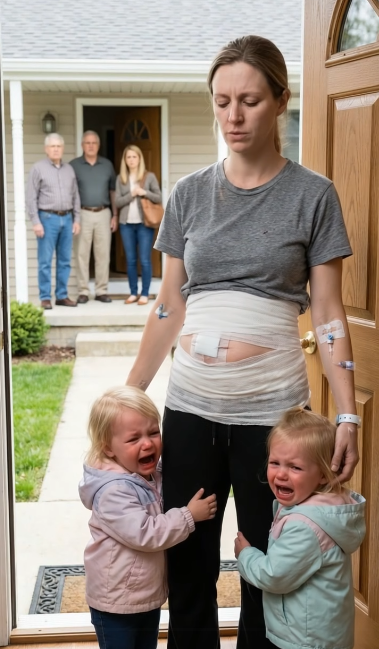
Three weeks after my surgery, they showed up at my door.
They pounded like I owed them oxygen. My mother demanded I turn everything back on. My sister sobbed that her husband had left her. My father whispered that family supports each other.
I listened. Calm. Clear. Whole.
I told them the truth. That family does not abandon a daughter facing brain surgery. That family does not choose concerts over grandchildren. That family does not treat love like a debit card.
Then I told them the final truth.
The house they lived in—the one they claimed as theirs—belonged to me. Five years earlier, when my father gambled away his retirement and defaulted on the mortgage, I bought the house outright to save them. The deed was in my name. They hadn’t been homeowners. They had been tenants.
I was selling it.
Thirty days.
My mother screamed. My sister collapsed. My father stared at the ground. I closed the door while they shouted, and for the first time in my life, I didn’t feel guilty.
Inside, my daughters slept peacefully. Mrs. Joyce hummed hymns in the living room. David held me while the pounding faded into nothing.
I blocked their numbers. Deleted their contacts. Not out of revenge, but necessity. Cutting them off didn’t make me heartless. It made me alive.
The surgery saved my life. Cutting financial ties saved my future.
Some families confuse obligation with love. Some parents raise children to be resources, not humans. Walking away from that does not make you selfish. It makes you free.
From that hospital bed, I stopped all contact, hired real help, and chose survival in every sense of the word. And for the first time, I wasn’t the fixer. I wasn’t the inconvenience.
I was just Serena—healthy, present, and finally untethered from people who only loved me for what I provided.