Some success stories are built on opportunity.
Others are built on survival.
And then there are stories like his—where survival comes first, and everything else has to be carved out afterward, piece by painstaking piece.
Long before the world knew him as Dylan McDermott, before the red carpets, the awards, and the acclaim as one of television’s most compelling leading men, he was just a boy named Mark, navigating a life that would have broken most people before they even had the chance to dream.
He was born on October 26, 1961, in Waterbury, Connecticut, into a world defined more by uncertainty than by comfort.
His parents were barely more than children themselves.
His mother, Diane, was only fifteen. His father, Richard, seventeen. They were too young, too inexperienced, and unprepared for the responsibilities life demanded. Their brief relationship ended when Mark was just two, leaving a void that would shape his earliest understanding of family, love, and loss.
But the trajectory of his childhood would darken even further.
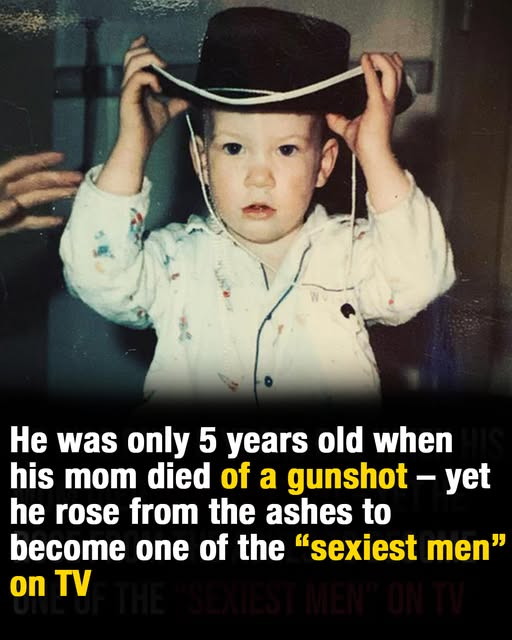
By the age of five, he had already faced a loss so profound it would shadow him for decades. His mother was killed.
The circumstances were murky. Officially, it was labeled an accidental shooting—a tragic event, unfortunate but isolated. But even at that young age, Mark sensed that explanation didn’t fit. He had been close enough to understand the danger that lingered in his home. His mother’s boyfriend at the time was entangled in addiction, violence, and criminal behavior. Arguments, threats, and tension had been a constant, a daily reality no child should endure.
On the night Diane died, Mark had been forced out of the house just moments before the gunshot. He saw enough, understood enough, to know the truth: it was not an accident.
For years, the facts remained buried—official reports incomplete, evidence lost, whispers ignored. But the memory never left him. It became a quiet companion, something to hide deep inside to survive, something to set aside to move forward, yet impossible to forget entirely.
After her death, Mark and his infant sister were taken in by their grandmother, who did her best to provide stability amid chaos. But Waterbury itself was no haven. A working-class city, tough, raw, demanding resilience, it forced him to adapt early. He became acutely aware of his surroundings, learning to read people, navigate social hierarchies, and survive in a world that often seemed hostile to the vulnerable.
Adolescence brought its own struggles. Mark felt awkward, unmoored, uncertain of himself. He looked outward for guidance, for examples of who he could become. He found it in the actors he admired—Marlon Brando, Humphrey Bogart—men whose presence was commanding, whose control of self and narrative seemed like something he could emulate. He studied their movements, their expressions, the cadence of their voices. It was more than imitation; it was experimentation, a way to discover identity through observation and practice.
Meanwhile, his father was living a very different life in New York City, running a bar in Greenwich Village. There, Mark was exposed to a fast-moving, unpredictable world of noise, characters, and tension. By thirteen, he was already working—first as a busboy, then a waiter, eventually tending bar.
“I’ve been punched out many times,” he would later recall.
And yet, those experiences gave him lessons no school could. He learned how to assess people instantly, handle conflict without losing control, and assert himself in situations where the stakes were high. His father, chaotic yet vibrant, became more like an older brother than a traditional parent. They shared late nights, stories, and lessons in resilience, though the home was far from conventional.
Everything shifted when his father remarried.
His stepmother, playwright Eve Ensler, recognized something latent in Mark. Something others hadn’t yet seen: potential.
She encouraged him to act—not as a pastime, but as a path forward.
For the first time, something clicked. Acting was no longer mimicry; it was direction. It was a way to channel pain, observation, and energy into something creative, something that could give form to experience.
He began studying seriously, enrolling at Fordham University and later at the prestigious Neighborhood Playhouse, immersing himself in theater, performance, and the art of storytelling through character. Every lesson, every exercise, every late-night rehearsal became a brick in the foundation of a future he was quietly building.
His first real breakthrough came in one of his stepmother’s productions. The stage became a proving ground, and success there began opening doors. Roles followed, opportunities expanded, and gradually, Mark made a decision that would define his professional identity: he changed his name.
Not for vanity, but necessity and significance. Industry regulations prevented him from continuing under his birth name. He chose “Dylan,” inspired by the poet Dylan Thomas, but also tied to personal history. His father and stepmother had once intended to name a child Dylan—a child they lost to miscarriage. The name carried both loss and connection, linking past grief with a new beginning.
From that point forward, the world knew him as Dylan McDermott.
His career ascended steadily. Early roles led to major projects, establishing him as not just a leading man, but an actor capable of nuance and depth. His work on The Practice earned critical acclaim and a Golden Globe win in 1999. From there, he moved into diverse roles, appearing in American Horror Story and major films like Olympus Has Fallen, proving his adaptability across genres.
Recognition followed: awards, nominations, accolades, and even being named one of television’s “Ten Sexiest Men.”
Yet beneath all that glamour and acclaim, the past never faded.
The truth about his mother’s death lingered, unresolved. Files remained missing, evidence incomplete, and the case dormant, waiting.
Until Dylan decided to confront it.
In 2011, he returned to Waterbury, determined to seek clarity. What investigators uncovered was startling. The weapon at the scene didn’t match the wound. Witness accounts contradicted official reports. Patterns of abuse and neglect emerged—details overlooked or ignored decades earlier.
The case was reclassified: Diane McDermott’s death was not accidental. It was murder.
The man responsible had been identified but would never face justice; years earlier, he had been found dead, alone, in the trunk of a car.
For Dylan, the revelation didn’t offer conventional closure. But it offered clarity—a truth long buried that could finally be acknowledged, understood, and integrated.
He has spoken openly about how those early experiences shaped him. Losing a parent at five changes the lens through which you see the world. It forces growth, resilience, and a capacity to transform pain into something meaningful. It hardens, yet also cultivates empathy, depth, and the drive to create.
“I learned from it,” he has said. And indeed, that learning informs not only his performances but the way he engages with life, relationships, and challenges.
Behind the public image, the awards, the fame, there is a story of survival. A story of resilience. A story of someone who chose to move forward, carrying past wounds not as burdens alone, but as fuel for growth, understanding, and artistry.
Dylan McDermott didn’t simply rise from adversity.
He carried it with him.
And he transformed it into a life, a career, and a presence that continues to resonate—both on screen and off.
Because the heart of his story is not about opportunity or luck. It’s about survival.
And survival, once mastered, becomes something far greater.