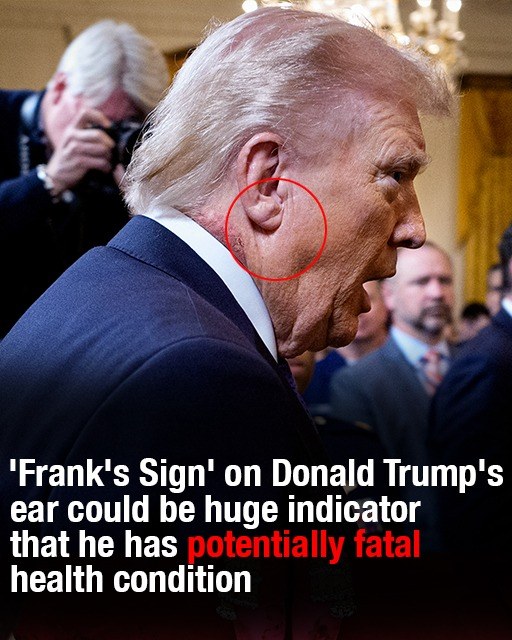
The images from the Medal of Honor ceremony did more than simply reveal a minor skin rash; they revived long-standing questions about the health of a 79-year-old president who continues to insist that he remains in excellent physical condition. What at first appeared to be a small medical detail quickly evolved into a much broader public discussion. Dr. Sean Barbabella described the mark as a “preventative skin treatment,” an explanation intended to reassure the public and calm potential concerns. However, in an era dominated by social media and constant analysis of public appearances, that explanation was not enough to stop the wave of speculation spreading across the internet. Every small sign, every subtle change in appearance or behavior, began to be carefully examined by commentators, analysts, and social media users.
For some time now, nearly every public appearance of the president has been observed with intense scrutiny. A small bruise on a hand, a slightly slurred word during a speech, or even a tired glance captured by a camera has often become the subject of extended discussion. Details that might normally pass unnoticed in everyday circumstances are collected, compared, and interpreted as part of a larger narrative suggesting physical decline or vulnerability. In this way, a single moment captured by cameras can quickly transform into a symbol representing wider concerns about a leader’s health and capacity to govern.
Critics and commentators responded rapidly to any detail that might carry deeper meaning. Media figures and political analysts began examining photos and videos from the ceremony, searching for subtle clues that might indicate something more significant. For example, political commentator David Pakman pointed out a faint diagonal line on the president’s earlobe. He tentatively connected this observation to studies suggesting that such a crease could be associated with cardiovascular risk. Although Pakman himself acknowledged that these observations are not definitive medical evidence and that the scientific connection remains debated, the idea nevertheless lingered in the public imagination. A small anatomical detail began to be interpreted as a possible signal of something far more serious beneath the surface.
This level of scrutiny reflects more than simple concern about a leader’s physical health. It also reveals a broader tension present in modern public life: how citizens perceive transparency, accountability, and vulnerability among their leaders. In a time when information spreads instantly and a single photograph can be analyzed by millions of people within minutes, every public gesture becomes open to interpretation. A smile, a hand movement, or a slight change in appearance may be examined as if it contains hidden messages about a leader’s real condition.
Within this context, the rash itself almost became secondary to the conversation surrounding it. The discussion focused less on its medical significance and more on what it symbolized. For many observers, it became part of a larger narrative about perception, doubt, and the way society interprets the physical condition of political figures. In a sense, a minor dermatological issue became a mirror reflecting collective anxieties about leadership, honesty, and even human mortality.
Journalists and social media users began debating not only what the mark might mean medically, but also what it suggested about public access to information and trust in official statements. The discussion expanded beyond the diagnosis itself to include questions of transparency: how much information is shared with the public, and how much remains within the private circle of advisors and physicians surrounding the president? In such an environment, every detail—no matter how trivial—can be treated as a possible signal pointing toward larger truths or hidden risks.
For the public, these images reinforced a familiar dynamic that often shapes modern political discourse: the tension between reassurance and suspicion. When a political leader provides calm and reassuring explanations, some members of the public accept them as sufficient. Others, however, continue searching for additional signs, examining every detail to see whether it aligns with official statements. In an environment where trust in institutions may be fragile, even the smallest visual cues can be magnified and interpreted as evidence of deeper decline.
Ultimately, the photographs from the ceremony were not simply about a minor dermatological condition. They became an illustration of how image, narrative, and perception interact within modern politics. In an era where nearly every public moment is documented and analyzed, physical vulnerability—whether real or imagined—can easily transform into a symbol representing deeper national anxieties. The reactions surrounding these images demonstrate that society’s interpretation of a leader’s health often reflects broader questions about trust, transparency, and political stability.