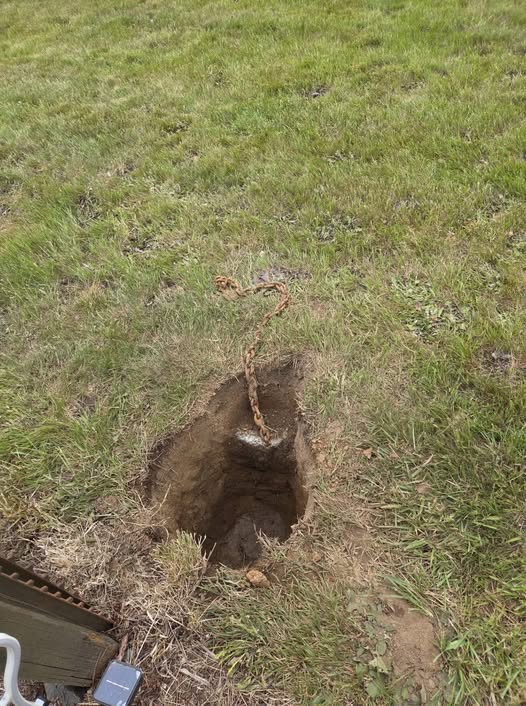
When I finally got around to replacing our mailbox, it didn’t feel like anything significant—just overdue upkeep. The wooden post was cracked, the box leaned awkwardly, and the whole setup looked like it had been slowly losing a battle against weather, gravity, and passing vehicles for years. I expected a simple job: remove the old post, install a new one, and finish before midday.
That expectation disappeared the instant my shovel struck something solid.
It wasn’t the familiar resistance of rock or concrete. It was metal—dense, unyielding metal. I cleared away more dirt and uncovered a thick, rusted chain buried several inches below ground. For a brief moment, my imagination took over. Buried treasure. An old safe. Some long-forgotten cache hidden decades ago.
That idea vanished almost immediately.
What I found wasn’t mystery—it was experience. As I dug further, it became clear the chain led straight down into a concrete anchor. This wasn’t hiding anything valuable. It was an old-school rural mailbox reinforcement.
If you’ve never lived along a country road, it might seem excessive. If you have, it makes perfect sense.
A rural mailbox anchor is a quiet answer to a loud, repetitive problem. The design is straightforward: a heavy chain fixed to an anchor buried deep in concrete, with the other end secured to the mailbox post. From the road, everything looks ordinary. But push it, and it barely shifts. Hit it with a mirror or bumper, and suddenly the mailbox isn’t the fragile part anymore.
Mailbox vandalism used to be common in rural areas. Teenagers would drive by late at night, smashing boxes with bats, hands, or car mirrors. Some thought it was funny. Others just wanted to see something break. The outcome was always the same—destroyed mailboxes and homeowners forced to replace them again and again.
I remember growing up and seeing entire stretches of road stripped bare in a single weekend. On Monday mornings, only broken wood and twisted metal remained. Within days, new posts would appear—often stronger and more intimidating than before.
People adapted. Some filled wooden posts with concrete. Others switched to thick steel pipes sunk deep into the ground. One neighbor wrapped his post with welded rebar like a medieval weapon. After someone hit that one, the message spread quickly.
Standing there with a shovel, staring at that buried chain, I felt an unexpected respect for whoever installed it. They’d clearly had enough. No complaints. No signs. No arguments. Just a permanent, silent solution placed underground.
Out of curiosity, I tugged on the chain. It didn’t move at all. Whatever it was attached to had been set deep and done right. Removing it would require serious effort, maybe even machinery. After a few moments, I stopped trying.
There was no reason to take it out.
In fact, I decided it should stay exactly where it was.
People sometimes question whether these old rural solutions still make sense today. After all, we have cameras, sensors, and smart devices now. But many rural areas lack reliable connectivity, and even when technology works, it only documents the damage after it happens. It doesn’t prevent it.
Physics does.
That doesn’t mean turning a mailbox into a weapon. Intentionally damaging vehicles is dangerous and illegal. But reinforcing something so it doesn’t collapse every time someone is careless or malicious is perfectly reasonable. A strong anchor doesn’t attack—it simply refuses to fail.
There’s something distinctly rural about that mindset. No noise. No confrontation. Just preparation.
That buried chain also reminded me of how things used to be built—not for looks, not for convenience, but for durability. No one was ever meant to see it once it was installed. All that mattered was that it worked. And decades later, it still does.
I set the new post, secured it properly, and filled the hole back in. The chain vanished beneath the soil again, silent and unseen, continuing its job without needing attention. Anyone driving by would never know it existed. Anyone trying to knock the mailbox over might discover it the hard way.
There’s something poetic about that.
People talk a lot about the “good old days,” often with more nostalgia than accuracy. But moments like this feel genuine. They aren’t about romance or simplicity—they’re about grit. About solving problems decisively. About refusing to deal with the same frustration twice.
That old anchor isn’t aggressive. It’s patient. It holds. It waits. It doesn’t announce itself or seek recognition. It just stays buried, doing exactly what it was designed to do.
Call it rural practicality. Call it quiet defiance. Call it overbuilding small things because you’re tired of fixing them repeatedly. Whatever the name, that chain earned its place in the ground.
And now, beneath my new mailbox, it remains. Not as a threat. Not as a trap. Just as a reminder that sometimes the best solutions are invisible—created by people who learned the hard way and decided once was enough.