Every Christmas Eve, something changed in our apartment. The air filled with warmth and comfort—the sweetness of honey-glazed ham, the creamy scent of mashed potatoes, and the golden smell of fresh cornbread. But my mother’s cooking was never only for us. Like clockwork, she always prepared one extra plate, wrapping it carefully in foil as if it were precious. When I was little and asked who it was for, she’d smile and say, “Someone who needs it, sweetheart.”
That someone was a man named Eli.
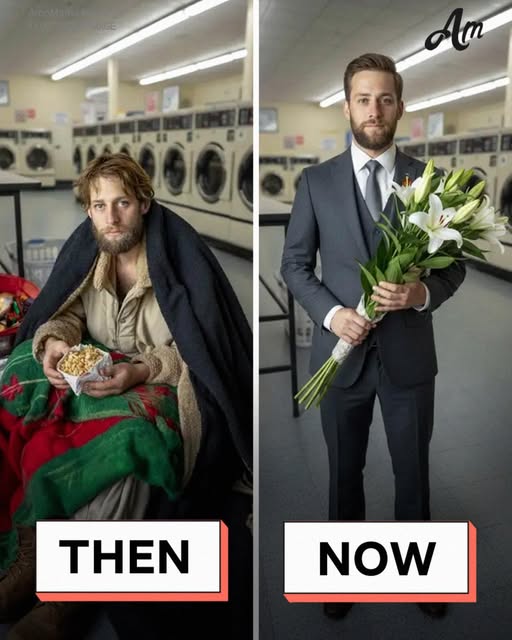
He lived quietly in the corner of a twenty-four-hour laundromat at the end of our block. Thin, bundled in a worn hoodie, everything he owned fit into a single plastic bag. Most people passed him without a glance, but my mother never did. Every Christmas Eve, she knelt beside him, handed him the warm food, and spoke to him like he mattered. Once, I asked if he was dangerous. She answered in a way that stayed with me forever: “A forgotten, hungry person is dangerous. A man who says thank you is not.”
Over time, pieces of Eli’s life emerged. He had grown up in foster care with a younger sister, and when she died in a car accident, his world collapsed. Grief and pride hardened him. He turned down shelters, saying he would “rather freeze than feel indebted.” My mother never argued. She simply kept coming back—with meals, warm socks, and kindness that asked for nothing.
Then everything fell apart.
Cancer took my mother in less than a year. By the time December arrived, I was barely functioning, moving through grief like a fog. On Christmas Eve, standing alone in her kitchen, I could almost hear her voice reminding me, “It’s for someone who needs it.” Acting on instinct and obligation, I cooked a simple meal—chicken, boxed potatoes, canned vegetables—and drove to the laundromat.
I expected to see the familiar man in the torn hoodie.
Instead, I saw someone entirely different.
Eli stood near the dryers wearing a neat, dark suit, holding a bouquet of white lilies. He looked steady. Whole. When he saw me, his eyes filled with tears. “You came,” he said softly.
As we sat together on the hard plastic chairs, the truth my mother had never shared finally came out.
Years ago, when I was a toddler, I had wandered away from her at a crowded county fair. Crying and scared, I ran straight into Eli. He didn’t panic or take advantage of the moment. He simply took my hand and walked me to security. When my mother found us, she didn’t see a threat—she saw the man who protected her child.
She sought him out afterward and began helping him quietly, year after year. She didn’t just feed him; she listened. She told him about my life—my first job, my graduation, the small victories—treating him like family. She helped connect him with counseling and job training. The suit he wore that night was a promise he had made to her: proof that he survived.
Later, standing beside her grave, Eli spoke again.
“She asked me to do one last thing,” he said. “She wanted me to watch over you. To be the brother you never had.”
In that moment, I understood. My mother hadn’t only been saving Eli—she had been preparing someone to stand beside me when she was gone. She taught me that love doesn’t stop with loss; it continues through the lives it touches.
That night, Eli and I ate together in my quiet apartment. And for the first time since my mother passed away, the weight on my chest eased.
I hadn’t just brought food to someone in need.
I had found family.