Military aviation operations represent some of the most intricate and demanding undertakings in modern defense. They involve a precise integration of advanced aircraft systems, highly trained aircrews, and a rigorous set of safety procedures designed to mitigate risk at every stage of flight. Even with decades of engineering advancements, continuous maintenance, and state-of-the-art design, mechanical malfunctions and unexpected technical failures can occasionally arise. When they do, aviation safety protocols provide a structured framework that guides pilots, ground crews, and support personnel through carefully coordinated responses designed to safeguard lives, aircraft, and surrounding infrastructure. Such systems are the backbone of military aviation safety and ensure that even high-risk scenarios can be managed with minimal damage or injury.
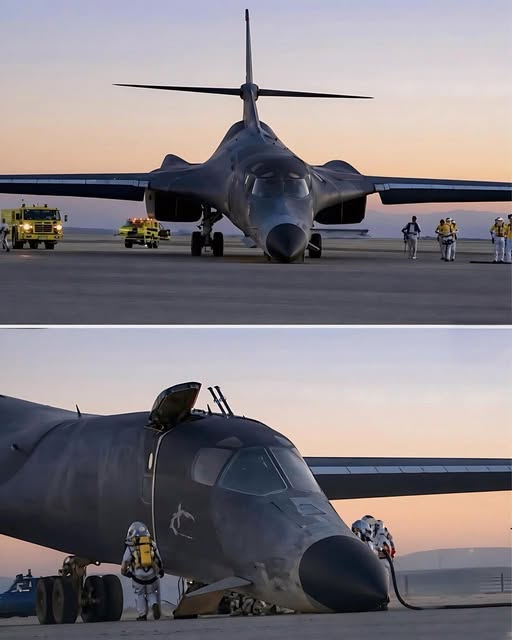
A recent incident involving a B-1B Lancer at Edwards Air Force Base illustrates how these systems function under pressure. The aircraft reportedly experienced a malfunction of its nose landing gear, which necessitated an emergency landing on a nearby dry lake bed. While the event was visually dramatic to onlookers, aviation experts emphasize that such occurrences fall within the anticipated risk spectrum of military flight operations and that the outcome demonstrates the efficacy of structured emergency procedures, rigorous crew training, and specialized response facilities.
The Incident: Emergency Landing Near Edwards Air Force Base
Public reports indicate that during routine flight operations, the B-1B Lancer encountered an issue with its nose landing gear—a crucial component responsible for supporting the forward portion of the aircraft and allowing directional control during taxiing and landing. Malfunctions in this system require immediate, disciplined responses to prevent further complications or structural damage.
Upon recognizing the potential failure, the pilots immediately activated emergency protocols, coordinating with air traffic control and ground safety teams. The strategy focused on a controlled recovery, leveraging both the aircraft’s main landing gear and the specialized features of Edwards Air Force Base. The Lancer executed a main-gear-first landing, gradually lowering the nose onto the dry lakebed surface. Emergency crews were strategically positioned along the landing path, ready to respond in case of fire, fuel leaks, or other hazards. Thanks to precise coordination and adherence to protocol, the aircraft came to a safe stop, and no serious injuries were reported among the crew.
Eyewitness accounts describe a tense scene: sparks flying as the aircraft’s nose gradually contacted the surface, a testament to both the severity of the malfunction and the resilience of the aircraft’s design. While visually alarming, such sparks are expected during emergency landings and do not necessarily indicate catastrophic damage.
Understanding the B-1B Lancer
The B-1B Lancer, a long-range supersonic bomber, entered service with the U.S. Air Force in the 1980s as part of the strategic bomber fleet designed during the final decades of the Cold War. Its development focused on speed, range, and payload capacity, originally with nuclear deterrence missions in mind, though its role has evolved to encompass conventional operations and strategic global missions.
Key features of the B-1B include:
Variable-sweep wings that adjust in-flight to optimize lift, speed, and fuel efficiency.
Four turbofan engines providing long-range supersonic capabilities.
Advanced avionics and navigation systems supporting complex mission planning.
High payload capacity allowing transport of conventional munitions across vast distances.
Despite decades of service, the B-1B remains operational due to continuous maintenance programs, structural inspections, and incremental upgrades, maintaining its strategic relevance alongside emerging platforms like the B-21 Raider.
The Critical Role of Landing Gear Systems
Landing gear systems are among the most critical safety components on any aircraft. They support the weight of the plane during takeoff, landing, and taxiing, and facilitate precise directional control. A modern landing gear system typically consists of:
Main landing gear – supports the majority of the aircraft’s weight.
Nose landing gear – stabilizes the forward fuselage and enables steering during ground operations.
Hydraulic and mechanical systems – extend, retract, and lock the gear securely in position.
Though designed with redundancies, landing gear systems can experience malfunctions due to hydraulic failures, worn components, or sensor errors. A malfunction does not automatically prevent a safe landing but requires careful planning, coordination, and precise execution.
Emergency Procedures for Nose Gear Malfunctions
Nose gear issues are rare but not unprecedented. Military pilots undergo extensive simulator training to prepare for scenarios such as this. Standard emergency protocols typically include:
Assessment of the Situation – Pilots determine if the gear has failed to deploy or lock, exploring backup extension systems if necessary.
Communication With Air Traffic Control – Alerting controllers ensures priority landing clearance and mobilizes ground response teams.
Weight Management – Pilots may hold in the air to burn fuel and reduce landing weight, lessening stress on the aircraft.
Landing Area Preparation – Emergency vehicles and personnel position themselves for immediate intervention.
Controlled Landing Execution – The aircraft lands on main gear first, lowering the nose gradually to prevent sudden impact.
These procedures reflect a combination of pilot skill, engineering foresight, and coordinated ground support.
Edwards Air Force Base: A Hub for Aviation Safety
Edwards Air Force Base is uniquely equipped for emergency aviation operations. Its desert location, extremely long runways, and vast dry lakebeds provide safe landing areas even for compromised aircraft. The base maintains specialized rescue teams trained for diverse aviation emergencies and possesses extensive experience in aircraft recovery operations. Its facilities allow rapid deployment of fire suppression units, medical teams, and hazard containment equipment, minimizing risk during emergency landings.
Crew Training and Risk Mitigation
Military aircrews undergo rigorous and continuous training to handle emergencies. This includes:
Flight simulator scenarios replicating mechanical failures.
Drills for coordination with ground safety crews.
Risk assessment and decision-making under pressure.
Regular evaluation of emergency response procedures.
Training emphasizes discipline, communication, and teamwork, ensuring that crews can manage rare but critical incidents with composure.
Post-Incident Analysis and Safety Reviews
After any emergency event, formal safety reviews are conducted to determine the cause and prevent recurrence. Analysts examine:
Mechanical components and hydraulic systems.
Maintenance and inspection records.
Flight data and cockpit voice recordings.
Crew actions and communication logs.
Such reviews allow the Air Force to refine maintenance protocols, update training, and implement design improvements where necessary.
Aging Aircraft and Future Developments
The B-1B Lancer fleet has been operational for decades, requiring consistent maintenance, structural inspections, and updates to avionics systems. Maintaining older aircraft safely demands rigorous adherence to protocols and continuous monitoring of components. Meanwhile, the next-generation B-21 Raider will eventually replace aging bombers, offering advanced stealth, efficiency, and avionics improvements while reducing operational risks associated with older airframes.
Conclusion: Lessons From the Incident
The B-1B Lancer’s safe emergency landing near Edwards Air Force Base demonstrates:
The effectiveness of structured emergency procedures.
The importance of extensive crew training and preparedness.
The value of specialized infrastructure like Edwards AFB for aviation safety.
The resilience of modern military aircraft under challenging conditions.
While a nose landing gear malfunction presents a serious operational challenge, this event highlights how coordination, engineering, and training converge to protect personnel and aircraft. Aviation incidents like this underscore the ongoing need for vigilance, maintenance, and emergency preparedness in military operations, serving as both a lesson and a reassurance about the robustness of modern aviation systems.