On a bright summer afternoon in Puerto Vallarta, the Malecón buzzed with life in the way only a seaside promenade can. Music from street performers floated through the air. Vendors shouted to attract customers. Children ran barefoot, their ice cream cones slowly melting, and the salty ocean breeze mingled with the sweet scents from nearby stalls. For most, it was the kind of day that would turn into a warm, cherished memory.
For Elena, it became the day time split in two.
Eight years earlier, she had been there with her daughter, Sofía—small, curious, and endlessly chatty. Sofía adored the beach. She loved how the waves chased after her feet and how the gulls swooped low, as though they were part of the game. Elena recalled adjusting her daughter’s braids that morning, tying them neatly, as she always did. She remembered the scent of sunscreen on Sofía’s skin and the way her laughter seemed to echo, carried by the breeze.
They were walking near the water’s edge, just a few steps away from the crowd. Elena turned her head for what felt like an instant. A man brushed past her, muttering an apology in a hurry. Someone dropped a bag of fruit, and oranges tumbled across the pavement. Elena instinctively stepped back, glancing down to avoid tripping.
When she looked up again, Sofía was gone.
At first, Elena refused to believe it. She calmly scanned the crowd, expecting to see her daughter a few steps ahead, maybe distracted by a street performer or a bracelet vendor. She called out her name once, then again, louder.
“Sofía!”
The crowd flowed past. The music kept playing. People kept laughing.
Elena’s heart began to race, waking up to an emergency that had just begun. She pushed through strangers, her eyes darting, searching for familiar braids, familiar clothes, familiar little hands. She ran to the nearest vendor, asking if they had seen a little girl. She repeated the question, changing her description, her tone—hoping the right words would bring her daughter back.
Minutes passed. Then more minutes. And with them, the world around her began to shift.
Security was called. The police arrived. A report was filed. Elena’s voice quivered as she described her child—the color of her hair, her height, the tiny mole near her ear that she always kissed. People combed the beach and the surrounding streets, forming groups of frantic searchers that disbanded as the daylight faded.
By sunset, Elena felt no fatigue. She felt hollow.
That night turned into a week. The week bled into months. Posters were posted. False sightings, cruel pranks, hopeful leads that led to nothing. Elena learned the art of waiting—the way her body stayed tense even when her muscles were at rest, the way hope could feel like an ache. She learned to sleep in fits and starts, afraid to be too far from her phone.
She prayed. Not as a plea for a miracle, but as a quiet defiance against surrender.
Eventually, she returned to Mexico City. She didn’t “move on”—she survived. She kept her small bakery open because it provided structure, and because people depended on it. Every morning, she kneaded dough with hands that shook less than her heart. She smiled at customers. She remembered their names. She said “thank you.” She did everything expected of her, all while carrying the unbearable weight of not knowing where her daughter was.
Her husband had passed away years before, long before Sofía disappeared. Elena had already faced grief once. This, however, was different. Grief has a shape. This grief was hidden within uncertainty.
Eight years passed like this—slowly, painfully, relentlessly.
Then one morning, an ordinary day cracked open into something else.
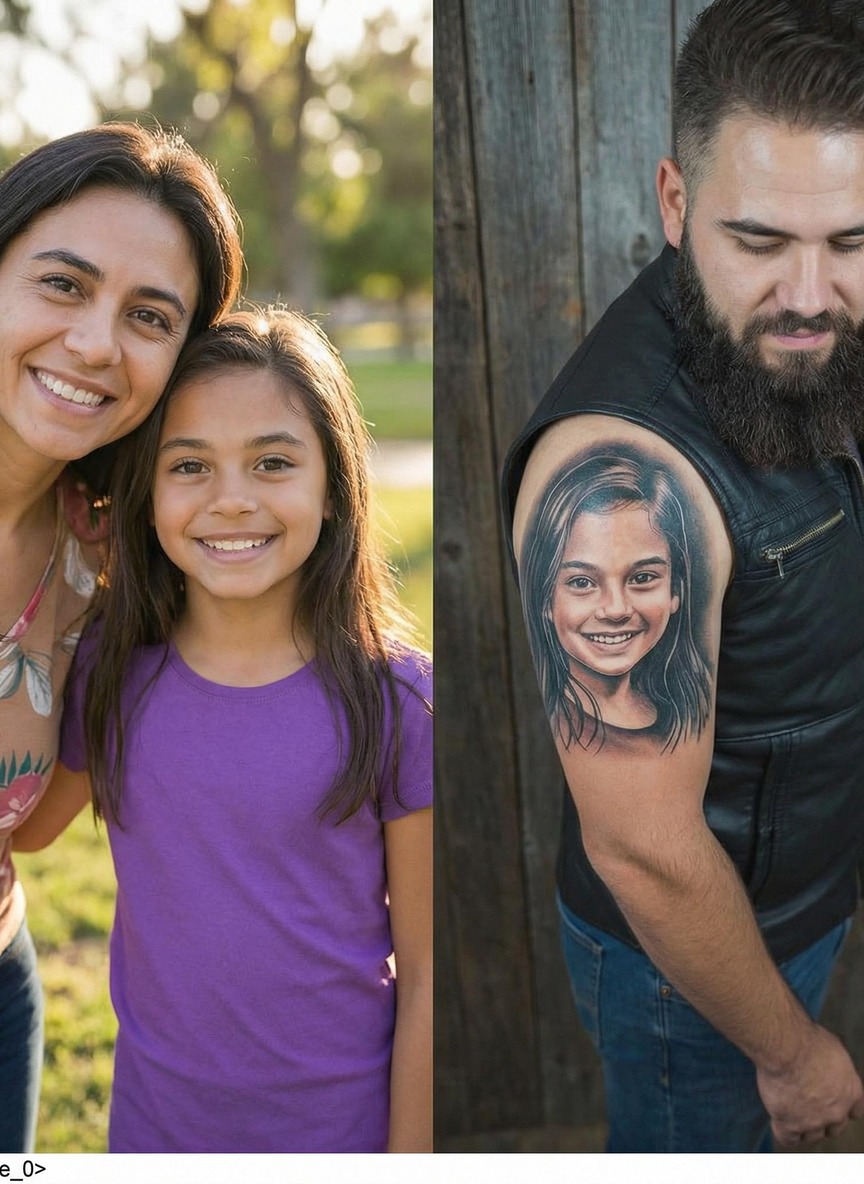
A group of young men walked into her bakery, laughing softly among themselves. They looked like students, the kind who came in for something quick—water, sweet bread, coffee. Elena greeted them and took their order. As she reached for a glass, her eyes caught a tattoo on one of the young men’s arms.
It was a simple portrait: a girl’s face, bright eyes, braided hair.
Elena froze.
Not because the art was extraordinary—she had seen tattoos before. But because something about it felt like recognition that bypassed logic. The braids. The eyes. The slight tilt of the girl’s head, as if she were always about to ask a question.
Elena’s hand gripped the counter to steady herself. Her voice came out softer than intended.
“Who is that?” she asked.
The young man glanced at the tattoo, smiling easily. “My sister,” he said. “Sofía.”
The room tilted.
Elena’s fingers went numb. For a moment, she couldn’t hear the background noise—the bell over the door, the hiss of the espresso machine, the sound of the street outside. All she could hear was the name.
“Sofía,” she whispered, almost like it was sacred and dangerous.
The young man nodded. “Sí. That’s her.”
Elena swallowed hard, her thoughts racing. There were many Sofías in the world. Many girls with braids. Many coincidences.
But her body already knew something her mind was refusing to accept.
She forced herself to breathe. “How old is your sister?” she asked, careful to keep her voice steady.
“Sixteen,” he answered. “She’ll be seventeen soon.”
Eight years. The math struck her like a blow.
The young man noticed her reaction. His smile faltered. “Señora… are you okay?”
Elena stared at him, then back at the tattoo. Her voice trembled. “Where did you grow up?” she asked, her heart pounding.
He hesitated, sensing the shift. “Outside the city,” he said, “in a smaller town.”
Elena nodded, her pulse quickening. “And your sister… how did she come to your family?”
The young man’s expression changed—guarded, then thoughtful, then cautious. He looked at his friends, who had fallen silent.
“My mother found her,” he said quietly. “A long time ago. She was little. She was scared. She didn’t have anyone with her.”
Elena pressed her palm against the counter, grounding herself. “Did she know her name?”
“At first, no,” he admitted. “She barely spoke. But later, she said ‘Sofía.’ My mother believed that was her name.”
Elena’s throat tightened. “Does she remember anything else? A place? A woman? The sea?”
The young man’s eyes softened. “She remembers the ocean,” he said. “She always has. She says she used to hear waves in her dreams.”
Tears filled Elena’s eyes. She looked down, trying to keep her composure.
“My name is Elena,” she said quietly. “Eight years ago, my daughter Sofía disappeared in Puerto Vallarta.”
The words hung between them like a spark waiting to catch fire.
The young man stared at her, his friends still and uncertain. After a long moment, he spoke.
“My name is Daniel,” he said gently. “And… I think you need to meet her.”
Daniel explained what he knew. Years ago, his mother had found a little girl by the roadside, disoriented and hungry. She took her in, cared for her, kept her safe. What was supposed to be temporary became permanent when no one came looking for the child. Love and fear combined, and his mother raised Sofía as her own.
Sofía grew up surrounded by care. She went to school, learned hard work, and was known for her kindness—an understanding of suffering that seemed beyond her years. Before his mother passed, she told Sofía the truth: that she might have another family, that her past held unanswered questions.
Sofía took the news quietly. She wasn’t angry, but she needed to know. Not to punish anyone, but to understand. To complete herself.
Daniel offered to take Elena to meet her.
Elena closed her bakery early for the first time in years, her hands trembling as she locked the door. It felt like her life was about to shift into something unrecognizable.
The clinic was small, clean, built on dedication rather than wealth. Elena followed Daniel inside, her heart thudding in her chest.
And then she saw her.
A young woman behind the desk looked up, sensing something before recognizing it. Braided hair. Familiar eyes. Not identical, not perfect—but unmistakably similar. Something in the way she stood, the sharpness in her gaze, hit Elena like a long-lost memory.
Sofía stood slowly, as if drawn by an invisible force.
Elena took one step forward, then another. The world narrowed again, but this time, it was warm and impossible.
“Sofía,” Elena whispered.
The young woman’s eyes filled with tears instantly. Without hesitation, she moved toward Elena.
They collided into an embrace—no longer polite, no longer careful. It was real. Desperate. Years of absence crashing into one moment. Elena clung to her, afraid to let go. Sofía pressed her face into Elena’s shoulder, sobbing like a child who had finally found the home she had been missing.
In the days that followed, the truth was confirmed—documents, records, formal steps. But nothing changed the truth. The truth had already been spoken in the way they held each other.
Sofía chose to come to Mexico City. Not because she rejected the life she had known, but because she wanted to reclaim what had been taken. The bakery was filled with laughter, with shared meals, with conversations stretching late into the night. Elena listened to Sofía’s stories, each one a mixture of pain and