The sun sank low over the Pacific horizon, draping Puerto Vallarta’s boardwalk in a molten amber glow. To a casual onlooker, it was paradise: the soothing crash of waves, children’s laughter spilling over the sand, the tempting aroma of sizzling street food mingling with the salty air. But for Elena, this coastline was haunted. Eight years earlier, the boardwalk had been the stage of her life’s greatest horror. Her ten-year-old daughter, Sofía, had vanished in a heartbeat. One moment, she had been there—a radiant child in a yellow embroidered dress, hair perfectly braided—and the next, she had vanished, leaving behind only an unbearable silence that would stretch almost a decade.
The memory remained carved into Elena’s mind with a cruel precision. That day had begun as an ordinary family outing, a rare escape from Mexico City. She remembered the scorching sun on her shoulders, the brief moment she looked away to adjust her hat and reach for sunscreen—and the empty space beside her when she turned back. At first, she thought Sofía had wandered off to chase a shell or a kite, but confusion swiftly curdled into a paralyzing dread. Hours bled into days, days into weeks, and the boardwalk became a theater of desperate search: volunteers combing every inch of sand, loudspeakers endlessly broadcasting Sofía’s description. Yet nothing surfaced. No discarded shoe, no scrap of yellow fabric, not even the small cloth doll Sofía had clutched that morning. It was as if the ocean itself had swallowed her.
The years that followed were a grueling march of grief and suspended hope. Elena and her husband, Javier, returned to their small apartment in Roma Norte, but they were shadows of themselves. Javier, crushed by guilt and despair, withered away and passed three years after Sofía’s disappearance. Elena carried on alone, running their modest family bakery. To neighbors and customers, she was steadfast—a woman who opened the shop at dawn, the scent of fresh conchas and pan dulce trailing her like a loyal companion. She smiled, served, lived. Yet in the quiet darkness of night, she clung to a single, unshakeable truth: Sofía was alive. Somewhere. She could feel it, a tether pulling across the void, whispering her daughter’s name into the night as a ritual of faith.
Fate intervened one suffocating April morning, eight years later. Elena sat near the bakery door, seeking a stray breeze, when a dusty pickup rolled to the curb. A group of young laborers entered to buy water and sweet rolls. She greeted them politely, her focus on the transaction rather than the men themselves—until one reached for change and the sleeve of his shirt shifted.
Her heart stopped.
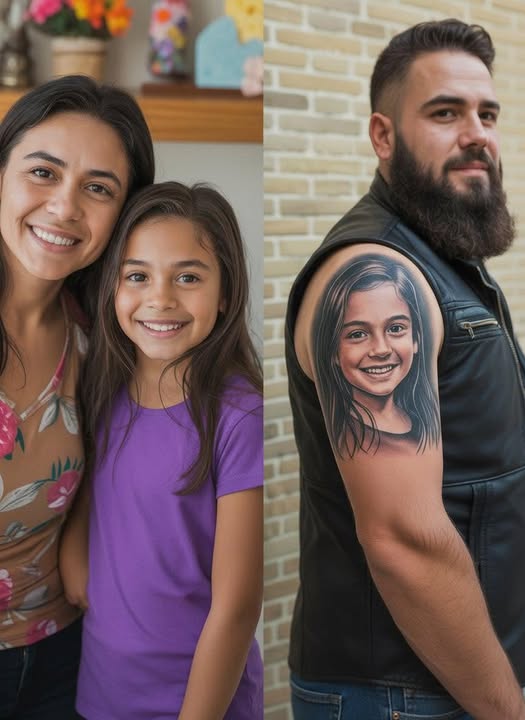
The tattoo revealed a child’s face—braided hair, large soulful eyes—etched in black ink. It was Sofía. The shock was so visceral that Elena gripped the counter to keep from collapsing. Her voice barely a whisper, she asked about the tattoo. Silence fell. The young man, Daniel, met her gaze, somber recognition in his eyes. He explained: the tattoo was of his sister, Sofía.
The story that followed unraveled years of agony in a tangle of coincidence and human error. Daniel recounted how his mother had found a terrified little girl near a busy road years ago, a girl speaking of a beach and a yellow dress, crying for a mother she couldn’t find. Fearing the authorities, she had kept the child, raising Sofía as her own. Daniel, suspecting the truth as he grew, remained silent out of loyalty. Sofía had grown into a compassionate young woman, carrying only faint memories of her “first mother’s” bedtime prayers.
By that afternoon, Elena was on her way to a small community clinic where Sofía worked. The drive blurred with prayer and terror—would the girl recognize her, or would the past be erased? Entering the clinic, Elena saw a young woman behind the desk, her hair braided just as it had been. Recognition struck instantly. Sofía’s lips parted, uttering the word “Mom”—not a question, but an anchored truth.
They collapsed into each other’s arms, a raw, unguarded reunion. Time and distance dissolved instantly. Sofía revealed that she had kept the worn cloth doll from the boardwalk, a tangible relic of the life that had nearly been lost.
Medical tests and legal paperwork soon formalized what their hearts already knew. Sofía chose to return to Mexico City, moving back into the apartment above the bakery. The shop, once a place of dutiful solitude, blossomed again with laughter and energy. Sofía learned the family recipes, her hands moving through dough with her father’s rhythm, while Elena navigated the digital age alongside the vibrant life of the daughter she had almost lost.