No one ever really tells you what a city sounds like when the power goes out.
Most people imagine silence. A pause, dramatic and cinematic, like the world itself is holding its breath. That’s not what happens. Silence isn’t the absence of noise—it’s the sudden exposure to every sound you were never meant to notice, amplified, cruelly clear.
When the blackout hit the eastern half of Chicago, in the dead of winter, the city didn’t pause. It fractured. Somewhere unseen, glass shattered. Sirens wailed, directionless and confused. Metal groaned as it contracted in the cold. And beneath it all, lingering like a heartbeat I couldn’t ignore, was the sound of human breath—the uneven, desperate breathing of those left outside, wandering or trapped, because they had nowhere else to go.
I was one of them.
At twelve years old, I wasn’t just homeless. I was a cartographer of the city’s hidden rules. I knew which streetlights flickered longest before succumbing to darkness, which building lobbies tolerated a kid who looked clean enough, and which steam vents bought ten minutes of warmth before moisture froze on clothes, transforming comfort into ice. I understood the city better than the people who designed it.
That night, the map failed me.
The temperature dropped quickly, the kind of cold that doesn’t announce itself—it seeps into your joints, stiffening limbs and thoughts alike. Wind from the lake cut across the streets like a living thing, purposeful, personal, aiming for you. I was making my usual loop near an abandoned transit depot, counting steps to keep my mind from drifting, when I heard it.
Not a scream. Screams provoke action. This was worse. Soft, rhythmic, almost polite—the sound of someone who had already exhausted panic and was now waiting quietly for the world to decide their fate.
Every instinct told me to keep moving. Don’t look. Don’t stop. Curiosity gets you noticed, and noticed gets you hurt. But the sound pressed against my ribs, like it belonged to me, like it had always been inside.
I cursed under my breath and turned behind a row of snow-dusted food trucks.
There he was.
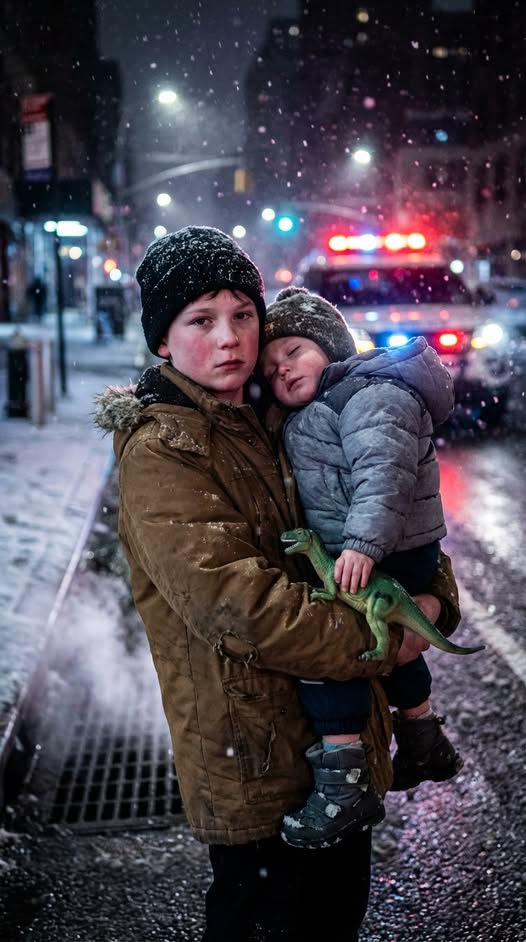
A boy. No older than five. Maybe younger. His jacket, serviceable in October, was a useless trap against the winter cold. His lips were blue, the kind of blue that doesn’t just signal cold—it signals danger. In one stiff, shaking hand, he clutched a bright green plastic dinosaur, clinging to it as though it could fight the cold for him.
He looked up at me, eyes wide, expression calm. No tears. Too cold for tears.
“My dad said to stay here,” he said. “He said he’d be right back. Then the lights went out.”
Something twisted in my gut.
“How long ago?” I asked.
He shrugged, slow and heavy. “Since the sun went down.”
I looked up. It was well past midnight.
I tried to pull him to his feet, but his legs folded like wet cardboard. His body had already begun the process I’d seen before in the underpasses and alleys: shutting down the extremities to protect the core. If he stayed another minute, he might not wake up.
The streets were desolate. Shelters had filled hours ago. Buses stood like frozen iron tombs. Hospitals ran on generators, turning people away unless blood was involved.
I had a choice: walk away and survive my own night, or take on a weight that might kill us both.
I crouched, turning my back to him. “Get on,” I said. “We’re leaving.”
When his icy little hands wrapped around my neck without hesitation, I knew we’d crossed a line neither of us could ever uncross.
His name was Oliver. He smelled like cold fabric and fear. I made him talk as we moved—about his dinosaur, cartoons, anything. Silence was dangerous; stillness was deadly. The nearest place with warmth was St. Jude’s Community Center, nearly three miles away. Every snow-packed block felt like a continent.
Halfway there, the city showed its teeth.
Shadows shifted near a smashed storefront. Looters, desperate and reckless. A flashlight cut through the snow. Someone shouted. I sprinted.
I knew the alleys. I knew fences with gaps, dumpsters that blocked sightlines. My lungs burned. Oliver bounced against my back, dead weight threatening to knock me over.
We ducked into the vestibule of an old, boarded-up bank. Hearts thundering, I shook him awake. “No sleeping,” I whispered. “What’s the dinosaur’s name?”
“Rex,” he murmured. “He eats bad guys.”
Good. We needed one of those.
Two blocks later, one of his shoes had disappeared, his sock soaked and freezing. Panic flared. I wrapped his foot with my scarf, then did the only thing left—I removed my jacket and wrapped him tightly. The cold slammed me like a punch.
By the time we reached St. Jude’s, I couldn’t feel my fingers. Inside, the lights glowed yellow and soft, like another world. I pounded on the door until someone answered. Hands reached for Oliver. Voices shouted for blankets. Heat slammed into me so fast I almost blacked out.
I don’t remember collapsing.
I woke up in a hospital two days later. Severe hypothermia. Frostbite starting in my fingers. A nurse told me I had been lucky.
Later, a social worker visited. Oliver’s father had been found—confused, injured, frantic. He hadn’t meant to leave him. The blackout had swallowed everything. Oliver was safe.
I was sent to a group home. Then another. Life didn’t magically improve. The city remained loud. Still dangerous.
But something had changed.
Years later, after leaving the alleys and steam vents behind, I stood outside a community center at a winter fundraiser. A man approached me, holding a small boy. The kid gripped a battered green plastic dinosaur.
“This is Oliver,” the man said. “He wanted to meet you.”
Oliver smiled. “Rex still eats bad guys,” he said.
For a moment, the city was quiet. Not empty, not dead—but steady.
Sometimes survival isn’t about saving yourself.
Sometimes survival is about refusing to leave someone behind, even when the night is cold enough to take everything from you.