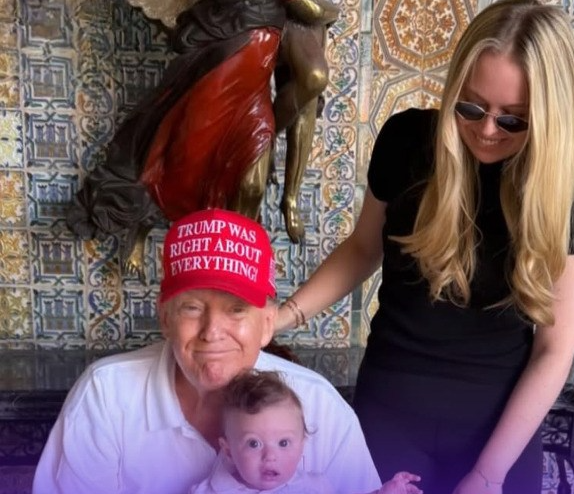
Tiffany Trump’s latest Instagram post should have been just another casual family snapshot, a quiet, ordinary moment: a grandfather holding his grandson, a pause in life between the storms of public scrutiny. But for Tiffany, every photo she shares carries layers of meaning. In this case, the post became a subtle answer to her father’s recent, unusual public remarks — remarks that once again highlighted her lifelong position within the Trump orbit: visible, yet somehow peripheral.
The images themselves were simple, almost disarming. Donald Trump sat with little Alexander perched on his lap, the boy gripping a pen with the intense concentration only toddlers can muster. Tiffany’s caption read: “Grandpa and Alexander hard at work.” No politics, no commentary, no rebuttals — just a moment of family life bathed in soft light, carrying an unspoken message.
And yet, the context was loud. Days before, Donald Trump had veered off-script during a public appearance, praising Tiffany for her achievements at Georgetown Law, but then embellishing the story: claiming her 2020 graduation ceremony had been canceled not because of the global pandemic, but because she had “done so well” and because her family name supposedly made her a target. The audience responded with puzzled silence, as the claim was demonstrably false, yet delivered with the confidence Trump often brings to reshaping personal and public history in real time.
Tiffany responded in her usual way: quietly, deliberately, and without public confrontation. No statements correcting her father, no emotional rebuttals. Instead, she posted images of her son, Alexander, sitting with the grandfather whose words often speak louder than hers in public.
Tiffany has long been dubbed the “forgotten daughter” — a label born of years of physical and symbolic distance. Raised primarily by her mother in California, she grew up outside the central Trump orbit. While her siblings were groomed for public attention — polished, branded, elevated — Tiffany remained in the background, pursuing her studies at Georgetown Law and quietly building a life away from the spotlight.
Her Instagram post reveals that life: a small child, a home that feels calm and intimate, a world more private than the high-profile lives of her siblings. But even in this peace, the gravity of public attention persists. A simple photo of her father holding her son inevitably invites scrutiny because in a political dynasty, private moments become public signals.
The timing of the post was notable. It arrived just as online discussion swirled about her father’s claims, reframing a pandemic year in personal terms. Trump’s intentions weren’t malicious — often, his embellishments serve to cast his children as exceptional or singled out — but they distort reality. Tiffany’s response, as always, is subtler: she communicates not through confrontation, but through selective visibility, allowing her images to speak for her.
In the photographs, Alexander is oblivious to politics, conspiracy theories, or the online dissection of every gesture his grandfather makes. He is simply a child absorbed in the present, a pen in his hand, safely seated on a grandparent’s lap. The contrast between the innocence of the boy and the intensity of the adult world around him is striking, almost poetic: life continues quietly amidst the noise.
Public reaction to Tiffany’s post was mixed, as always with anything Trump-related: curiosity, warmth, speculation, and the usual polarizing commentary. Observers noted how rare it is for Tiffany to include her father in her posts and wondered whether the images were a deliberate effort to reset the narrative, show unity, or simply highlight a personal truth.
The reality is likely simpler. Tiffany values privacy. She rarely engages in public political debate, avoids the theatrics of family business, and chooses what to share carefully. This post is a reflection of her selective visibility: a quiet assertion of what matters to her, without feeding into drama or speculation.
The images of her father holding Alexander demonstrate a different side of Trump, one that rarely surfaces publicly — humanized, calm, focused on family. They also show Tiffany claiming her own narrative: a private life within a highly public family.
She did not address the graduation comments directly, and probably never will. Public correction would create headlines she does not seek. Instead, she posted a family moment, redirecting the story without uttering a word. Her followers understood the message: this is what matters to me; this is what I choose to show.
Alexander, now part of the extended Trump lineage whether he wants it or not, is among eleven grandchildren, some already central in public campaigns and holiday photos. Tiffany’s protective approach has shielded him thus far, though that circle is inevitably widening.
Family moments in such a high-profile family become political signals whether intended or not. Tiffany’s post suggests balance, the delicate equilibrium she has navigated all her life: close enough to belong, distant enough to maintain autonomy.
Her father’s statements may continue to be unpredictable, embellished, or detached from fact. Tiffany’s response remains steady, quiet, and deliberate. She communicates in her own language — subtle, soft, and meaningful.
A child seated on a grandfather’s lap, a pen in hand, a calm moment captured in a chaotic world — perhaps that is Tiffany Trump’s message, intentional or not: life, family, and quiet choices persist, even when the noise around you does not.