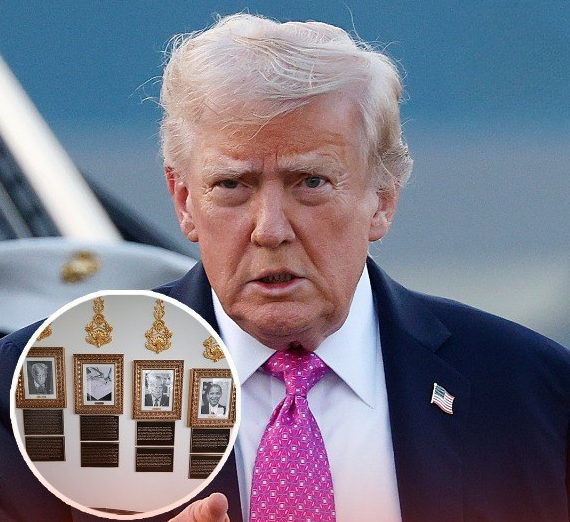
The White House, long regarded as a space of solemnity, historical continuity, and bipartisan respect, has recently become the focal point of a heated national debate. The source of this controversy is a set of newly installed plaques beneath presidential portraits in what has been dubbed the “Walk of Fame.” Unlike the neutral, factual biographies traditionally displayed, these plaques deliver sharply partisan—and often disparaging—assessments of former presidents. According to the White House Press Secretary, Donald Trump personally authored the texts, marking a stark departure from the usual decorum of the Executive Mansion.
The harshest critiques target Trump’s immediate Democratic predecessors. Beneath Barack Obama’s portrait, the plaque portrays the 44th president as “one of the most divisive political figures” in American history. It condemns the Affordable Care Act, describes the Obama-era economy as stagnant, and criticizes the Iran Nuclear Deal as a diplomatic failure. The text further accuses Obama of projecting global “weakness,” allegedly enabling the rise of ISIS and Russia’s annexation of Crimea. By embedding these critiques into the White House itself, the current administration has turned a historical exhibit into a permanent campaign-style attack.
The plaque dedicated to Joe Biden escalates the personal animosity. Departing from all presidential precedent, it uses Trump’s campaign-era nickname, “Sleepy Joe,” and calls Biden the “worst President” in U.S. history. It repeats unproven claims of a “corrupt” 2020 election and attributes multiple national and international crises solely to him, including high inflation, the “lost” southern border, and the chaotic withdrawal from Afghanistan. It further alleges that his policies encouraged foreign adversaries, citing Russia and Hamas.
In contrast, plaques honoring Republican leaders are overtly laudatory and align their legacies with Trump’s political brand. Ronald Reagan is celebrated as the “Great Communicator,” with a note highlighting his supposed early admiration for Trump. Richard Nixon, often treated with historical caution, receives praise focused on his political comeback and electoral successes, omitting any reference to Watergate or his resignation.
Trump’s own plaque is the most expansive, resembling a manifesto more than a biography. It portrays his presidency as a heroic struggle against a “Deep State,” boasting of overcoming “unprecedented weaponization of law enforcement” and surviving assassination attempts. The plaque declares that he ushered in a “Golden Age” for America, citing the end of foreign wars, border security, and mass deportations of criminal gang members.
The response to these plaques has been swift and broadly critical. Opponents argue the White House belongs to the American people, not any individual occupant, and that using it to defame rivals abuses public space. California Governor Gavin Newsom described the move as “petty” and a “desperate distraction” from pressing national issues. Historians warn that this represents dangerous “partisan revisionism,” potentially altering the official record to suit the sitting president’s personal grievances.
Observers note that the plaques reflect Trump’s political style, which blurs the line between official duties and personal branding. By placing these “insult plaques” in a gallery seen by foreign dignitaries and visitors, the administration signals that the era of respectful, impartial presidential transition may be over. Scholars argue that this undermines the dignity of the office, turning the White House into a venue for juvenile, internet-style trolling.
Long-term concerns also loom. Historically, the White House portrait gallery symbolizes the endurance of the presidency—the office persists even as leaders change. By introducing vitriol, the administration risks establishing a precedent of “retaliatory history,” where each new president could replace predecessors’ plaques with insults of their own.
Legal and ethical questions are also being raised. While presidents have broad discretion over White House decor, using federal funds for what effectively amounts to personal or campaign messaging could contravene ethics rules, including the Hatch Act. Yet, in today’s political climate, these concerns are often overshadowed by the audacity of the act itself.
Ultimately, the debate over the “Walk of Fame” plaques is about more than decoration; it concerns control over the American narrative. Supporters view the plaques as “truth-telling,” breaking through establishment facades. Critics see them as evidence of insecurity and a rejection of the humility expected of national leaders. As the plaques remain, the White House bears a jarring, divisive mark. The “Golden Age” proclaimed on Trump’s own plaque remains debated, but the “Age of Grievance” he has inscribed into the building is now part of its historical record.