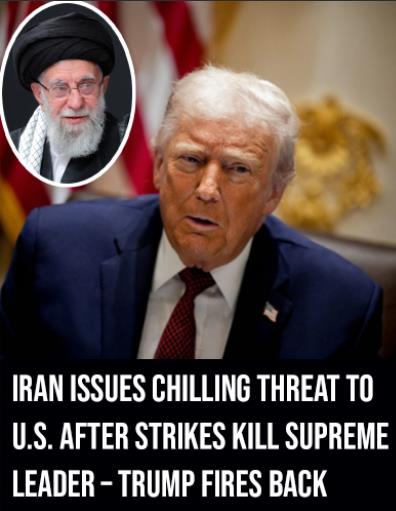
US airstrikes. A dead Supreme Leader. And a chilling promise of “devastating blows.” In one explosive, history-altering weekend, Donald Trump and Israel launched a meticulously coordinated military operation that struck at the very heart of Iran’s political and religious hierarchy. Ayatollah Ali Khamenei, the figurehead of the Islamic Republic, was killed in a strike that sent shockwaves through Tehran, the Middle East, and the world at large. The immediate fallout was staggering: Iranian leadership scrambled to consolidate control, militias went on high alert, US and allied bases across the region elevated their security protocols, and both sides exchanged increasingly brazen threats of unprecedented retaliation. The international community, long accustomed to simmering tensions, suddenly faced the terrifying prospect of a fully escalated regional conflict—one that could draw in powers far beyond the Middle East.
Trump’s decision to greenlight the Tehran strike represented a point of no return, a moment where cautious diplomacy was abandoned in favor of calculated, high-stakes military action. By eliminating Khamenei and key senior officials, Washington and Jerusalem didn’t merely remove a regime figurehead; they struck at the symbolic and ideological core of the Islamic Republic itself. The message was unmistakable: the leadership structure that had governed Iran for decades had been breached, and the consequences would ripple through the country’s political, religious, and military institutions. Iran’s immediate response was both swift and incendiary, launching waves of drones and ballistic missiles toward American assets and regional allies. Intelligence reports indicated that Tehran had placed every US installation in the Gulf and surrounding territories on heightened alert, signaling that no target would remain off-limits. The rhetoric emerging from Iranian officials was unambiguously combative, void of traditional diplomatic nuance, emphasizing instead revenge, retribution, and the dismantling of what they called the “aggressor’s foothold in the region.”
Meanwhile, President Trump escalated the crisis further through his Truth Social posts, framing the confrontation in terms that merged personal vendetta with national strategy. He promised to “obliterate” Iran’s missile capabilities, warning of a “force that has never been seen before” being unleashed in response to any retaliation. This public escalation transformed the standoff into a highly personal showdown, in which the stakes were not only national security and military dominance but also the cultivation of an image of unyielding strength. His messaging, coupled with Israel’s coordinated military posture, sent Tehran a clear signal: any strike against US interests would trigger a swift, overwhelming, and unpredictable response. The combination of formal military action and social media declaration intensified fears across global capitals, as governments and financial markets scrambled to assess the potential for escalation and regional destabilization.
Iran, for its part, responded with uncharacteristic defiance, declaring that “red lines had been crossed” and that “devastating blows” would come in return. Statements from the Revolutionary Guard and other paramilitary leaders painted a picture of a nation ready to retaliate across multiple fronts—targeting US bases, Israeli installations, and possibly even American allies in the region. Intelligence agencies reported accelerated missile deployments and the mobilization of proxy forces in Iraq, Syria, and Lebanon. The rhetoric was not idle; Tehran signaled its intention to demonstrate that the death of Khamenei would not be treated as a singular event, but as a provocation that justified a historically severe counterstrike. Analysts warned that the speed of retaliation, combined with miscommunication, could easily spiral into a wider regional war that no one could fully control.
The psychological impact of this operation extended far beyond military circles. Civilians across Iran, Israel, and the Gulf states braced for the possibility of aerial bombardments, missile strikes, and ground skirmishes. Embassies were evacuated, energy markets spiked in volatility, and international organizations called for urgent de-escalation, though few held out hope that diplomacy could immediately temper the momentum of hostility. The global media cycle, as always, amplified every statement, every threat, every movement, creating a feedback loop in which fear and speculation propelled the crisis further into public consciousness.
In sum, the weekend’s events marked a dramatic shift in the balance of power and perception. Trump’s strike, the death of Iran’s Supreme Leader, and the retaliatory promises that followed did more than destabilize a single nation; they recalibrated the strategic calculus for the entire Middle East. The fragile equilibrium that had prevented full-scale war for decades was shattered, replaced by a volatile and unpredictable standoff, where a single misstep—by a pilot, a commander, or a political leader—could ignite a broader conflict. The world now watches with bated breath, aware that the next exchange, however small, could reverberate far beyond Tehran or Washington, reshaping alliances, economies, and the lives of millions caught in the crossfire.