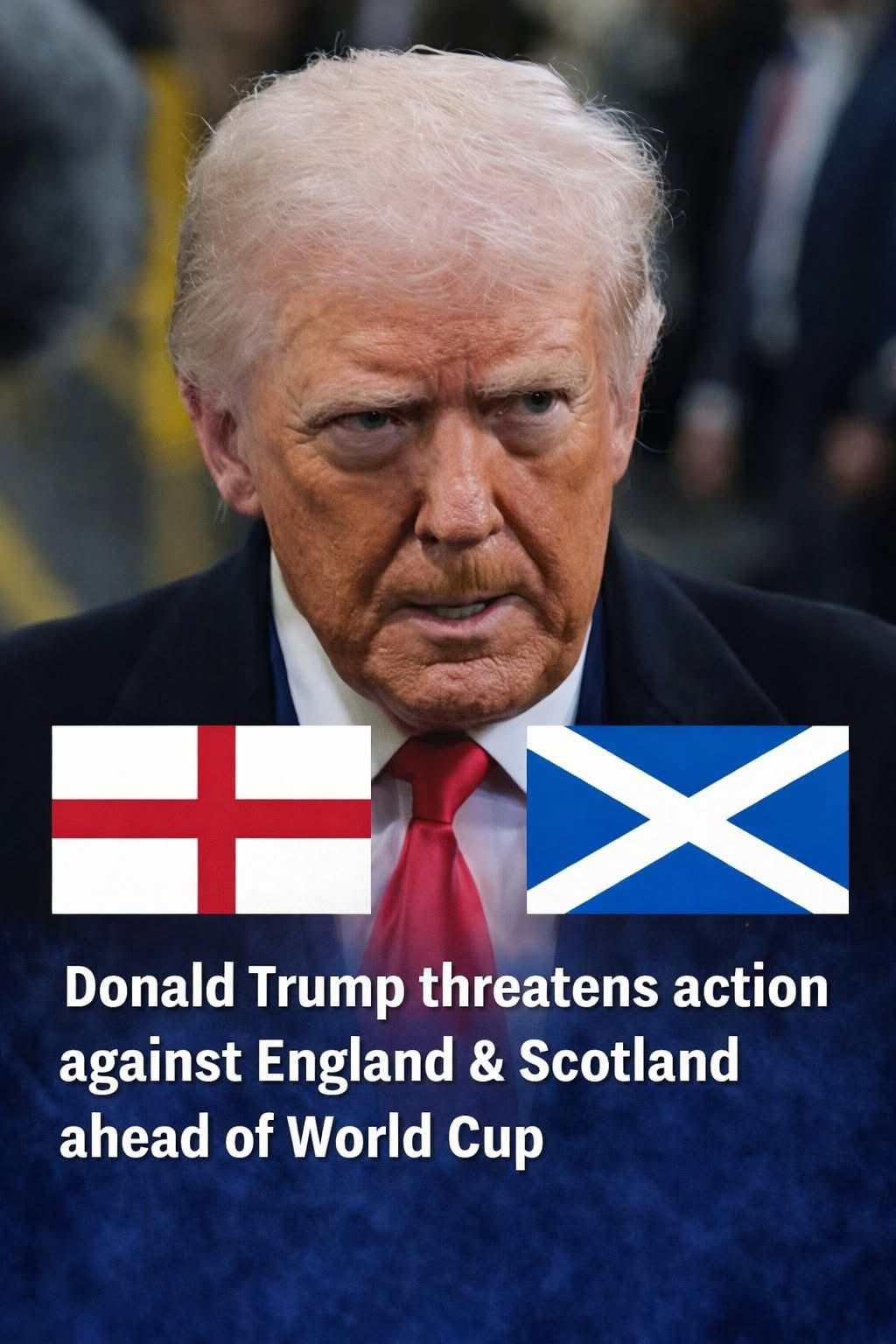
The international political climate has entered a period of renewed strain as Donald Trump revives a contentious initiative many believed had been left behind with his previous presidency. With the 2026 World Cup on the horizon—an event traditionally associated with cooperation and global unity—the former U.S. president has instead turned the spotlight toward escalating confrontations with key European allies. Central to this growing diplomatic dispute is Trump’s revived determination to see the United States acquire Greenland, a concept that has shifted from an offhand proposal into a central pillar of his current national security narrative.
Trump’s renewed focus on Greenland stems from his conviction that the island represents a critical strategic stronghold in an increasingly competitive Arctic region. In recent remarks, he has framed American ownership not as territorial ambition, but as a stabilizing necessity in a world marked by shifting power dynamics. He points to the expanding Arctic presence of Russia and China, warning of what he describes as a dangerous “security gap” that, in his view, only the United States is capable of addressing. According to Trump, rival powers are actively seeking long-term positions on the island that could undermine U.S. interests and weaken NATO’s defensive framework.
Greenland, however, is a self-governing territory within the Kingdom of Denmark. While it maintains control over its domestic affairs, matters of defense and foreign policy remain tied to Copenhagen. Danish and Greenlandic officials have responded with firm and unequivocal resistance. Danish Prime Minister Mette Frederiksen has repeatedly dismissed the notion of selling Greenland as unrealistic and unacceptable, a stance that has only hardened as Trump’s rhetoric has intensified. Leaders in Greenland have echoed this position, emphasizing that while they welcome cooperation and investment, their land is not available for purchase.
What has pushed this long-standing issue into a full-scale diplomatic confrontation is Trump’s recent turn toward economic pressure. Through a combination of public speeches and social media statements, he has widened his criticism beyond Denmark to include several major European nations. The United Kingdom, Norway, Sweden, France, Germany, the Netherlands, and Finland have all been singled out. Trump has accused these countries of traveling to Greenland for “unclear and suspicious reasons,” suggesting a covert European effort to weaken American strategic influence in the Arctic.
Tariffs have become Trump’s primary tool in this campaign. He has threatened to impose heavy trade penalties on goods imported from the targeted European states, arguing that financial pressure is necessary to force negotiations over Arctic security. These announcements have unsettled international markets and cast uncertainty over World Cup preparations. Critics argue that leveraging a global sporting event as the backdrop for trade disputes represents a sharp break from established diplomatic norms and risks alienating the very allies the United States depends on for economic and military cooperation.
The inclusion of the United Kingdom—specifically referencing England and Scotland—has strained the traditionally close U.S.-UK relationship. British officials have expressed confusion over claims of “unknown purposes” in Greenland, noting that Arctic research missions and environmental monitoring are routine international activities. The prospect of new tariffs comes at a delicate moment for Britain’s economy, and the idea of a trade conflict with a close ally over Greenland has triggered significant criticism within the UK.
Although Trump has vaguely referenced military considerations in the broad context of national defense, his strategy remains focused on economic leverage rather than force. He has accused European allies of benefiting from American protection while simultaneously engaging in what he labels strategic maneuvering in the Arctic. By tying Greenland’s acquisition to arguments about fair trade and global security, Trump is attempting to reframe a traditional territorial expansion as a modern geopolitical necessity.
Reaction from the global community has been swift and overwhelmingly negative. European Union leaders have condemned Trump’s threats as violations of Danish sovereignty and Greenland’s right to self-governance. Many analysts interpret the situation as a stress test for European unity, with concerns that targeted economic pressure could fracture alliances and provoke retaliatory tariffs, potentially destabilizing the global economy at a time of heightened geopolitical uncertainty.
Within the United States, opinions remain sharply divided. Supporters view Trump’s stance as a decisive effort to secure American dominance in an emerging strategic frontier, pointing to Greenland’s mineral resources and geographic importance. Critics, however, argue that the campaign undermines international law, damages U.S. credibility, and disregards the cooperative frameworks that govern Arctic affairs, which emphasize diplomacy over unilateral action.
As the 2026 World Cup approaches, the convergence of global sport and high-level geopolitics has become impossible to ignore. The tournament—jointly hosted by the United States, Canada, and Mexico—was meant to celebrate international camaraderie. Instead, discussions surrounding the “Greenland issue” now loom over participating nations, placing athletes and fans amid an unfolding diplomatic storm.
European leaders continue to coordinate responses to the proposed tariffs, while Greenland’s population expresses growing frustration at being treated as a strategic bargaining chip. Island officials remain firm in asserting that their future will be determined by the people who live there—not by political agendas in Washington or Copenhagen. Whether Trump’s economic strategy will shift the balance of power or deepen U.S. isolation remains uncertain. What is clear is that Greenland has emerged as a central flashpoint in 2026, transforming a remote Arctic territory into one of the most contentious issues in modern international relations.