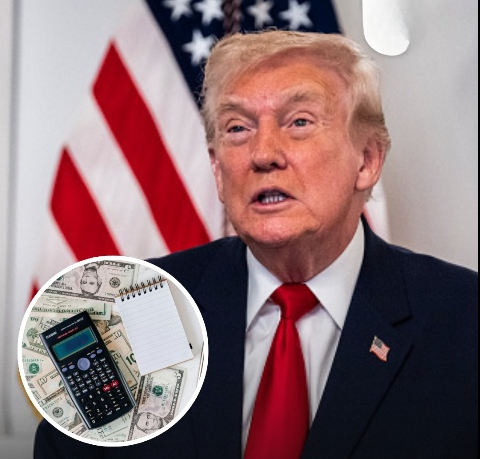
Trump’s promise detonated across the political landscape like a live wire: eliminate the federal income tax entirely and replace it with tariffs so massive that they alone could fund the entire U.S. government. No more IRS forms to fill out, no more April anxiety as you scramble to file your taxes on time, no more paycheck deductions that seem to disappear without a trace. Just a clean break from a system that many Americans feel has been bleeding them dry for decades, leaving them trapped in a cycle of frustration, confusion, and resentment toward a government that seems to take more than it gives.
On the surface, it sounds almost seductive — an easy fix, a bold proposal that promises to finally level the playing field. Trump positioned this plan as a patriotic rebalancing of power — tax foreign goods, not American families. Make the global manufacturers, who for decades have outsourced jobs and undercut U.S. workers, finally pay their fair share. Let American citizens and families breathe easier, knowing that the costs of running the government won’t be placed on their backs any longer. Make the world pay for the privilege of accessing the vast American market. The message was simple, emotional, and precisely engineered to hit every frustrated taxpayer right in the gut.
Millions cheered. The promise of a tax-free future, a future where you could keep more of your hard-earned money, resonated deeply with many Americans, especially those who had long felt they were being punished by an unfair system. They saw Trump’s plan as a win — a victory over the bureaucracy, over the complex tax code that seems to benefit everyone except them. Millions scoffed, though, dismissing it as a reckless fantasy, a political gimmick, a slogan dressed up as policy. Yet despite the doubts, everyone paid attention. And that’s exactly what Trump wanted — to dominate the conversation, to force America to consider the very real frustration that underpins his proposal.
However, beneath the applause, the cheers, and the emotional fervor, lies a far more complicated reality — a set of economic truths that simply cannot be ignored. Federal income tax isn’t just a small slice of the government’s revenue pie — it’s more than half of all federal revenue. It’s the bedrock upon which the vast majority of federal programs, social services, defense spending, infrastructure, and entitlement programs are built. In comparison, tariffs bring in only a tiny fraction of that amount. To make up the difference using tariffs alone would require a level of economic acrobatics that border on the impossible. Such a dramatic shift would strangle imports, driving up consumer prices on everything from cars to clothing, groceries to electronics. It would result in a form of economic self-sabotage, where the very consumers who would fund the government through higher tariffs would find themselves paying more for the basics. Moreover, retaliatory trade wars from foreign nations would likely escalate, sparking a global economic crisis that could ripple through every corner of the economy, affecting businesses, workers, and families alike.
You simply cannot choke off imports and simultaneously rely on them to fund the government. The numbers, the realities of global trade, and the interconnectedness of the world economy simply don’t bend to that vision. The mechanics just don’t work that way.
Still, Trump’s pitch works because it taps into something deep in the American psyche — a cultural nerve that many politicians have long ignored or overlooked. Americans don’t just dislike taxes; they resent the entire process — the paperwork, the complexity, the feeling that everyone else seems to be gaming the system. The IRS forms, the tax deadlines, the long hours spent trying to figure out whether you’re paying too much or not enough. The emotional cost of taxes often feels higher than the actual financial burden. There’s a sense of unfairness, of opacity, of hidden loopholes that only the wealthy or well-connected know how to exploit.
Trump’s promise of wiping that slate clean, of eliminating the tax system that feels so broken and unfair, resonates deeply with so many who are exhausted by the endless cycle. It’s not just about the money — it’s about the emotional relief that comes with a simple, clean solution. It doesn’t matter that the economic roadmap for this plan is foggy at best, full of what-ifs and unknowns. For many people, the emotional payoff is what matters most. The prospect of freedom from an unjust system is powerful, especially when framed as a kind of revolution against a political elite that seems disconnected from the struggles of everyday people.
Supporters frame it as liberation: a government finally lifting its hand off their shoulders, no longer squeezing their pockets dry. A chance to make America great again by bringing fairness back into the system. Critics, on the other hand, call it reckless fantasy: an over-simplified slogan masquerading as a policy proposal, designed to win votes and dominate headlines without offering a viable path forward. They argue that this is a dangerous game to play, one that sacrifices long-term economic stability for short-term political gain. Economists warn that shifting the entire cost of federal operations onto tariffs would disproportionately impact working-class households, the very people Trump claims to protect. Tariffs don’t discriminate — they get baked into the prices of goods that everyone buys, from groceries to electronics, from clothes to fuel. Working families would bear the brunt of these new costs, far outweighing any relief they might feel from the elimination of income taxes.
Despite all the warnings and cautions from economists, the proposal isn’t going away. It’s like political dynamite — easy to say, impossible to ignore. It forces a conversation about how America funds itself, who shoulders the financial burden, and whether the next administration will take steps to reshape the financial contract between citizens and their government. It pushes people to think about how we distribute the cost of governing, and who benefits from the current system.
For now, Trump’s plan sits at the collision point between aspiration and arithmetic. It excites, it terrifies, and it leaves economists sweating into their spreadsheets as they try to figure out how such a plan could work, or whether it could work at all. Whether it becomes a defining reform or remains just another rallying cry remains to be seen, but one thing is clear: he’s cracked open a debate that isn’t going back into the box. And that, in itself, is a victory for Trump — no matter how the numbers turn out.
The idea of abolishing income tax will continue to pull crowds in, not because the numbers add up or the plan makes sense, but because the frustration behind those numbers does. Americans are tired of feeling like they’re shouldering a disproportionate burden. And in the face of that frustration, the promise of a fresh start — even one that may not fully add up — is an enticing one.