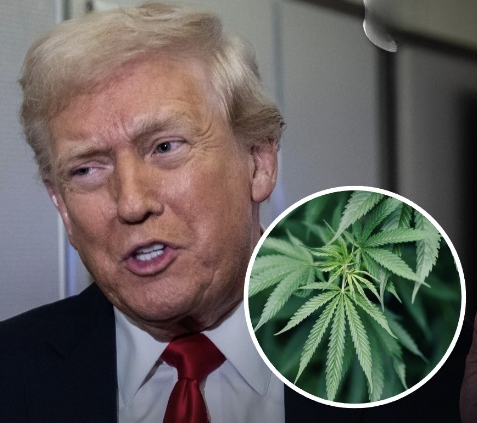
Donald Trump is on the verge of making a decision that could fundamentally reshape decades of U.S. drug policy, a choice with far-reaching consequences that touch everything from law enforcement to Wall Street, from Main Street to the halls of Congress. Behind closed doors, powerbrokers from a spectrum of industries are quietly positioning themselves, their stakes in the outcome clear yet largely invisible to the public. Billionaires, pharmaceutical conglomerates, crypto magnates, and cannabis company CEOs have all taken their seats at the table, each hoping to influence or at least benefit from the shift. The ripple effects of his decision will not only affect the legal landscape but could also recalibrate the economy, alter medical research priorities, and redefine social attitudes toward marijuana. And amidst this high-stakes negotiation, one crucial question lingers unanswered: what does Trump truly intend to do, and who will emerge as the ultimate winner—or loser—when the decision is finally announced?
Trump’s contemplation of marijuana reclassification arrives at a moment where politics, economics, and public opinion intersect in unusually complex ways. His recent attendance at a $1 million-per-head fundraiser hosted by cannabis executives and influential pharmaceutical leaders drew attention not only for its exclusivity but for the signal it sends about where the priorities of his administration may lie. In public remarks following the event, Trump acknowledged that his team is seriously evaluating whether marijuana should remain in Schedule I, alongside heroin, or be downgraded to Schedule III. The implications of this move are significant. Although such a reclassification would not immediately legalize recreational marijuana nationwide, it would drastically reduce criminal penalties for possession, sale, and distribution, while simultaneously opening doors for federally sanctioned medical research. For cannabis businesses, the shift could deliver long-sought tax advantages and make it far easier for companies to attract institutional investment. For Big Pharma, it represents a potential goldmine: a legal framework to explore cannabinoid-based drugs on a scale never previously possible under federal law.
Trump has publicly described the issue as “very complicated,” a phrase that captures both the political tightrope he must walk and the conflicting pressures from multiple stakeholder groups. On one side, medical experts, patient advocacy groups, and a growing segment of public opinion praise marijuana’s potential benefits in treating chronic pain, neurological conditions, and anxiety disorders. On the other, law enforcement agencies, conservative policymakers, and community groups voice concern about broader social consequences, including potential increases in youth usage, addiction, and impaired driving. The tension between these competing narratives gives Trump both political risk and opportunity, offering a chance to claim a transformative policy achievement while simultaneously inviting scrutiny from multiple quarters.
The political context amplifies the stakes. Joe Biden’s administration has flirted with marijuana reclassification but has failed to implement any significant changes, leaving the debate stalled at the federal level. By inheriting this unresolved issue, Trump has a unique opening: he can position himself as the decision-maker who takes action, potentially appealing to libertarian-leaning voters, cannabis entrepreneurs, and medical researchers eager for reform. At the same time, any misstep—whether perceived as endorsing reckless recreational use or failing to protect public health—could trigger backlash from both traditional conservative constituencies and law enforcement advocates. Every statement he makes, every tweet, and every handshake at private fundraisers is now scrutinized through the lens of this policy decision, underscoring how politically charged and economically potent the issue has become.
Beyond politics, the financial implications are enormous. Cannabis companies, many of which operate in a patchwork of state-legal markets, are eager for clarity at the federal level. Reclassification would enable businesses to access banking services, secure loans, and attract large-scale investment, all of which have been severely limited under the Schedule I designation. Pharmaceutical giants, meanwhile, are closely monitoring the developments, eyeing opportunities to develop prescription-grade cannabinoid therapies that could compete with existing medications in pain management, mental health, and neurology. Investors across the spectrum—from hedge funds to venture capitalists—are bracing for volatility in markets tied to cannabis, biotech, and pharmaceuticals, anticipating that the mere hint of federal reclassification could trigger multi-billion-dollar shifts in valuations.
Meanwhile, public sentiment is evolving. Nationwide polling consistently shows a majority of Americans support some form of cannabis legalization, particularly for medical use. Public enthusiasm for reform contrasts sharply with federal law, which still classifies marijuana as having no accepted medical use. Trump’s decision, therefore, has the power to reconcile—or further expose—the disconnect between popular opinion and federal policy. It’s a rare moment where a single policy adjustment could influence social norms, medical research, criminal justice reform, and financial markets simultaneously.
In short, Trump’s deliberation over marijuana is about more than a plant or a scheduling category; it is a fulcrum on which politics, public health, the economy, and social attitudes pivot. Every step he takes is watched, analyzed, and interpreted by investors, policymakers, activists, and everyday Americans alike. The decision will reverberate through courtrooms, boardrooms, and living rooms, affecting families, patients, and entrepreneurs across the country. And while lobbyists and wealthy power players may hope to shape the outcome, the ultimate consequences will be measured not in campaign donations or press releases, but in lives impacted, opportunities created, and the precedent set for the future of U.S. drug policy.
Trump stands at a crossroads, balancing pressure from diverse interests with the unpredictable dynamics of public opinion. Whatever choice he ultimately makes, it will be remembered not just as a regulatory adjustment, but as a landmark moment with ramifications far beyond politics. Wall Street will react, Main Street will debate, and the courts may see a surge of challenges and cases. In the meantime, cannabis companies, pharmaceutical executives, and investors remain in a state of anxious anticipation, watching to see whether the federal government finally acknowledges what millions of Americans already know: that marijuana occupies a complex, multifaceted, and increasingly mainstream place in society.