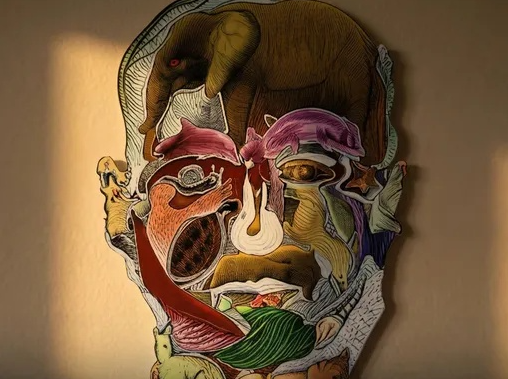
Personality is never a single, tidy definition. It’s a mosaic of experiences, instincts, habits, fears, strengths, and quirks that evolve with us over time. Some tendencies help us flourish, while others create challenges or complicate relationships. Yet every trait — even the difficult ones — is part of what makes us human. Understanding these nuances fosters compassion toward ourselves and clarity in how we relate to others. That’s why lighthearted personality visuals often resonate so strongly. They aren’t scientific tools or psychological assessments, but they offer a playful mirror, a way to see ourselves from a fresh perspective.
One popular version begins as a seemingly ordinary human face. Look closer, and the image starts to shift. Shapes within the face — the eyebrows, chin, and cheekbones — reveal hidden forms: layered animals, each drawn with symbolic intent. The first animal your eyes notice may suggest a personality trait you lean toward unconsciously.
These illustrations work not because they diagnose, but because they tap into instinct. Your eyes are naturally drawn to certain shapes, highlighting tendencies that already exist within your mind. Whether the connection feels accurate or not, it sparks a moment of honest reflection.
The elephant, for example, represents stubbornness — a determination to hold your ground. Those who see the elephant first often value persistence and conviction, though the shadow side is rigidity and resistance to change.
The iguana suggests emotional distance — a tendency to observe rather than participate. It’s not coldness, but self-protection.
The horse reflects pride and self-sufficiency. Confident yet cautious about vulnerability, people drawn to the horse often walk the line between dignity and defensiveness.
Some animals mirror internal experiences. The cricket symbolizes worry, the quiet mental tension that some carry constantly. The turtle embodies caution, signaling those who move through life deliberately. The rabbit reflects sensitivity and insecurity — an acute awareness of the world paired with self-doubt.
Other animals highlight behavioral patterns in challenging situations. The bear signals structure and reliability, though it may struggle with unpredictability. The fox points to avoidance, a talent for navigating around conflict. The dolphin embodies spontaneity, joyful impulsiveness, and creativity, sometimes at the expense of order.
Additional creatures add nuance: the toucan seeks recognition, the kangaroo suggests inconsistency, the peacock hints at vanity or presentation, and the whale represents emotional withdrawal. Subtler symbols include the snake for strategic thinking, the bird for a restless mind, the sloth bear for procrastination, and the snail for resistance to change.
None of these traits is inherently good or bad. Stubbornness can be strength; caution can be wisdom; spontaneity can spark creativity; sensitivity can reveal empathy. The goal of the illustration isn’t judgment — it’s illumination.
Its appeal lies in simplicity. You glance, your instincts respond, and you gain insight into how your mind interprets the world. You may instantly recognize yourself — or you may not. Both reactions are valuable.
If the animal resonates, it validates something you already sensed. If it doesn’t, it offers a new lens to question why certain instincts or reactions appear in your life. Even disagreement can deepen self-awareness.
These visual exercises are best approached lightly but thoughtfully. They aren’t roadmaps, diagnoses, or labels — they are invitations. They encourage reflection, awareness, and appreciation for the complexity of personality.
So take a moment. Picture the illustration again. Notice the animal your eyes landed on first. What does it reveal? Recognition? Curiosity? Resistance? Whatever your response, it’s an opportunity to explore your inner world and remember that personality is not fixed — it’s a living, evolving mosaic of instincts, choices, and hidden layers.
Sometimes, uncovering just one of those layers begins with a single, unexpected animal hiding in a picture.