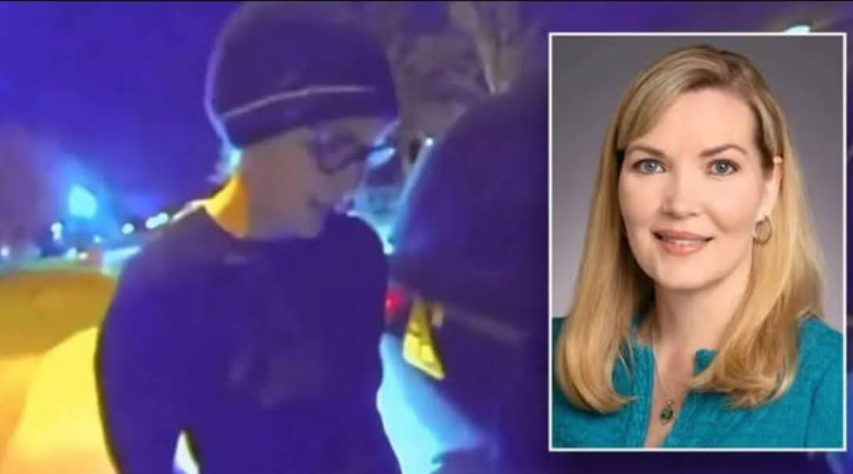
The moment police realized the suspected burglar was a sitting state senator, everything shifted. What began as a routine response to a possible break-in on a quiet Minnesota street suddenly became a collision of power, family, grief, and the law. Grainy bodycam footage showed a figure dressed in black, moving cautiously through shadows, carrying a backpack that would later become central evidence. The unusual combination of a grieving daughter in black, a cautious stepmother, and the visible tension of the moment created a tableau that seemed to belong to a movie — except this was very real, and the consequences were enormous. A jury would ultimately be asked to decide whether the actions of Nicole Mitchell were those of a desperate daughter caught in the pain of loss or a lawmaker deliberately breaking the law, shaking public trust to its core.
In the courtroom, every detail of that night was scrutinized under an intense microscope. Prosecutors painted a picture of calculated intent. They emphasized her clothing — black from head to toe — as a sign she wanted to remain unseen. They noted the unusual entry point, the flashlight hidden in a sock, and the backpack carefully wedged in a window, filled with electronics, identification, and containers. Even her self-deprecating comment to officers, “Clearly, I’m not good at this,” was framed as tacit acknowledgment that she understood the gravity of her actions. To the prosecution, Mitchell’s grief did not justify her choices. Her identity as a lawmaker only magnified the breach, suggesting a conscious disregard for the rules she had sworn to uphold.
The defense, however, told a radically different story. Their narrative focused not on calculated planning but on human desperation and fractured family dynamics. They depicted a daughter struggling to reclaim the belongings of a father she had lost, attempting to retrieve ashes, photographs, and memories from a stepmother navigating the challenges of Alzheimer’s. They argued that Mitchell did not act out of malice or criminal intent. Instead, she surrendered immediately when confronted, cooperated with authorities, and explained her actions. The defense emphasized context, humanizing a situation that could easily be reduced to a sensational headline. To them, the law could only be understood fully when weighed against the deeply personal pain that motivated a daughter in crisis.
Minnesota residents watched as the case unfolded, and the implications extended beyond one family or one night. This was not simply a legal matter; it was a confrontation between public expectation and human complexity. When those who write the laws themselves face allegations of violating them, the boundaries of accountability are tested. Every piece of evidence, every testimony, and every frame of bodycam footage became a lens through which the public examined trust, responsibility, and the fragility of social contracts. Questions multiplied: How should grief and desperation be weighed against deliberate action? Can a lawmaker’s position heighten culpability, or does it intensify the scrutiny unfairly?
Outside the courtroom, conversations swirled in living rooms, offices, and cafes across the state. Neighbors debated the meaning of the act, reflecting on their own beliefs about justice and fairness. Friends of both the accused and the family wrestled with loyalty, compassion, and disappointment. News outlets replayed every moment, dissected every gesture, and compared procedural norms with human impulses. In many ways, the case became a mirror reflecting the tension between law and empathy, authority and vulnerability.
At its core, the incident is a reminder of the fragility of trust. Lawmakers are expected to be exemplars of the law they craft; citizens expect them to act with prudence and integrity, even in private struggles. When that expectation is challenged, when the personal and political collide so starkly, the aftermath resonates far beyond any individual verdict. Minnesotans — and anyone following the case — are left to confront the difficult reality that human motives are rarely pure or simple, and that public trust, once strained, may never fully return.
The jury now holds the power to decide not just on legality, but on nuance. They must weigh grief against governance, desperation against deliberation, and family bonds against civic responsibility. The outcome will reverberate across the state, shaping how citizens perceive not only this case but the broader integrity of public office. And in that tense intersection of law, emotion, and authority, one question looms largest: when those who make the rules themselves break them, can society forgive, or will doubt linger indefinitely?