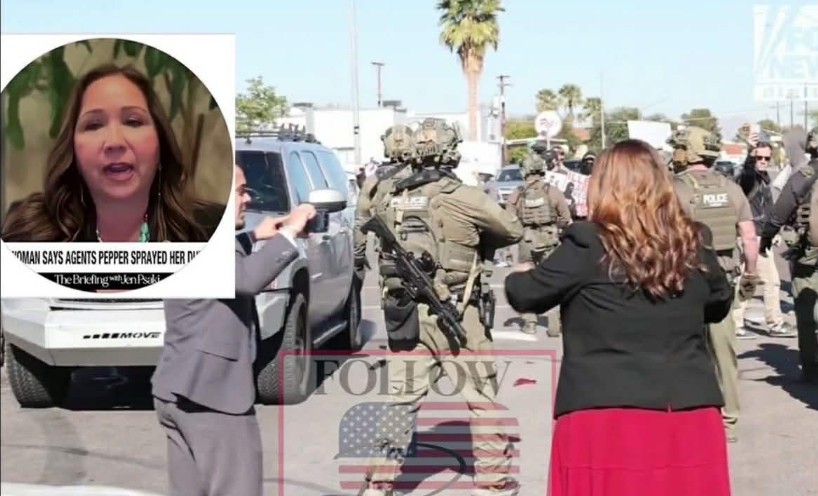
A Democratic congresswoman made national headlines this week after inserting herself directly into an active ICE operation, positioning herself between federal agents and suspects attempting to flee, and later appearing on television in tears, claiming she had been “pushed” and “shot at.” The viral footage sparked immediate outrage online, dominated news cycles, and became a political talking point—but a closer look at the incident reveals a far more nuanced story, one that raises questions about the intersection of politics, public safety, and media narratives.
Eyewitness accounts and video recordings show that the congresswoman walked into the middle of a highly sensitive enforcement action, seemingly under the assumption that her elected status would grant her immunity from the rules that govern law enforcement operations. ICE officers were in the process of securing several suspects who were attempting to evade detention when she stepped into the scene. Despite repeated warnings, she refused to step aside. One agent reportedly told her plainly that she needed to move immediately so that officers could perform their duties safely, both for the suspects’ protection and for her own.
The situation escalated quickly. Officers deployed less-lethal beanbag rounds to subdue resisting suspects—a standard protocol in these high-stress situations—but at no point were these rounds aimed at the congresswoman. Nevertheless, her television appearance framed the incident as if she had been directly targeted by live fire. Her recounting emphasized her personal fear and vulnerability, overshadowing the operational realities of the scene. Within hours, her dramatic version of events spread across social media, with clips, memes, and commentary dissecting her every word and gesture.
What happened on that street is a vivid example of the tension between political theater and law enforcement realities. ICE agents were following a carefully coordinated plan designed to apprehend suspects safely. Every movement, every order, every precaution had been considered in advance to minimize risk. By refusing to step aside, the congresswoman introduced unpredictable elements into an already volatile situation, forcing agents to momentarily divide attention between public safety and managing her presence. While some may view her actions as courageous advocacy, others see them as reckless interference.
The political optics were immediate and unavoidable. Supporters rallied to her side, portraying her as a fearless protector standing up for vulnerable communities, a symbol of resistance against an enforcement system they consider overzealous. Opponents criticized her for turning a public safety operation into a political spectacle, accusing her of jeopardizing both law enforcement officers and civilians in pursuit of media attention. Her televised account became a case study in modern politics: one where perception can dominate reality, and where social media amplification can override factual nuance.
Beyond the politics, the incident raises critical questions about accountability and the responsibilities of public officials. Elected leaders have a duty to advocate for constituents and speak out against perceived injustices—but there is also an obligation to respect professional expertise and the boundaries of authority in situations that involve risk to human life. By choosing to step into the operation, the congresswoman blurred that line, creating a scenario in which public safety and political messaging collided with potentially dangerous consequences.
In the aftermath, federal investigators reviewed the incident, confirming that all safety protocols had been followed and that the agents’ actions were legally justified. The congresswoman’s claims of being “shot at” were found to be unsubstantiated, though the emotional impact of her presence on the officers and suspects was noted in official reports. Media coverage has continued, with outlets dissecting the incident from every angle—ethics, legality, political opportunism, and the broader implications for elected officials interacting with law enforcement on the ground.
This episode is emblematic of a larger phenomenon in contemporary politics: the tension between viral visibility and operational reality. For elected officials, every public act carries the potential to become a digital spectacle. For law enforcement, every mission carries the potential for life-or-death consequences. When the two collide, questions inevitably arise about priorities, responsibility, and the real cost of political performance.
Ultimately, the situation highlights a simple but important truth: politics and public safety occupy very different spheres, and conflating the two can have serious ramifications. While the congresswoman’s intentions may have been rooted in concern, the consequences—chaos on the street, endangered officers, and misrepresentation of facts—illustrate the dangers of turning enforcement operations into stages for personal narratives. The public is left to navigate the conflicting accounts, weighing emotion against evidence, spectacle against reality.
In the end, the incident serves as both a cautionary tale and a reflection of the times. It reminds us that in an age of instant reporting, social media virality, and 24-hour news cycles, even well-intentioned actions can spiral into political drama. More importantly, it underscores that when politics intersects with public safety, the stakes are real, the decisions matter, and sometimes the line between advocacy and recklessness is dangerously thin.