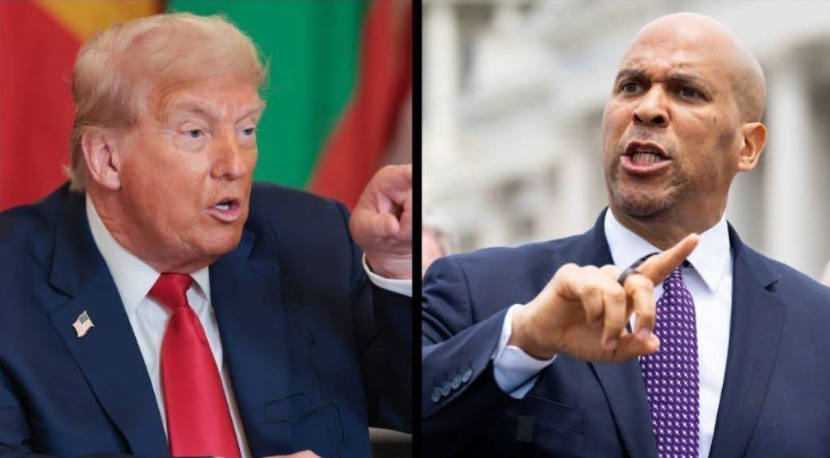
Cory Booker didn’t just speak with passion; he deliberately staged a performance meant to shock and provoke. In one televised interview that quickly went viral, the New Jersey senator proclaimed that he would willingly go to jail to oppose Donald Trump, yet he offered no specifics, no legal framework, and no law that he might actually break. On the surface, it was a bold statement of resistance—a declaration of moral courage—but beneath it, it was a meticulously crafted act of political theater. Defiance became a performance, martyrdom became a personal brand, and the entire moment served as a direct challenge to the authority and legitimacy of the legal system in the eyes of millions of Americans. It was a declaration that painted him as fearless, principled, and heroic, but also left a gaping question: was this courage grounded in law, or was it a carefully staged narrative designed to appeal to emotion rather than reason?
Booker’s promise to “stand up and fight” Trump, even at the cost of imprisonment, was less a concrete legal stance and more a storytelling device. He wrapped himself in the imagery of historic civil rights figures—leaders who had sacrificed freedom and endured imprisonment for moral causes—but he did so with deliberate ambiguity. He never specified any actual action he would take that would constitute a crime, nor did he outline a clear ethical boundary he might cross. Instead, he transformed the conversation into a symbolic showdown, inviting audiences to equate any confrontation with Trump with a heroic struggle against injustice itself. By framing ongoing investigations into Newark officials as politically motivated persecution, he blurred the line between legitimate accountability and systemic abuse, crafting a narrative in which any enforcement of the law against allies becomes an attack on democratic principles. Every accusation against an associate or supporter could now be interpreted through this lens, transforming the legal system into a political arena where guilt and innocence are filtered through partisan allegiance.
This type of framing carries real risks, especially in a country already primed for institutional distrust. When a sitting senator, someone with a national platform and considerable influence, signals to millions that prosecutions may be acts of political loyalty tests rather than impartial enforcement of the law, it reshapes public perception of justice itself. Citizens are invited to doubt law enforcement and judicial processes, to see prosecutors and investigators not as neutral actors but as opponents in a partisan war. By elevating personal narrative above legal clarity, Booker encourages a mindset in which legal outcomes are interpreted through political bias rather than objective assessment. Supporters may cheer the defiance without recognizing that the rhetoric undermines faith in foundational institutions, creating a climate in which laws are increasingly seen as tools for political advantage instead of social order.
Booker’s rhetoric also signals an aspirational identity: martyr, moral crusader, and principled rebel against a figure he positions as authoritarian or corrupt. It is carefully calibrated to resonate with audiences who already feel alienated from the system or who perceive Trump’s actions as existential threats to democracy. By portraying himself as someone willing to suffer incarceration for the cause, Booker taps into deep emotional currents, evoking admiration, loyalty, and a sense of moral duty among viewers. Yet the irony is that he accomplishes this without engaging with the legal realities that such a claim would entail. There is no risk of actual imprisonment presented—no admission of lawbreaking, no strategy for civil disobedience, no acknowledgment of legal consequences—making the entire performance symbolic, theatrical, and somewhat detached from tangible reality.
The broader implications are serious. When influential politicians frame legal processes as inherently political, they contribute to a cultural climate where laws are weaponized in public perception and the justice system is de-legitimized in the eyes of the populace. Actions that should be seen as routine accountability, oversight, or lawful investigation become recast as partisan attacks. Citizens may take cues from such messaging, treating legal outcomes as badges of ideological victory or defeat rather than objective determinations. This normalization of viewing law through a political lens weakens the social fabric, eroding trust in institutions that rely on impartiality and rule of law. It encourages supporters to see themselves as defenders against a system that is, by narrative design, hostile to their values, while discouraging neutral engagement or dialogue across ideological lines.
Booker’s maneuver also highlights the power of narrative over substance in modern political discourse. The emotional resonance of “I’d go to jail to oppose Trump” outstrips any scrutiny of whether such a statement is legally feasible, practically necessary, or ethically grounded. The optics of courage, defiance, and principled risk carry far more immediate impact than the mechanics of law, creating a feedback loop in which audience perception matters more than factual accuracy. In this environment, rhetoric that prioritizes symbolic martyrdom can have long-lasting consequences, shaping public attitudes toward law, governance, and civil obedience. Even as time passes, the words endure, subtly conditioning the public to accept partisan framing as a lens for justice.
Ultimately, Cory Booker’s televised declaration is emblematic of a larger trend in political communication: the elevation of performative heroism over concrete action. It is a carefully choreographed display that seeks to inspire, mobilize, and brand, while simultaneously avoiding the messy realities of legal consequence. In doing so, it walks a fine line between inspiring advocacy and eroding institutional trust. The risk is not merely rhetorical—it is structural. By turning legal accountability into a stage for political theater, Booker’s rhetoric helps normalize the idea that laws themselves are secondary to ideology, that enforcement can be interpreted selectively, and that moral heroism can be claimed without bearing the tangible costs. It is a moment that will resonate far beyond the initial interview, leaving a subtle but significant imprint on how the public conceives of law, authority, and the responsibilities of elected officials.